I see the British Museum is planning to expand its exhibit space to accomodate a new tour of the Terracotta Warriors. I saw them years ago at an exhibit at the De Young Museum in San Francisco. This time, though, the exhibit will include some of the interesting figures of acrobats, scribes, and animals that have been recently excavated.
I was also thrilled to note that following the Chinese exhibit, the British Museum is planning to mount a major exhibition about the Roman Emperor Hadrian. I may need to plan a return visit to London for that one!
Saturday, February 10, 2007


Sunday, January 14, 2007
Conference on Roman Amphitheatres Slated
The conference, Roman Amphitheatres And Spectacula: A 21st Century Perspective is organised by English Heritage and Chester City Council and will be held at Chester’s Grosvenor Museum on February 17-18 2007.
Speakers from around the world have been lined up to showcase new research and stimulate debate about amphitheatre studies. Details of new amphitheatre sites found across the Roman world will be revealed and the organisation of the spectacles, like gladiatorial combat, will also be examined.
For more details on the conference see their website and visit the Chester Amphitheatre project site for more details
Speakers from around the world have been lined up to showcase new research and stimulate debate about amphitheatre studies. Details of new amphitheatre sites found across the Roman world will be revealed and the organisation of the spectacles, like gladiatorial combat, will also be examined.
For more details on the conference see their website and visit the Chester Amphitheatre project site for more details
Saturday, January 13, 2007
Origins of the Huns debated
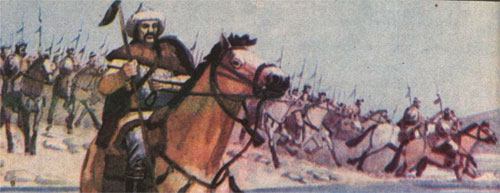
This week I started listening to a book about Attila the Hun and the impact of the Huns on the decline of the Roman Empire. As most of my study has focused on the Republican Period, I am still relatively uninformed about the late western Imperial Period except what I have gleaned from watching the TV miniseries "Attila" and reading a well-informed novel by a retired Canadian history professor, Boris Raymond, "The Twelfth Vulture of Romulus".
Therefore I was unfamiliar with theories about the origins of the Huns and found John Man's assertion that the Huns were remnants of the defeated XiongNu peoples of the area that would later be populated by the Mongols. Despite their "Chinese" sounding name, the XiongNu are
"...thought to have descended from various Turkic peoples known as Xianyun, Xunyu and Hongyu, yet all the knowledge we have come from Chinese sources written centuries later. However, as time passed, the name Xiongnu was applied to the Xiongnu’s subjects too, including Turkics, Mongolics, Tokharians, Iranics, etc.
The exact foundation of the Xiongnu Empire is unknown, but the earliest Chinese records about them date back to 4th-3rd centuries BC." - The XiongNu, All Empires
One of their greatest leaders was a king named Modu:
"Modu (Maodun in Modern Chinese), son of Touman, was his father's heir, but he was sent to exile to the Yuezhi, a nomadic Tokharian people in Gansu. Touman finally marched on the Yuezhi (this was a fake invasion, because Touman's new wife had wanted to kill Modu) but Modu was able to escape. Touman allowed Modu to return, and gave him a unit of 10,000 cavalries under his command. Modu trained his men very strictly, and during a hunt, he "accidently" shot his father with an arrow in 209 BC. "
Man related a much more interesting version of the above incident however. He said Modu trained his cavalry to shoot wherever he, himself, released an arrow, without hesitation. He began their training with innocent hunting expeditions but one day he shot at his favorite horse and the horse was impaled by a shower of arrows. Next day, he loosed an arrow towards his favorite wife. Again, she was pierced by a following volley of arrows. Finally, he went hunting with his father, the king, and loosed an arrow towards him. The king was pinioned by so many arrows there wasn't room for another shaft in his body.
I also found it ironic that Roman mercernaries were hired by the last western Xiongnu king to try, unsuccessfully, to protect him from the conquering Han.Decline and Collapse of the Xiongnu Empire:"After Modu’s death, he was succeded by Jiyu (also known Laoshang Jiyu Chanyu), who ruled between 174 BC and 160 BC. During his reign, the Xiongnu kept their strentgh, Jiyu managed to penetrate deep into Central China near Chang'an (the Han capital) in 166 but he married with a Han princess and opened the Xiongnu territories to Han spies disguised as officers and diplomats. These spies provoked the subject peoples to revolt against their masters, which later resulted in the break up of the vast Xiongnu Empire. One of them, Zhang Qian, was famous from his expedition to the Yuezhi, although he was captured by the Xiongnu and was forced to stay as a captive for ten years. When he reached Chang'an in 126, he brought important information about the peoples and towns of the areas he had visited. These datas later helped the Chinese to expand into Central Asia easier.
After Jiyu's death, the successor rulers couldn't stop the decline of the Xiongnu Empire. The Xiongnu raids into China were stopped by the Han ruler Han Jingdi; Han Wudi reformed his army in Xiongnu style and between 127 and 117 BC, the Xiongnu lost Tarim to Han Wudi; during the reign of Judihou Chanyu, Tian Shan, Jungaria and Turfan were conquered by the Han and eventually, the Xiongnu lost the control of the Silk Road in 60 BC. In 85 BC, the Wuhuan and the Dingling rebelled, defeating the weakened Xiongnu. After this rebellion, the victorious Dingling split into Western and Northern Dingling. Huhanye, a half-Chinese Xiongnu prince, entered Han protectorate in 58 BC but his brother Luanti Hutuwusi revolted against him and he declared his independence in the same year wih the title Zhizhi Chanyu. This event caused the Xiongnu Empire to split into two separate empires in 55 BC; the Eastern and Western Xiongnu, each one ruled by a member of the Xiongnu Imperial family.
In 54 BC, the Eastern Xiongnu withdrew to Ordos while the Western Xiongnu migrated to Soghdiana in Transoxiana, where they set up a new empire near the River Talas. Under Zhizhi Chanyu's rule, starting from 51 BC, the Western Xiongnu conquered Wusun, Western Dingling, Jiankun (Qirghiz) and vassalised the Kingdom of Kangguo (Samarkand). In 41 BC, Zhizhi Chanyu built a fortified capital in the valley of Talas. However, the Han attacked Zhizhi Chanyu in 36 BC, destroyed his capital and killed him. Thus, the Western Xiongnu Empire came to an end. It's been claimed that there were Roman mercenaries in Zhizhi Chanyu's army during the siege of his capital." - The XiongNu, All Empires
Saturday, December 16, 2006
Exhibit Shows Egypt's Sunken Treasures - Forbes.com
Exhibit Shows Egypt's Sunken Treasures - Forbes.com:
The great port of Alexandria was a bustling trade hub, a transit point for merchandise from throughout the ancient world - until much of it vanished into the Mediterranean Sea.
Treasure hunters have long scoured the Egyptian coast for vestiges of the port, thought to have disappeared about 13 centuries ago. Now an exhibit at Paris' Grand Palais brings together 500 ancient artifacts recovered from the area by underwater archeologists using sophisticated nuclear technology.
"Egypt's Sunken Treasures" features colossuses of pink granite, a 17.6-ton slab inscribed with hieroglyphics, a phalanx of crouching sphinx, pottery, amulets and gold coins and jewelry - all painstakingly fished out of the Mediterranean. Some of the oldest artifacts are estimated to have spent 2,000 years underwater.
The show, which runs through mid-March, spans more than 1,500 years of Egyptian history and traces the decline of the Pharaohs and occupations by Greeks, Romans and Byzantines.Some of the oldest pieces, such as a sphinx dating from the 13th century B.C., were brought to Egypt's coast from other regions of the country. Later objects clearly show the influence of the Greeks, who controlled much of Egypt starting in the fourth century B.C.
In an exquisite black-granite sculpture, the ancient Egyptian goddess Isis strikes a quintessentially Pharaonic pose, with one leg forward and arms pressed tightly at her sides. But the sensual drape of her gown, with its delicate folds, belies an unmistakably Greek touch.
The Stela of Ptolemy, a mammoth marble slab standing 19.5 feet high, bears inscriptions in both hieroglyphics and Greek.
Sculptures from the Greco-Roman period show the degree to which the European colonizers assimilated Egyptian culture, and vice versa. In a second century B.C. bust, the Egyptian god Serapis looks just like the Greek god Zeus, with a full beard and curly locks. With its wild expression and frizzy hair, a second century A.D. bust of an Egyptian water god is the exact image of a Roman Bacchus.
One of the most impressive objects in the show is the so-called Naos of the Decades, a hieroglyphics-covered prayer niche dating from around 380 B.C.
The roof of the niche was discovered in 1776 and taken to Paris, where it became part of the Louvre Museum's permanent collection. In the 1940s, archaeologists working under Egyptian Prince Omar Toussoun discovered two more bits - the naos' back and the base. But it wasn't until the recent submarine excavations, which uncovered several more fragments, that archaeologists finally managed to put the naos together again.
Sunday, December 10, 2006
ANCIENT EMPIRES AND SEXUAL EXPLOITATION: A DARWINIAN PERSPECTIVE
By Walter Scheidel (Stanford)
Despotism and differential reproduction
In the Roman literary imagination, one-man rule and despotic power are intimately associated with polygyny and the forcible accumulation of sex partners. A few salient examples will suffice to illustrate this point. Caesar had a reputation as a major womanizer (Suet. Caes. 50-2); Augustus even ?as an elderly man is said to have harboured a passion for deflowering girls, who were collected for him from every quarter, even by his wife - (Suet. Aug. 71; cf. above, section 2.3.1, on the wife of Zimri-Lim of Mari); Tiberius comes across as hopelessly debauched, abducting freeborn girls to corrupt them; Caligula reportedly likewise spoiled married matrons (Suet. Cal. 36); Claudius is credited with insatiable sex drive and many affairs (e.g., Dio 40.2.5-6), and again, his wife - Messalina - procured mistresses for him (Dio 40.18.3); Nero put married women into brothels (Suet. Nero 27); Vespasian, in his role as a more
restrained "good" emperor, kept several mistresses after the death of his principal freedwoman concubine (Suet. Vesp. 21), whereas his son Domitian, designated one of the "bad" emperors, constantly engaged in sexual activities, which he referred to as "bed-wrestling" (Suet. Dom. 22). Commodus, also "bad", "herded together women of unusual beauty, keeping them like purchased prostitutes in a sort of brothel for the violation of their chastity" (HA Comm. 5.8); in this way, he acquired 300 concubines, "gathered for their beauty and chosen from both matrons and harlots" (ibid. 5.4.). Even the "good" emperor Pertinax, having at first dismissed Commodus's entourage, had many of them brought back "to administer to the pleasures of the old man" (HA Pert. 7.8-9). Elagabalus, beyond the pale even by the standards of "bad" rulers, "never had intercourse with the same woman twice except with his wife", and installed a palace brothel (HA Elag. 24.2-3). In a more exotic flourish, he is also made to hitch chariots to women of the greatest
beauty, driving them "usually himself naked" (ibid. 29.2).
Asking "how much was the economic and political inequality in the Roman empire matched by
reproductive inequality, or polygyny" (310), Betzig 1992b: 313-20 makes much of these stories. At first sight, her willingness to accept them as reliable evidence will seem naive to the literary critic. Strictly speaking, her suggestion that the internal consistency of such anecdotes confirms their credibility remains a non sequitur: the reverse interpretation " that sexual conduct of this kind was a topos that could indiscriminately be ascribed to different individuals " seems at least as plausible. Then again, her point that the Roman biographical tradition tallies well with what is more reliably known about other premodern kings and emperors may carry greater force. The one thing we can be sure of is that Roman upper-class authors consistently associated the despotic use - for them, abuse - of monarchical power with promiscuity in general and with transgressive sexual behaviour in particular. Thus, while reasonably "good" rulers (such as Caesar, Augustus or Vespasian) are merely credited with strong sexual appetites
and polygynous affairs, their "bad" counterparts are portrayed as violating social norms by compelling sex from non-consenting free or even married women. From a Darwinian perspective, this explicit link between political inequality in its most extreme form and reproductive potential is in itself of considerable interest, given that it mirrors faithfully a fundamental principle of differential male reproductive success.
The close match between what Romans thought, or found expedient to claim, their rulers did and what we know rulers in more overtly polygynous cultures actually did is similarly striking (see above, sections 2.2-3).
Even so, it remains difficult to resolve the tension between these underlying realities and the
creative power of literary representation. For a literary critic, the actual conduct of Roman emperors may be of secondary importance or even irrelevant, and it is perfectly feasible to dissect the biographical tradition as a patchwork of complementary stereotypes that could be re-arranged in a limited number of constellations in keeping with the biases of the observer. Intertextual relationships also come into play: when the Roman aristocrat Fabius Valens is said to have advanced "with a long and luxurious train of harlots and eunuchs" when he campaigned for Vitellius (Tac. Hist. 3.40-1), we are immediately reminded of such quintessentially "oriental" characters as Dareios III or Surenas, the victor of Carrhae (see above, section 2.3.3). By contrast, the student of reproductive variance must address a more intractable - and less
fashionable - question: does the literary tradition reflect existing mechanisms of creating mating
opportunities for powerful Romans? Are we to believe that the Romans would have created lurid images of the reproductive consequences of despotic power that are both perfectly plausible in Darwinian terms and compatible with comparative evidence if they had lacked any practical experience with these consequences? Without proper contextualisation, this common sense "no smoke without fire" approach will seem simple-minded; when judged against the background of evolutionary theory and comparative data, it may become more respectable. However that may be, Roman elite authors inhabited a world of habitual sexual coercion; they were men for whom the sexual availability of disempowered women - slaves - was a given. In their search for a definition of the "tyrant", it seems to have been attractive to model the relationship between disempowered citizen/subject and ruler/master (dominus) on their own relationship with their slaves. Reducing respectable - i.e., free and/or married women - to the status of
sexually available slaves, the tyrant-emperor overturns the social order by re-staging in the sphere of the free (and upper-class) citizenry patterns of interaction that are unquestioningly accepted between owners and slaves.
Given their immense wealth and the correspondingly large number of women at their disposal -
from female slaves and freedwomen to women who would have been attracted by their status - Roman emperors cannot have found it difficult to mate with as many women as they wished.84 Whether certain emperors chose to display their power by interfering with the reproductive rights of their subordinates - a central theme of the biographical tradition - remains open to debate. In my view, this tradition is instructive for two different reasons. First, it shows that with regard to the correlation between cultural success and the proximate determinants of reproductive variance, the literary imagination operates within a conceptual framework that puts heightened emphasis on critical evolved behavioural mechanisms. In this regard, Roman biography resembles Homeric myth (see above, section 3.3.1). And second, by likening the sexual conduct of emperors to that of slaveowners, this particular strand of the literary tradition helps corroborate our model of chattel slavery as the primary means of translating cultural into
reproductive success in societies which upheld SIM (see above, sections 3.2-3 and 3.5.2).
Despotism and differential reproduction
In the Roman literary imagination, one-man rule and despotic power are intimately associated with polygyny and the forcible accumulation of sex partners. A few salient examples will suffice to illustrate this point. Caesar had a reputation as a major womanizer (Suet. Caes. 50-2); Augustus even ?as an elderly man is said to have harboured a passion for deflowering girls, who were collected for him from every quarter, even by his wife - (Suet. Aug. 71; cf. above, section 2.3.1, on the wife of Zimri-Lim of Mari); Tiberius comes across as hopelessly debauched, abducting freeborn girls to corrupt them; Caligula reportedly likewise spoiled married matrons (Suet. Cal. 36); Claudius is credited with insatiable sex drive and many affairs (e.g., Dio 40.2.5-6), and again, his wife - Messalina - procured mistresses for him (Dio 40.18.3); Nero put married women into brothels (Suet. Nero 27); Vespasian, in his role as a more
restrained "good" emperor, kept several mistresses after the death of his principal freedwoman concubine (Suet. Vesp. 21), whereas his son Domitian, designated one of the "bad" emperors, constantly engaged in sexual activities, which he referred to as "bed-wrestling" (Suet. Dom. 22). Commodus, also "bad", "herded together women of unusual beauty, keeping them like purchased prostitutes in a sort of brothel for the violation of their chastity" (HA Comm. 5.8); in this way, he acquired 300 concubines, "gathered for their beauty and chosen from both matrons and harlots" (ibid. 5.4.). Even the "good" emperor Pertinax, having at first dismissed Commodus's entourage, had many of them brought back "to administer to the pleasures of the old man" (HA Pert. 7.8-9). Elagabalus, beyond the pale even by the standards of "bad" rulers, "never had intercourse with the same woman twice except with his wife", and installed a palace brothel (HA Elag. 24.2-3). In a more exotic flourish, he is also made to hitch chariots to women of the greatest
beauty, driving them "usually himself naked" (ibid. 29.2).
Asking "how much was the economic and political inequality in the Roman empire matched by
reproductive inequality, or polygyny" (310), Betzig 1992b: 313-20 makes much of these stories. At first sight, her willingness to accept them as reliable evidence will seem naive to the literary critic. Strictly speaking, her suggestion that the internal consistency of such anecdotes confirms their credibility remains a non sequitur: the reverse interpretation " that sexual conduct of this kind was a topos that could indiscriminately be ascribed to different individuals " seems at least as plausible. Then again, her point that the Roman biographical tradition tallies well with what is more reliably known about other premodern kings and emperors may carry greater force. The one thing we can be sure of is that Roman upper-class authors consistently associated the despotic use - for them, abuse - of monarchical power with promiscuity in general and with transgressive sexual behaviour in particular. Thus, while reasonably "good" rulers (such as Caesar, Augustus or Vespasian) are merely credited with strong sexual appetites
and polygynous affairs, their "bad" counterparts are portrayed as violating social norms by compelling sex from non-consenting free or even married women. From a Darwinian perspective, this explicit link between political inequality in its most extreme form and reproductive potential is in itself of considerable interest, given that it mirrors faithfully a fundamental principle of differential male reproductive success.
The close match between what Romans thought, or found expedient to claim, their rulers did and what we know rulers in more overtly polygynous cultures actually did is similarly striking (see above, sections 2.2-3).
Even so, it remains difficult to resolve the tension between these underlying realities and the
creative power of literary representation. For a literary critic, the actual conduct of Roman emperors may be of secondary importance or even irrelevant, and it is perfectly feasible to dissect the biographical tradition as a patchwork of complementary stereotypes that could be re-arranged in a limited number of constellations in keeping with the biases of the observer. Intertextual relationships also come into play: when the Roman aristocrat Fabius Valens is said to have advanced "with a long and luxurious train of harlots and eunuchs" when he campaigned for Vitellius (Tac. Hist. 3.40-1), we are immediately reminded of such quintessentially "oriental" characters as Dareios III or Surenas, the victor of Carrhae (see above, section 2.3.3). By contrast, the student of reproductive variance must address a more intractable - and less
fashionable - question: does the literary tradition reflect existing mechanisms of creating mating
opportunities for powerful Romans? Are we to believe that the Romans would have created lurid images of the reproductive consequences of despotic power that are both perfectly plausible in Darwinian terms and compatible with comparative evidence if they had lacked any practical experience with these consequences? Without proper contextualisation, this common sense "no smoke without fire" approach will seem simple-minded; when judged against the background of evolutionary theory and comparative data, it may become more respectable. However that may be, Roman elite authors inhabited a world of habitual sexual coercion; they were men for whom the sexual availability of disempowered women - slaves - was a given. In their search for a definition of the "tyrant", it seems to have been attractive to model the relationship between disempowered citizen/subject and ruler/master (dominus) on their own relationship with their slaves. Reducing respectable - i.e., free and/or married women - to the status of
sexually available slaves, the tyrant-emperor overturns the social order by re-staging in the sphere of the free (and upper-class) citizenry patterns of interaction that are unquestioningly accepted between owners and slaves.
Given their immense wealth and the correspondingly large number of women at their disposal -
from female slaves and freedwomen to women who would have been attracted by their status - Roman emperors cannot have found it difficult to mate with as many women as they wished.84 Whether certain emperors chose to display their power by interfering with the reproductive rights of their subordinates - a central theme of the biographical tradition - remains open to debate. In my view, this tradition is instructive for two different reasons. First, it shows that with regard to the correlation between cultural success and the proximate determinants of reproductive variance, the literary imagination operates within a conceptual framework that puts heightened emphasis on critical evolved behavioural mechanisms. In this regard, Roman biography resembles Homeric myth (see above, section 3.3.1). And second, by likening the sexual conduct of emperors to that of slaveowners, this particular strand of the literary tradition helps corroborate our model of chattel slavery as the primary means of translating cultural into
reproductive success in societies which upheld SIM (see above, sections 3.2-3 and 3.5.2).
Studies of 3rd century papyri reveals emperors in crisis changed legitimization

Physorg.com:
Dutch researcher Janneke de Jong, who was analyzing about two-hundred Greek papyrus texts from a digital database containing 4500 documents including edicts, contracts, petitions, administrative correspondence and censuses, noticed a change, beginning in the third century, in the form of legitimisation the emperors used in their titles denoting their position of power. (In the third century, Greek was the administrative language in the eastern part of the Roman Empire.)
The emperors increasingly emphasized their dynastic position by referring to their sons and future successors in the titles. They also increasingly laid claim to godly support.
De Jong believes that the texts reflect a development in the emperor ideology that was a response to other events in the Roman Empire. The third century was a period of crisis and transformation in the history of the empire. The borders were threatened and there were monetary, socioeconomic and religious tensions. During the second half of the third century, in particular, there was a rapid succession of emperors during civil wars and revolts.
When the emperor Diocletian came to power in 284, he and his successors implemented a range of reforms in the governing system and the army. This included a change in the position of emperor who became more of an absolute monarch claiming to rule by the grace of god.
Technorati tags: Roman emperor dynasty deify
Saturday, December 09, 2006
New exhibit displays artifacts from Jewish Wars

I noticed a new exhibit has opened in Nashville that includes items from Masada. The exhibit was organized by the Hebrew University of Jerusalem Institute of Archeology. It should be interesting although I would be a bit skeptical about its objectivity.
The Tennessean.com: A new exhibit that organizers are calling the largest collection of Holy Land antiquities to ever hit U.S. soil is now open at the Convention Center in downtown Nashville.
The "From Abraham to Jesus" exhibit features 340 artifacts, multimedia presentations of Bible stories and a re-creation of an ancient bazaar.
The exhibit of artifacts considered holy to both Jews and Christians is designed to show the linkage between the two faiths and to give people unlikely to visit Israel the chance to view them, said Cary Summers, CEO of Way Makers, the company that organized the exhibit.
"The vast majority of Americans will not get the opportunity to go to Israel," Summers said.
"We decided to get the key items to the United States."
Those key items include a child's leather sandal excavated in the 1950s from Masada, the site of a mass suicide by Jews in 70-72 AD to escape Roman conquest.
They also include an ossuary, or bone box, believed to have once held the remains of the son of Simone the Cyrene, the man who carried the cross for Jesus. And there are palm-size remnants of some of the 2,000-year-old Dead Sea Scrolls that have never before been exhibited in the United States, including a fragment containing the Hebrew inscription "Man cannot eat by bread alone, but by the words of God."
The 30,000-square-foot exhibit's artifacts, multimedia presentations and re-creations are intended to walk visitors through a tactile experience of 2,500 years of biblical history.
Visitors to the exhibit are guided, via headset, by an hour- and-a-half audio featuring the voices of a fictional archaeologist explaining the exhibition's significance to his granddaughter. At the end of the exhibit, visitors can put on 3-D glasses for a panoramic film shot in Israel.
At the end of the tour, there is a 5,000-square-foot bazaar, with merchandise for sale from Israel, including ceramics, hand-blown glass, food, paintings by Israeli artists, spices and shofars, or traditional Jewish horns, among other items.
Official site: http://www.fromabrahamtojesus.com/
Saturday, December 02, 2006
A Corpus of Writing-Tablets from Roman Britain
By Dr. A.K. Bowman FBA, Prof. J.M. Brady FRS FEng., Dr. R.S.O. Tomlin FSA, Prof. J.D. Thomas FBA, Research Assistant - Dr J. Pearce
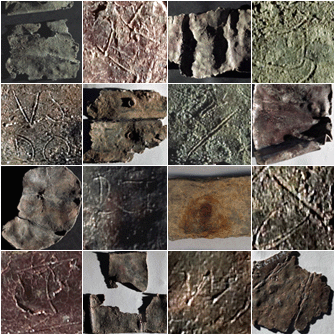
Lead 'curse tablets' comprise thin rectangular sheets which, when complete and unrolled, generally measure 6 - 12cm long and 4 - 8cm wide, although many survive only as fragments. Though often described as 'lead', metallurgical analysis of tablets from Bath, for example, shows that many are better characterised as pewter, given their high tin content. The sheets, having been cast and / or flattened, were generally trimmed to provide a roughly rectangular surface area. The text was inscribed on the tablet with a point, perhaps a stylus like those used to write on wax tablets, and the tablet was then rolled or folded with the written surface innermost, and the ends folded over. This is the state in which they are usually found. The tablets were sometimes pierced by nails, which occasionally survive in situ, although more frequently only the holes indicate their original presence. This nailing provides one explanation of the name of defixio by which these artefacts are often known (the Latin verb from which it is taken, defigere, has the meaning both to fasten and to curse). Some tablets may have been nailed to a wall or post prior to deposition, perhaps to display their message. However nails often seem to have been hammered through the blank side, making the text invisible if the tablet had been on view (Click here for images of curse tablets).
In Britain the majority of lead tablets seem to have been deposited on temple sites, famously at Bath and at Uley in Gloucestershire. At Bath they were deposited in the hot spring. Instances are also recorded from other 'watery' contexts, graves and settlements. On settlements occasional evidence suggests a preference for wet places; for example individual tablets come from the ditch of a fort and the drain of a bathhouse. As tablets are often found outside formal excavation, it can be difficult to identify the type of site on or context in which they were deposited. This is therefore a question for which we need much more reliable information.
In order to read the texts the tablets must be carefully unfolded. Given their usually brittle condition, this process can only be successfully performed in the laboratory. Distortion and cracking from folding and rolling have frequently affected the appearance of the texts. When freshly cut the strokes of the text would have shone against their background, but subsequent oxidisation has made both tablet surface and incisions the same dull grey. Corrosion has sometimes removed or damaged the surface of the tablets. Light must be cast from several different angles on to the tablet in order to render visible all the separate strokes that make up letters. The results of this examination are produced in drawings, on which the readings and subsequent translations of the tablets are based. It is impossible for a single photograph to reproduce adequately all the parts of all letters.
Tuesday, November 28, 2006
Exhibit of North African Mosaics now at the Getty Villa!
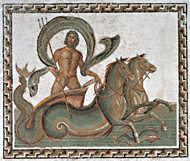
I was so excited to see the notice about the "Stories in Stone" exhibit of north African Roman Mosaics that has opened at the Getty Villa! I had hoped to go down there and now I have a particular reason to go before April 30, 2007!
"This exhibition presents a selection of mosaics from the national museums of Tunisia. They are among the finest of the thousands of mosaics produced between the second and the sixth centuries A.D. in the Roman province of Africa Proconsularis, a portion of which is known today as Tunisia.
These works, fashioned as pavements for both public buildings and private homes, represent subjects such as nature, theater and spectacle, and myths, gods, and goddesses. The exhibition also includes material on the conservation of mosaics and on the work of the Getty Conservation Institute's field project on conservation of mosaics in situ.
Mosaic art flourished in North Africa, where the diversity of limestone and marble fostered a tradition of polychromatic (multicolored) work. Beginning in the late second century, mosaics made in Roman Africa became more colorful, featuring geometric designs embellished with floral patterns. During the third century, scenes with figures emerged. In public baths, for example, mosaics often related to the sea and depicted natural elements as well as marine gods. In the fourth century, increasingly original decorative motifs included laurel garlands and crowns as borders. Figural compositions portrayed vignettes of daily life, such as hunting, fishing, athletics, and amphitheater games."
I was afraid I might never get a chance to travel to Tunisia to see their wonderful mosaics because of my husbands fear of me traveling in the region because of all of the anti-American sentiment. Now I have a chance to see at least some of them.
Maybe I can arrange to visit by February 1 and then I can see the special lecture, Puzzling Iconography:
Christine Kondoleon, senior curator of Greek and Roman art at the Museum of Fine Arts, Boston, explores the enigmatic iconography of several mosaics in the exhibition
Thursday, February 1, 2007, 8:00 p.m.
I also noticed that the Getty is selling two very interesting books on mosaics:
Stories in Stone: Conserving Mosaics of Roman Africa
Edited by Aicha Ben Abed and
Tunisian Mosaics: Treasures from Roman Africa
By Aicha Ben Abed
The Getty is charging $75 for the first book (a hardcover) and $29.95 for the second book but I found the first book on Amazon and preordered it for only $29.95 and the second book for only $19.77. Plus I don't have to stuff them in my suitcase!
Thursday, September 28, 2006
Carlisle's Roman History subject of new website
News & Star: "CARLISLE?S Roman history is the subject of an interactive website launched at Tullie House Museum & Art Gallery yesterday.
The website for primary school teachers and pupils, is an informative resource for teachers as well as having child-friendly activities which deliver information on the Romans in the area.
An interactive map details what the Romans were doing and where, in relation to modern Carlisle, and there is a reconstruction of a skull found at an excavation site at the north end of The Lanes.
Julie Wooding, Tullie House Museum & Art Gallery learning and access officer, said it has taken a lot of hard work and creative skills to ensure it is the resource teachers require. "
The website for primary school teachers and pupils, is an informative resource for teachers as well as having child-friendly activities which deliver information on the Romans in the area.
An interactive map details what the Romans were doing and where, in relation to modern Carlisle, and there is a reconstruction of a skull found at an excavation site at the north end of The Lanes.
Julie Wooding, Tullie House Museum & Art Gallery learning and access officer, said it has taken a lot of hard work and creative skills to ensure it is the resource teachers require. "
Friday, September 08, 2006
Teaching Company's new course on Classical Archaeology fascinating

I'm presently listening to the Teaching Company's new course on Classical Greek and Roman archaeology and am enjoying it immensely. I had no idea that Sir William Hamilton, husband of the Emma Hamilton who was the paramour of Admiral Horatio Nelson, was the man that really began the serious study of Greek vases. I also found it interesting that the lecturer, Dr. John Hale of the University of Louisville, observed that the original Bourbon-sponsored excavation at Herculaneum under the supervision of military engineer Rocco Gioacchino Alcubierre was conducted with a high degree of professionalism and was not as amateurish as so-called father of classical archaeology, Johann Winckelmann, would have people believe.
According to Dr. Hale, Winckelmann was outraged that he was not allowed to go down into the tunnels when he first visited Herculaneum and subsequently published unfounded claims that the work there was being shoddily done.
Dr. Hale is also more sympathetic to Heinrich Schleimann than other classicists. He said he feels that Schleimann, although orignally recklessly greedy for fame and unscrupulous in his original methods, eventually attempted to conduct work in his later life with a much more professional approach. He also feels the study of archaeology needed these types of flamboyant individuals from time to time to continue to spark enthusiasm for the field.
In this morning's lecture he also talked about the efforts of German archaeologist Edmund Buchner to find remnants of Augustus' mighty Horologium, a giant sun dial the size of two football fields that used an Egyptian obelisk originally created for Pharaoh Psammetichus as its gnomon, constructed on the Campus Martius. Of course Buchner succeeded in 1979, uncovering part of it in the cellar of a cafeteria in the Via di Campo Marzio. I noticed a website that said permission to see the original marble paving revealed by Buchner is available from the German Archaeological Society.
A good article about it can be read at: http://www.livius.org/a/italy/rome/horologium/horologium_augusti.html
Friday, August 04, 2006
Imperial Rome new exhibit to open September 23 at the Fernbank Museum
The Weekly Online!: "Fernbank Museum of Natural History presents 350 years of illustrious world history with the world-premiere of a special exhibition that explores the legacy of the Roman Empire. Featuring 450 artifacts that range from small coins to larger-than-life statues, Imperial Rome showcases the brilliance of ancient Roman society during its glory days. The exhibition will open on the 2069th birthday of Caesar Augustus, Rome?s first emperor, and will be on view from September 23, 2006-January 3, 2007.
Created through a collaboration between Italy?s Contemporanea Progetti, Florence, and Atlanta?s Fernbank Museum of Natural History, the exhibition examines life during the era of Imperial Rome through a series of galleries showcasing the legendary emperors, gods, households, lifestyles, and peace, or Pax Romana, established by the powerful military. "
Created through a collaboration between Italy?s Contemporanea Progetti, Florence, and Atlanta?s Fernbank Museum of Natural History, the exhibition examines life during the era of Imperial Rome through a series of galleries showcasing the legendary emperors, gods, households, lifestyles, and peace, or Pax Romana, established by the powerful military. "
Teaching Company offers new course on Roman Archaeology
I see that The Teaching Company is offering a new course on Greek and Roman Archaeology.
" In these 36 half-hour lectures, archaeologist John R. Hale of the University of Louisville guides you through dozens of ancient sites with the skill of a born storyteller. Dr. Hale mixes the exotic adventures, unexpected insights, and abiding mysteries of archaeology's fabled history with anecdotes of his own extensive field experience to create an extremely fast-paced narrative that unfolds like a series of detective stories.
The detective metaphor is particularly apt because archaeologists approach their work like sleuths at a crime scene, using a range of tools, techniques, and technologies to piece together clues that paint a vivid portrait of life during the formative era of Western civilization.
For example, in Lecture 18, Dr. Hale recounts his own search with geologist Jelle de Boer for the secret behind the ecstatic trances of the Oracle of Delphi?a project celebrated in the recent book The Oracle: The Lost Secrets and Hidden Message of Ancient Delphi by Pulitzer Prize?winning reporter William J. Broad of The New York Times. Dr. Hale and Dr. de Boer used traditional archaeological techniques, combined with geological mapping and chemical analysis of rock and water samples, to solve the mystery of the priestess's famous altered states.
Dr. Hale's other research includes a long-running position as field director for the University of Louisville's excavations at Torre de Palma, and he is a participant in the search for sunken ships from the armada that attacked Greece during the Persian Wars, as recounted by the ancient Greek historian Herodotus. The winner of many classroom teaching awards, Dr. Hale has also lectured widely beyond the university, bringing archaeological discoveries to the general public."
It sounds really interesting so I have ordered my copy!Thursday, August 03, 2006
Early "anti-tank" vehicles used at the battle of Asculum
In Dr. Gerald Fagan's lecture series, "Great Battles of the Ancient World", he mentioned that at the battle of Asculum where the Romans squared off against the Epirotes under King Pyrrhus, the Romans introduced a new weapon to counteract the use of war elephants. Dr. Fagan describes these vehicles as anti-elephant wagons. They apparently were enclosed vehicles bristling with spears that contained javelineers.
Wikipedia describes them as "these were ox-led chariots, equipped with long spikes to wound the elephants, pots of fire to scare them, and screening troops who would hurl javelins at the elephants to drive them back."
Dr. Fagan pointed out that they may have been effective if they had been deployed properly. Apparently the Roman commander deployed them on the Roman left so Pyrrhus simply moved his war elephants to the other end of the line.
Since I had never heard of these early "anti-tank" vehicles, I found it all very interesting.
Wikipedia describes them as "these were ox-led chariots, equipped with long spikes to wound the elephants, pots of fire to scare them, and screening troops who would hurl javelins at the elephants to drive them back."
Dr. Fagan pointed out that they may have been effective if they had been deployed properly. Apparently the Roman commander deployed them on the Roman left so Pyrrhus simply moved his war elephants to the other end of the line.
Since I had never heard of these early "anti-tank" vehicles, I found it all very interesting.
Wednesday, July 19, 2006
British outbred by Anglo-Saxon 'apartheid'
IOL: "The Anglo-Saxons who conquered England in the fifth century set up a system of apartheid that enabled them to master and outbreed the native British majority, according to gene research published on Wednesday.
In less than 15 generations, more than half of the population in England had the genes of the invaders, investigators say.
'The native Britons were genetically and culturally absorbed by the Anglo-Saxons over a period of as little as a few hundred years,' said Mark Thomas, a University College London biologist.
'They prevented the British genes from getting to the Anglo-Saxon'
'An initially small invading Anglo-Saxon elite could have quickly established themselves by having more children who survived to adulthood, thanks to their military power and economic advantage.
'We believe that they also prevented the native British genes getting into the Anglo-Saxon population by restricting intermarriage in a system of apartheid that left the country culturally and genetically Germanised,' he said.
'This is what we see today - a population of largely Germanic genetic origin, speaking a principally German language.'"
In less than 15 generations, more than half of the population in England had the genes of the invaders, investigators say.
'The native Britons were genetically and culturally absorbed by the Anglo-Saxons over a period of as little as a few hundred years,' said Mark Thomas, a University College London biologist.
'They prevented the British genes from getting to the Anglo-Saxon'
'An initially small invading Anglo-Saxon elite could have quickly established themselves by having more children who survived to adulthood, thanks to their military power and economic advantage.
'We believe that they also prevented the native British genes getting into the Anglo-Saxon population by restricting intermarriage in a system of apartheid that left the country culturally and genetically Germanised,' he said.
'This is what we see today - a population of largely Germanic genetic origin, speaking a principally German language.'"
Roman militarism and the definition of warfare
I am listening to a new Teaching Company lecture series entitled "Great Battles of the Ancient World" presented by Professor Garrett G. Fagan
of Pennsylvania State University. His first few lectures explores the various theories about what characteristics define warfare as opposed to other forms of communal violence. One predominate theory is that warfare is distinguished by the use of formations, tactics, and generally uniform weaponry and training. (Sorry, I don't have my course handbook with me so I don't remember the scholar's name putting forth this definition. This made me wonder, though, how proponents of this theory would categorize Roman battles with ethnic groups that did not embrace these hallmark traits, like the Celts or the Germanic tribes. Does warfare exist if only one side employs the distinguishing characteristics of what some scholars define as warfare? I was also surprised that this theory did not take into account communal political goals usually surrounding governance that, to me, would be more of a hallmark of formal warfare than the physical trappings of combat.
Another point Dr. Fagan discussed was that formal warfare appears to become more culturally entrenched in more segmented societies. By segmented, I assume he means hierarchical. This made me wonder about the cultural differences between Rome and Carthage. Both cultures engaged in warfare but Carthage concentrated on commerical development and trade rather than military conquest as its mode of growth. Was Roman culture more segmented than that of Carthage? I know both cultures had slavery and both cultures had an elite aristocracy, but were the social rules governing the "middle class" far more structured in Rome than Carthage? Was this a factor in the emphasis on military achievement in Rome as compared to commercial achievement in Carthage?
of Pennsylvania State University. His first few lectures explores the various theories about what characteristics define warfare as opposed to other forms of communal violence. One predominate theory is that warfare is distinguished by the use of formations, tactics, and generally uniform weaponry and training. (Sorry, I don't have my course handbook with me so I don't remember the scholar's name putting forth this definition. This made me wonder, though, how proponents of this theory would categorize Roman battles with ethnic groups that did not embrace these hallmark traits, like the Celts or the Germanic tribes. Does warfare exist if only one side employs the distinguishing characteristics of what some scholars define as warfare? I was also surprised that this theory did not take into account communal political goals usually surrounding governance that, to me, would be more of a hallmark of formal warfare than the physical trappings of combat.
Another point Dr. Fagan discussed was that formal warfare appears to become more culturally entrenched in more segmented societies. By segmented, I assume he means hierarchical. This made me wonder about the cultural differences between Rome and Carthage. Both cultures engaged in warfare but Carthage concentrated on commerical development and trade rather than military conquest as its mode of growth. Was Roman culture more segmented than that of Carthage? I know both cultures had slavery and both cultures had an elite aristocracy, but were the social rules governing the "middle class" far more structured in Rome than Carthage? Was this a factor in the emphasis on military achievement in Rome as compared to commercial achievement in Carthage?
Thursday, June 29, 2006
BBC production examines the 'why' of art

BBC production examines the 'why' of art: "'How Art Made the World' may sound like a grandiose title, but the five-part series makes some good arguments in support of that saucy assertion.
Co-producers public television station KCET and the BBC reject the predictable chronological format of 'who did what when' and focus on the question 'Why?' Why are representations of the human body frequently so unrealistic? Why do abstract patterns appear in prehistoric cave paintings? Why do humans create images of death?
The episodes visit sites both remote and spectacular on several continents (Asia is not represented, but that's a longer series) to explore the earliest known examples of artistic expression. They couple those objects -- which range from figurines to temples -- with the latest thinking of not only art historians and archaeologists but of psychologists and neuroscientists.
Highlights of some of the episodes are cave and rock paintings in Europe, Africa and North America, presented with evidence that their abstract patterning derives from trance states, and the filming of such a ritual; works commissioned by the likes of King Darius of Persia, Alexander the Great, and the Roman Augustus for political empowerment and propaganda; a first-century Greek grotto with digitally re-created statues depicting a dramatic scene from Homer's "Odysseus"; an Australian aboriginal storytelling ceremony that amplifies the impact of archetypal painted images; and an Etruscan tomb wherein heavenly and hellish scenes of the afterlife encourage self-sacrifice for the common good over surrender."
Thursday, June 22, 2006
Heroic literature's role in reducing warrior violence
I have now started a new lecture series about the High Middle Ages and find it interesting that with the loss of an emphasis on education and classical literature there seems to have been a precipitous decline in what I would call social conscience during late antiquity up to the High Middle Ages. Dr. Philip Daileader is presenting this lecture series too and he described how severe the problems of noble violence became. Where in the Roman Empire, the wealthy elite were expected to provide civil service and public works, a large number of the warrior elite of the early and high Middle Ages simply used their power to brutalize and extort more wealth from those around them whether another noble, merchant, or peasant.
Dr. Daileader said that clerics tried to stem the tide of violence with the peace and later truce of God movements but the most successful efforts to rein in the aristocracy were achieved with the introduction of chivalric literature modelled somewhat after classical heroic literature.
Dr. Daileader's description of early tournaments was also quite eye-opening. Like war games with fully loaded weapons, these tournaments would be as hazardous to those living near the site where the tournament was to take place as it was to participants. He said that if an opponent hid in a farmhouse, a participant would often burn down the farmhouse to "capture" the opponent, apparently without any concern for the farmer whatsoever. He also described kippers who were peasants with clubs hired by tournament participants to run out on the field and club an unhorsed knight senseless so he could be more easily stripped of his armor. If the person died, I guess that was just considered the breaks! These activities didn't sound any kinder or gentler than gladiator combat!
Dr. Daileader said that clerics tried to stem the tide of violence with the peace and later truce of God movements but the most successful efforts to rein in the aristocracy were achieved with the introduction of chivalric literature modelled somewhat after classical heroic literature.
Dr. Daileader's description of early tournaments was also quite eye-opening. Like war games with fully loaded weapons, these tournaments would be as hazardous to those living near the site where the tournament was to take place as it was to participants. He said that if an opponent hid in a farmhouse, a participant would often burn down the farmhouse to "capture" the opponent, apparently without any concern for the farmer whatsoever. He also described kippers who were peasants with clubs hired by tournament participants to run out on the field and club an unhorsed knight senseless so he could be more easily stripped of his armor. If the person died, I guess that was just considered the breaks! These activities didn't sound any kinder or gentler than gladiator combat!
Monday, June 19, 2006
Depopulation as a primary cause of the fall of the western Roman Empire
In the concluding lecture of "The Early Middle Ages", Dr. Daileader
points out the shortcomings of the "fall" theories of both Edward
Gibbon and Henri Pirenne. Instead, he points to widespread
archaeological evidence of severe depopulation occuring between the
2nd and 7th centuries as the factor underming both the Roman economy
and the Roman military.
He stated that there was evidence of urban decay as early as 200 CE
with successive footprints of towns and cities growing smaller and
smaller. Although some of the urban population may have moved back to
the country, studies of laws dealing with deserted lands also became
increasingly more desperate from the 2nd century onward.
He admits climate change and increased warfare may have played a role,
but there is evidence that new diseases introduced during the second
century, measles and smallpox (probably from China), were devastating
even before the Bubonic plague made its first appearance in the 6th
century. The resulting deurbanization severely impacted such Roman
institutions as its educational systems.
Although he attributed the loss of organized institutions to
depopulation it still leaves the question of why there was a cessation
of tutorage among the elite unless they, too, became so impoverished
they could no longer afford tutors?
As for Pirenne's theory of economic collapse because of disruption of
trade routes by Islamic conquests, Dr. Daileader points out that
current research shows that trade was still quite active through the
Northern Arc via Viking traders. In fact, Daileader points out that
the number of major routes (via Russia) connecting the Mediterranean
with Carolingian Europe actually increased sixfold. He highly
recommended Michael Mccormick's book "Origins of the European Economy:
Communications and Commerce" that was published in 2001 as an
excellent study of this phenomenon.
points out the shortcomings of the "fall" theories of both Edward
Gibbon and Henri Pirenne. Instead, he points to widespread
archaeological evidence of severe depopulation occuring between the
2nd and 7th centuries as the factor underming both the Roman economy
and the Roman military.
He stated that there was evidence of urban decay as early as 200 CE
with successive footprints of towns and cities growing smaller and
smaller. Although some of the urban population may have moved back to
the country, studies of laws dealing with deserted lands also became
increasingly more desperate from the 2nd century onward.
He admits climate change and increased warfare may have played a role,
but there is evidence that new diseases introduced during the second
century, measles and smallpox (probably from China), were devastating
even before the Bubonic plague made its first appearance in the 6th
century. The resulting deurbanization severely impacted such Roman
institutions as its educational systems.
Although he attributed the loss of organized institutions to
depopulation it still leaves the question of why there was a cessation
of tutorage among the elite unless they, too, became so impoverished
they could no longer afford tutors?
As for Pirenne's theory of economic collapse because of disruption of
trade routes by Islamic conquests, Dr. Daileader points out that
current research shows that trade was still quite active through the
Northern Arc via Viking traders. In fact, Daileader points out that
the number of major routes (via Russia) connecting the Mediterranean
with Carolingian Europe actually increased sixfold. He highly
recommended Michael Mccormick's book "Origins of the European Economy:
Communications and Commerce" that was published in 2001 as an
excellent study of this phenomenon.
Church efforts to reshape Roman and Barbarian family structures

I continue to be enthralled by Dr. Daileader's course "The Early Middle Ages" offered through The Teaching Company".
Another fascinating area that Dr. Daileader expounds upon is the
evolution of the family structure during Late Antiquity and the Early
Middle Ages. Dr. Daileader pointed out that Roman and Germanic
families shared several important traits. These include the fact that
a family was based on a concept of household rather than core family
unit. The household would include servants, clients, and property.
Heads of households wielded extensive power over its members including
the acceptance or rejection of newborns. Both Roman and Germanic
peoples practiced marriage but accepted other relational forms such as
concubinage and divorce was an acceptable practice to terminate a
relationship. Both Romans and Barbarians favored indogamy (marriage
within the kin group) to preserve concentrations of wealth within the
extended family. Adoption was also viewed as a totally acceptable way
to augment a family if appropriate heirs had not been produced.
But, significant differences existed as well. Romans practiced
monogamy while polygamy was widely practiced among Germanic tribes.
In a Roman marriage, property was transferred from the bride's family
(dowry) to the groom while in Germanic marriage, the property transfer
went from the groom to the bride in form of bride price and morning
gifts. A Roman marriage required the freely given consent of the two
individuals but a Germanic marriage did not. (He pointed out that
under Roman law a pater familias could involk the death penalty if an
offspring refused to go through with a prearranged marriage but the
marriage itself could not be performed unless both parties agreed to it).
As the two cultures began to fuse and Christianity spread, however,
the church sought to openly reshape family patterns. The church began
to impose sanctions against marriage within the kin group going as far
as the sixth cousin and even forbid marriage to members of godparents
families and even in-laws family members. The church condemmed
infanticide but also opposed adoption. The church opposed divorce but
also opposed remarriage of widows and widowers. Lastly the church
condemned concubinage.
Historian Jack Goody theorized that the church attacked these
practicies because they were strategies of heirship designed to
maximize the possibility of producing an heir so family property could
be transmitted to the next generation. He speculates that this was
done to increase the chances that the church would ultimately receive
bequests of property and increase its concentration of wealth.
Historian David Herlihy argued that the church condemed these
practices for reasons of morality, theology, and social utility. As I
do not see what the moral purpose was for opposing adoption,
remarriage of widows and widowers, and marrying extremely distant
relatives, I find it hard to accept Herlily's argument. It was also at
this time that the Carolingians introduced the 10 percent tithe
extracted with the force of secular law from all practitioners in an
effort to increase church finances so a network of churches could be
built throughout the Carolingian empire. So I personally would be
more receptive to Goody's theory than Herlihy's.
Subscribe to:
Posts (Atom)