Tuesday, June 26, 2007

Seismologist says earthquake triggered the Boudiccan revolt


"It was an awesome David and Goliath battle waged two thousand years ago that shook the Roman Empire.

And now, the riddle of Queen Boudicca's victory over her mighty foe on East Anglian soil has taken a new tumble and twist that could rewrite the history books.

A study by a leading archaeologist has revealed that a previously unknown earthquake shook the southeast of England at the time the Iceni tribe led their rebellion - bringing a sign of divine approval for Boudicca and a bad omen for her opponents.

Up until now, a series of bizarre events that allegedly took place at the time have been played down as exaggeration and allegory rather than taken at face value.

But British classicist Raphael Isserlin has re-examined the ancient texts and concluded that they are not simply classical literary devices, but descriptions of a serious earthquake that hit the heart of the religious and political capital of Roman Britain - Colchester.

BBC History magazine, which has published Mr Isserlin's findings, explains that the texts recall how the “statue of the goddess Victory in Colchester partly rotated and toppled over, how strange sounds were heard and how the sea turned blood red”.

Along with Dr Roger Musson, the British Geological Survey's most senior seismologist, Mr Isserlin believes these three events are likely to occur during a strong earthquake.

“The noise, a deep, dull sound could conceivably have been described as a strange moan or prolonged groan - often accompanies earthquakes,” Dr Musson told BBC History.

“The seawater change could result from seismic waves causing cliff collapses or destabilising sloping mud deposits which can muddy the water and transform the colouring of the sea.

The re-interpretation is significant because the Colchester area saw one of the country's most serious seismic disasters of recent centuries - a 4.7 magnitude earthquake which hit the town and surrounding villages in 1884.

Around 1,200 buildings were damaged and the event caused huge amounts of noise.

“The realisation that the phenomena, referred to in the classical sources as encouraging the British rebels, almost certainly refer to a real earthquake, means the events played a very real role in helping to trigger the Boudiccan revolt,” added Mr Isserlin."

Wednesday, June 20, 2007

Zeugma Mosaics cover 800 Sq. Meters in Turkish Museum


"Until 2005 most people viewed Gaziantep as a mere transit point en route to supposedly more interesting places in Southeastern Turkey -- such as the colossal statues atop Mt. Nemrut or Urfa’s pools of Abraham.

All that changed with the completion and opening in June of that year of the massive new wing of the city’s archaeological museum. Built to house the magnificent finds from the nearby Hellenistic/ Roman city of Zeugma, Gaziantep and its museum now boast one of the premier collections of Roman mosaics anywhere in the world.

Not only is the quality of workmanship of the mosaics superb, so is the way in which they are exhibited. Central to the museum is a partial recreation, using original materials, of a room from a Roman villa at Zeugma. The intricate mosaic floor is surrounded by its original colonnade, and sections of amazingly well-preserved fresco complete the scene. In total there are over 800 square meters of mosaic on display at the museum, all imaginatively lit and well explained with information boards in Turkish and English.

What makes the museum even more remarkable is the fact that everything you see could so easily have been lost forever. In 1995 two French archaeologists had been given a six-week permit to dig the site of Zeugma, some 20 kilometers east of Gaziantep, on the west bank of the mighty Euphrates. With only five days remaining and little to show for their efforts, they uncovered a mosaic floor. Permission was granted to extend the excavations, and a race against the clock began to salvage as much of possible of what was clearly a major archaeological site before it was submerged under the waters of the Birecik dam. A frenzied effort by a massive international team in 2000 ensured that many of the mosaics were, indeed, rescued.

When you look at some of the scenes depicted in the mosaics at the museum, it is hard to believe that they are made up of tiny stone tablets, so fine is the workmanship. Many different craftsmen worked on the large mosaic floors at Zeugma. The least skilled and inexperienced were given the job of doing the plain borders and geometric work. Better craftsmen worked on plant and animal scenes. Next up the skill ladder were architectural scenes. Human figures were the preserve of the most skilled and experienced, but even here the work was ranked by degree of difficulty. The less talented worked on hands and arms, leaving the master craftsmen to do the faces. Just take a look at the fragment of mosaic which has rapidly become the symbol, not only of the museum, but of Gaziantep itself -- the so-called “gypsy girl.” Her eyes are expressiveness incarnate and appear to follow you as you walk across the room in front of her.

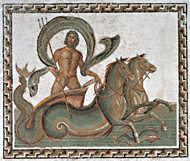
Most of the mosaics feature beautifully wrought scenes from Greek mythology and legend. Ariadne (the beautiful daughter of King Minos of Crete, treacherously dumped on the island of Naxos by the arrogant Theseus, whom she had helped kill the man-eating Minotaur) is depicted at her wedding with her savior -- Dionysus, god of wine. Achilles, dressed as a woman by his protective mother, Thetis, to prevent him being sent to fight at Troy, is found out when he can’t resist reaching out for weapons proffered to him by the wily Odysseus. Given Zeugma’s riverside location, its wealthy inhabitants were particularly fond of scenes depicting water deities. Most impressive of these is a panel showing Poseidon, second only to Zeus in the Greek pantheon of gods, emerging from the water above Oceanus and Tethys, who were believed to have had 3,000 daughters and 3,000 sons."

Mosaics are among my favorite art forms and I hope to visit this wonderful museum one day. There was an excellent presentation about the Zeugma excavation on OPB entitled "Lost Roman Treasure". I highly recommend it.

Also, see the Official Zeugma Website.

Recommended books:


Thursday, June 14, 2007

After 10 Years Curtain Rises on Rome Reborn


There's been quite a bit of publicity about the newly announced website for the Rome Reborn project at the University of Virginia this week. Naturally, I had to go up and take a look. This project originated way back in 1996. The project director, Bernard Frischer, explained his vision to the board in a meeting in the winter of 1996.


"In 1446 a truly innovative book was published by the Renaissance humanist and papal secretary, Flavio Biondo. Its Latin title was Roma instaurata, which we loosely translate as Rome Reborn. The book presented the first systematic topography of ancient Rome, based on an extensive array of sources and an intimate familiarity with the ancient ruins.

The first attempt at a scientific treatment of the ancient city, the book was frequently
reprinted and went through a dozen editions by the mid-sixteenth century. For purposes of our project, it is important to note that, for Biondo, the study of the ancient city did not concern itself with bricks and mortar alone, but also with the cultural life of the people who inhabited the city. Biondo also recognized that visualization of the lost world of ancient Rome was crucial, if his reader was to grasp, as he put it, how “greatly ancient Rome surpassed modern Rome in grandeur, beauty, and civilization.” Thus, next to chapters on the walls, gates, streets, hills, and neighborhoods of ancient Rome, there are also chapters on religious and political institutions and on the public baths, games, and spectacles. Little surprise, then, that one distinguished scholar has recently called Biondo “the founder of modern topography.”

Biondo’s book was the fruit of tours and studies of the city he made with an important
patron, and indeed its purpose was to help visitors to the ruins understand what they were seeing. Biondo was the first to express what has since become a commonplace: that the very greatness of the ancient city has made it difficult to understand. As Biondo put it, “so many and wonderful are the monuments of Rome…that they could fill up an enormous book, even if the author was sparing in his descriptions.” As an aid to the reader, he may have planned to include a detailed map of the ancient city, which, had he done so, would have been the first ever attempted in the modern period. It took another century for such a map to be published.

The Development of Visualization from Biondo to the “Plastico di Roma antica”

The need for such visual aids has constantly been felt because even highly educated
visitors to Rome report being overwhelmed by the daunting task of understanding the city. Edward Gibbon, author of the massive Decline and Fall of the Roman Empire (1788), was a learned man, if ever there was one. Yet he tells us the following about how difficult he found Rome on his first visit:

"My temper is not very susceptible of enthusiasm …But at the distance of twenty-five years I can neither forget nor express the strong emotions which agitated my mind as I first approached and entered the eternal City. After a sleepless night, I trod with a lofty step the ruins of the Forum; each memorable spot where Romulus stood, or Cicero spoke, or Caesar fell, was at once present to my eye; and several days of intoxication were lost or enjoyed before I could descend to a cool and minute investigation. My guide was Mr. Byers, a Scotch antiquary of experience and taste; but in the long daily labour of eighteen weeks the powers of attention were sometimes fatigued, till I was myself at last qualified…to [understand] the major works of ancient and modern art there."


Not everyone could (or can) afford to hire a fulltime guide for 18 weeks and stay in
Rome that long to learn about the city. Gibbon was fortunate that he was able to do so. Johann Wolfgang Goethe, arriving a few years after Gibbon, resembles most of us, I suspect, in having to fend for himself and in having to rely on the kinds of books and visual aids that Biondo pioneered. Upon first arriving in Rome, Goethe wrote this in his diary:

"[Rome] is something that has suffered many drastic changes in the course of two thousand years, yet we find there still the same soil, the same hill, often even the same column or wall, and in its people one still finds traces of their ancient character. Contemplating this, the observer [finds]…it difficult…to follow the evolution of the city, to grasp not only how Modern Rome follows on Ancient, but also how, within both, one age follows upon another. I shall first of all try to grope my way along this half-hidden track by myself, for only after I have done that shall I be able to benefit from the excellent earlier studies to which, from the fifteen century until today, eminent scholars and artists have devoted their lives.

As the quotation from Goethe suggests, it didn’t take long until Biondo’s verbal
reconstruction of the city in the form of a book inspired some two and three dimensional models. Thus Raphael, as supervisor of antiquities of the city of Rome at the beginning of the 1500s, is reported to have worked on a map of ancient Rome, but no trace of this survives. What we do have are many reconstructions on paper and canvass in the form of drawings, engravings, and paintings. For example, the Parisian architect Etienne Du Pérac produced a new plan of ancient Rome in 1574 and along with it a book entitled Drawings of the Ruins of Rome and How They Appeared in Antiquity. This collection went through nine editions over the next two centuries, proving yet again—if more proof were needed—that tourists and students of Rome find such aids absolutely indispensable.

By the way, a descendent of Du Pérac’s book is still in print in Rome today and is sold in the thousands at $35 per copy for the large size and $20 for the small. It is simply entitled Ancient Rome: Monuments Past and Present, and it ingeniously puts transparencies showing the ancient buildings over photos of the way things look today.

The climax of this effort to date is without doubt the Plastico di Roma antica—a 250
square meter reconstruction of the ancient city at a scale of 1:250. It represents the city at a fixed moment in time—the age of the Emperor Constantine the Great in the fourth century AD, when we think that the population had reached a peak of something like one million inhabitants. The buildings in the model are made of plaster of Paris, reinforced by vegetal fibers and metal. The hills are made of clay. Color is used, and there is an attempt to show vegetation and trees. Begun in the mid 1930s, the Plastico di Roma antica was built over the next forty years as a collaborative effort between architect Italo Gismondi, the Superintendent of Excavations at Ostia Antica, and many leading Roman archaeologists at the University of Rome. The participation of such subject experts ensured that the model was as scientifically accurate as possible.

Wonderful as the Plastico is—and I can’t say enough how much I love it and how much I use it in my research and teaching—it does have some understandable shortcomings.
First, it is a relatively low-resolution model, meant to be seen from a balcony 15-20 feet above, not from close up. Thus, most of the models of structures lack any surface detail such as doors and windows. Second, the Plastico shows Rome at a fixed moment in time and thus is not suited to show the growth and development of the city over time. It gives a somewhat misleading view of our knowledge of the city, providing only one reconstruction of each site when there are sometimes hotly competing alternative versions of the way things looked. Moreover, it is not possible for the average viewer to move around on top of the model, let along to walk down its streets or to enter its buildings. In fact, for obvious reasons, there are no interior spaces to the thousands of buildings in the model. Finally, the Plastico is fixed to one physical location—a fairly remote museum in a suburb of Rome. You can’t readily take students or tourists there, unless they are already in Rome. That reduces its utility to just a small fraction of its potential uses.

Rome Reborn: Beyond the “Plastico di Roma antica to the Virtual World of the Twenty-First Century

This, at last, brings me to Rome Reborn. One quick way of understanding what we are doing is to say that we are trying to remedy the shortcomings of the Plastico. Another way is to say that we are trying to create a VR model of Rome that represents the highend state of the art in terms of our knowledge about the city and of today’s commercially available computer technology. We think that once completed, our model of ancient Rome will change the way students and tourists think about antiquity. Filled with reconstructions of historical events, offering tours by virtual guides—some of whom will even speak in Latin—the model should not only prepare one for a visit to the actual city; it should also capture the sense of awe and arouse the sense of curiosity that travelers from Goethe and Gibbon to today feel when they see the city." - Bernard Frischer, Speech to Rome Reborn Advisory Board, December 2, 1996

Almost eleven years have passed and, although I commend Dr. Frischer's vision and efforts, I must admit to being a bit disappointed upon viewing the VR models presented on the website. I have seen more realistic models built by game companies in a fraction of the time. I think a collaboration with professional graphic artists would yield much better results much more quickly. Unfortunately, collaboration between game companies and educators has been very slow in coming. The Rome Reborn project is a prime example of a worthy activity that could benefit greatly from such a cooperative effort.

Tuesday, May 08, 2007

Roman Empire provided planned healthful communities for retired veterans

Brief but interesting reference to the Roman Empire's planned retirement communities:

"he rulers and managers of the Roman Empire were among the first to consider what went into making a retirement village, community or home a successful endeavor. According to an article written for Aging Today magazine by Robert Chellis and Susan Correa Silva, they had very progressive ideas about what should be included in such a venture.

When legions of Roman warriors had been posted in a far-away land for 25 or so years and had completed their service, they were often encouraged by their officers to stay where they were instead of trying to return to live in the capital. The rulers of the empire hoped to cut down on the number of military returnees, both to extend colonial control and to relieve social pressure on Rome by reducing the number of returning, unemployed veterans.

One answer to the problem was a Roman retirement colony in what is now the Moroccan desert. Built some 2,000 years ago for retirees of the 16th Legion, which had been posted in North Africa for 25 years, it was one of many retirement colonies built in the far reaches of the Roman Empire.

These colonies were fully realized cities with paved streets, an amphitheater and a large civic forum, as well as considerable public art and baths. Although they didn’t contain what we might refer to as nursing homes, they did have well-developed and quite sophisticated hospitals available to all as a public health measure. Physicians were assigned staff positions at the lavish public baths to ensure general good health, and most retirement towns had people trained to prescribe reasonable regimes based on exercise and/or diet."

Monday, April 30, 2007

Textkit website offers free ancient Greek and Latin learning materials


This is just too cool! Now if there was just a learn Italian website that I could use for my upcoming trip!

"Textkit was created to help you learn Ancient Greek and Latin!

Textkit is the Internet's largest provider of free and fully downloadable Greek and Latin grammars and readers. With currently 146 free books to choose from, Greek and Latin learners have downloaded 687,131 grammars, readers and classical e-books.

There are also many other areas of Textkit which can help you learn Greek and Latin. Register in our Forum where you can meet and learn Greek and Latin with other learners. Join a Textkit Study Group where you can move through a textbook at a set schedule with others. Subscribe to our newsletter. With a subscription you'll be able to download our growing collection of Greek and Latin answer keys. Explore Textkit Tutorials - a growing collection of in-depth Greek and Latin grammar discussions. Finally, check out our newest area, Textkit Vocabulary, where you can create entirely free online vocabulary courses complete with quizzes.

You can get started by visiting our Learn Ancient Greek and Learn Latin areas to find more downloadable grammars, readers, lexicons and dictionaries."

Sunday, April 29, 2007

British playwright crafts play about the destruction of Carthage

STARVED into submission following a three-year siege, Carthage burned at the hands of Rome.

Seventeen days on, with the walled city nothing more than a smoking pyre, its once 250,000-strong population reduced to a mere 50,000 slaves, the third Punic war ended, bringing to a close more than a century of conflict between the age-old adversaries.

It is against the backdrop of the circumstances leading up to this war that Edinburgh playwright Alan Wilkins has set his second collaboration with the Traverse Theatre's associate director, Lorne Campbell.

Carthage Must Be Destroyed, the latest play in the Cambridge Street theatre's 2007 season, receives its world premiere on Sunday, after two previews, beginning tonight.

Wilkins' retelling of the war, which raged from 150BC and 146BC, promises to be a compelling story of political intrigue, double-dealing and the ruthless realities of taking a nation to war.

Fifty years after the ravages of Hannibal, the Roman Republic is doing well, although taxes have risen and there doesn't seem to be quite as much money around for wine, villas and boys with good complexions.

There have been mutterings about Cato's rule. He needs to find a scapegoat and the state of Carthage fits the bill. Carthage has too much money. Carthage is stockpiling weapons. Carthage is a threat to Rome. Delenda est Cathago - Carthage must be destroyed - and Cato knows just the man for the job, Senator Gregor.

Practiced in the art of having just enough power to guarantee privilege without ever having so much that it brings responsibility, Gregor is about to encounter the sharp end of politics.

Wilkins, who is also playwright-mentor for the Traverse Theatre's Young Writers' Group and represented Scotland as a tutor playwright at the 2006 Interplay festival in Lichtenstein, reveals that he was attracted to this specific period of Ancient Rome's history because of its parallels with today. He explains: "That period has just the right amount of parallels with the present, but also, because it's a period about which not a lot is really known, it allows the writer a certain freedom to play around a bit more.

"And of course it is Rome, so there is a lot of inherent drama, the use of rhetoric, the togas and the wrestling. It's quite fun for a writer.

"What I wanted to avoid was making this an overtly political play with a message. Most people who I know that go to the theatre have fairly clear views on the Iraq situation anyway, so although the piece might cause them to reflect on the situation, I'm not beating a drum.

"The idea that the past can help us inform the present is not a new one, but there has to be an emotional drama to back it up to make it worth while going to the theatre."

First performed as a staged reading during the Traverse Cubed season last year, Carthage Must Be Destroyed reunites the writer with Campbell for the first time in three years.

He says: "The piece is really Gregor's story. Cato is the one who wants to invade Carthage in order to distract minds from domestic troubles - obviously there are contemporary parallels there, 25 years after the Falklands. But I was more interested in the people that allow that to happen. The politicians who just say yes in order to protect what they have. So, more than Cato, this is Gregor's journey."

"Ruthless Roman" play teaches history in 3D

Now this is an example of the way history should be taught:

"AS YOU entered the Whitley Bay Playhouse you could feel the excitement as children of all ages took there seats. Everyone jumped as loud music rattled around the room, entrancing you to wonder what would happen next on the stage.

“They’re behind you!” the audience cried, as the Ruthless Romans sneaked behind the Barmy Britons. A backdrop of a state-of-the-art electronic screen gave you a virtual visit back into history. Jokes made laughter amongst the audience which showed everyone getting pulled right into the entertaining performance.

What a great way to have a history lesson; in a few hours you learned the Roman Empire’s history. Instead of text books and paper, you had 3D glasses making the battles seem as though you were there. Getting hit by flying skulls and arrows made the audience gasp.

Only four actors in the cast produced many characters by changing their hair or bringing on props. Starting out in modern day Rome as three tourists from Britain, they took an Italian guide who showed them back in time.

A hilarious game of weakest link, or should I say ‘the weakest king’ – it was the audience’s job to vote who was the worst king – really got the audience fired up with excitement.

Live on stage, the loud sound effects made all the difference and lighting really showed what Rome was like in those times, educating the children without them even realising. They were teaching and entertaining at the same time."

Sunday, March 11, 2007

David Parsons publishes fascinating blog for classicists

While I was researching the work of Dr. Ray Howell for a post in the Roman Scholars blog, I came across this wonderful, information-filled blog authored by David Parsons, a retired teacher and member of the Association for Latin Teaching. Well worth a visit and thorough browsing.

Silures revolt subject of new research


I found this article very interesting. I had not read about the Silures tribe and their quarter-century battle against the Romans. I'll have to look up Dr. Howell's book.


"A leading historian has documented the exploits of the ancient Silures tribe, who fought a long campaign against the Romans two millennia ago.

Dr Ray Howell from the University of Wales, Newport, even says our penchant for wearing red may spring from the tribe's favourite battle colour.

Dr Howell, a reader at the university's School of Education, has published an examination of the South-East Wales tribe, who came close to thwarting the Roman domination of southern Britain.

He said, "What emerges is not only a warrior society, but also a sophisticated people who traded widely and made good use of horses and horse-drawn vehicles...

They had war chariots with equestrian equipment decorated with red enamel. For the Silures the colour of war was emphatically red...

He believes the Silures tribe were more advanced than most people give them credit for, having waged a ferocious guerrilla campaign against the Romans which lasted far longer than even the famous Boudica-led revolt.

The Iron-Age tribe managed to defeat a whole Roman legion during their bloody campaign.

And even though their attacks from hill forts were eventually subdued after a quarter of a century, Dr Howell believes some of the culture of the tribe, which is likely to have spoken an extremely early form of Welsh, lived on after the Romans left Britain for good...

He believes there is still plenty more for archaeologists to discover about the civilisation, with just five of some 40 hill forts in Gwent having been explored."

Wednesday, March 07, 2007

The Louvre and the Ancient World to premiere in Atlanta


This sounds like a fascinating exhibit:

“The Louvre and the Ancient World,” features masterpieces from the founding cultures of Western civilization and will include more than 70 works from the Louvre’s unparalleled Egyptian, Near Eastern and Greco-Roman antiquities collections. Showcasing works dating from the third millennium BC through the third century AD, the exhibition will examine the rise of the museum and its collections of antiquities under Napoleon, the discoveries and decipherment of hieroglyphics and cuneiform and the Louvre’s leading role in excavating the cradle of civilization at the end of the nineteenth century and during the 20th century (most of the excavations for Near East).

The oldest works in the exhibition are drawn from the ancient cultures of Egypt, Susa (in modern Iran), the Neo-Sumerian city of Tello (in modern Iraq) and the Canaanite city of Ugarit (in modern Syria). Key works from these periods include the diorite “Statue of Wahibre, Governor of Upper Egypt” (Late period Egyptian); an Egyptian papyrus that belonged to the first Egyptian Museum whose curator, Jean-François Champollion, is credited with first deciphering hieroglyphics (Third Intermediate Period); an Attic black-figure amphora attributed to the potter Exekias (550–540 BC); and a dolerite “Statue of Gudea, Prince of Lagash” from Tello (Neo-Sumerian Period). A special installation will showcase the colossal, ten-foot-long “Tiber”—one of the largest sculptures in the Louvre’s collections. The statue personifies the Tiber River, Rome’s main trade artery. “The Louvre and the Ancient World” will be on view from October 16, 2007, through September 7, 2008."

Saturday, February 10, 2007

British Museum Expanding Space for Terracotta Warriors and Hadrian

I see the British Museum is planning to expand its exhibit space to accomodate a new tour of the Terracotta Warriors. I saw them years ago at an exhibit at the De Young Museum in San Francisco. This time, though, the exhibit will include some of the interesting figures of acrobats, scribes, and animals that have been recently excavated.

I was also thrilled to note that following the Chinese exhibit, the British Museum is planning to mount a major exhibition about the Roman Emperor Hadrian. I may need to plan a return visit to London for that one!

Sunday, January 14, 2007

Conference on Roman Amphitheatres Slated

The conference, Roman Amphitheatres And Spectacula: A 21st Century Perspective is organised by English Heritage and Chester City Council and will be held at Chester’s Grosvenor Museum on February 17-18 2007.

Speakers from around the world have been lined up to showcase new research and stimulate debate about amphitheatre studies. Details of new amphitheatre sites found across the Roman world will be revealed and the organisation of the spectacles, like gladiatorial combat, will also be examined.

For more details on the conference see their website and visit the Chester Amphitheatre project site for more details

Saturday, January 13, 2007

Origins of the Huns debated


This week I started listening to a book about Attila the Hun and the impact of the Huns on the decline of the Roman Empire. As most of my study has focused on the Republican Period, I am still relatively uninformed about the late western Imperial Period except what I have gleaned from watching the TV miniseries "Attila" and reading a well-informed novel by a retired Canadian history professor, Boris Raymond, "The Twelfth Vulture of Romulus".

Therefore I was unfamiliar with theories about the origins of the Huns and found John Man's assertion that the Huns were remnants of the defeated XiongNu peoples of the area that would later be populated by the Mongols. Despite their "Chinese" sounding name, the XiongNu are

"...thought to have descended from various Turkic peoples known as Xianyun, Xunyu and Hongyu, yet all the knowledge we have come from Chinese sources written centuries later. However, as time passed, the name Xiongnu was applied to the Xiongnu’s subjects too, including Turkics, Mongolics, Tokharians, Iranics, etc.

The exact foundation of the Xiongnu Empire is unknown, but the earliest Chinese records about them date back to 4th-3rd centuries BC." - The XiongNu, All Empires

One of their greatest leaders was a king named Modu:
"Modu (Maodun in Modern Chinese), son of Touman, was his father's heir, but he was sent to exile to the Yuezhi, a nomadic Tokharian people in Gansu. Touman finally marched on the Yuezhi (this was a fake invasion, because Touman's new wife had wanted to kill Modu) but Modu was able to escape. Touman allowed Modu to return, and gave him a unit of 10,000 cavalries under his command. Modu trained his men very strictly, and during a hunt, he "accidently" shot his father with an arrow in 209 BC. "

Man related a much more interesting version of the above incident however. He said Modu trained his cavalry to shoot wherever he, himself, released an arrow, without hesitation. He began their training with innocent hunting expeditions but one day he shot at his favorite horse and the horse was impaled by a shower of arrows. Next day, he loosed an arrow towards his favorite wife. Again, she was pierced by a following volley of arrows. Finally, he went hunting with his father, the king, and loosed an arrow towards him. The king was pinioned
by so many arrows there wasn't room for another shaft in his body.

I also found it ironic that Roman mercernaries were hired by the last western Xiongnu king to try, unsuccessfully, to protect him from the conquering Han.


Decline and Collapse of the Xiongnu Empire:

"After Modu’s death, he was succeded by Jiyu (also known Laoshang Jiyu Chanyu), who ruled between 174 BC and 160 BC. During his reign, the Xiongnu kept their strentgh, Jiyu managed to penetrate deep into Central China near Chang'an (the Han capital) in 166 but he married with a Han princess and opened the Xiongnu territories to Han spies disguised as officers and diplomats. These spies provoked the subject peoples to revolt against their masters, which later resulted in the break up of the vast Xiongnu Empire. One of them, Zhang Qian, was famous from his expedition to the Yuezhi, although he was captured by the Xiongnu and was forced to stay as a captive for ten years. When he reached Chang'an in 126, he brought important information about the peoples and towns of the areas he had visited. These datas later helped the Chinese to expand into Central Asia easier.


After Jiyu's death, the successor rulers couldn't stop the decline of the Xiongnu Empire. The Xiongnu raids into China were stopped by the Han ruler Han Jingdi; Han Wudi reformed his army in Xiongnu style and between 127 and 117 BC, the Xiongnu lost Tarim to Han Wudi; during the reign of Judihou Chanyu, Tian Shan, Jungaria and Turfan were conquered by the Han and eventually, the Xiongnu lost the control of the Silk Road in 60 BC. In 85 BC, the Wuhuan and the Dingling rebelled, defeating the weakened Xiongnu. After this rebellion, the victorious Dingling split into Western and Northern Dingling. Huhanye, a half-Chinese Xiongnu prince, entered Han protectorate in 58 BC but his brother Luanti Hutuwusi revolted against him and he declared his independence in the same year wih the title Zhizhi Chanyu. This event caused the Xiongnu Empire to split into two separate empires in 55 BC; the Eastern and Western Xiongnu, each one ruled by a member of the Xiongnu Imperial family.


In 54 BC, the Eastern Xiongnu withdrew to Ordos while the Western Xiongnu migrated to Soghdiana in Transoxiana, where they set up a new empire near the River Talas. Under Zhizhi Chanyu's rule, starting from 51 BC, the Western Xiongnu conquered Wusun, Western Dingling, Jiankun (Qirghiz) and vassalised the Kingdom of Kangguo (Samarkand). In 41 BC, Zhizhi Chanyu built a fortified capital in the valley of Talas. However, the Han attacked Zhizhi Chanyu in 36 BC, destroyed his capital and killed him. Thus, the Western Xiongnu Empire came to an end. It's been claimed that there were Roman mercenaries in Zhizhi Chanyu's army during the siege of his capital." -
The XiongNu, All Empires

Saturday, December 16, 2006

Exhibit Shows Egypt's Sunken Treasures - Forbes.com

Exhibit Shows Egypt's Sunken Treasures - Forbes.com:
The great port of Alexandria was a bustling trade hub, a transit point for merchandise from throughout the ancient world - until much of it vanished into the Mediterranean Sea.

Treasure hunters have long scoured the Egyptian coast for vestiges of the port, thought to have disappeared about 13 centuries ago. Now an exhibit at Paris' Grand Palais brings together 500 ancient artifacts recovered from the area by underwater archeologists using sophisticated nuclear technology.

"Egypt's Sunken Treasures" features colossuses of pink granite, a 17.6-ton slab inscribed with hieroglyphics, a phalanx of crouching sphinx, pottery, amulets and gold coins and jewelry - all painstakingly fished out of the Mediterranean. Some of the oldest artifacts are estimated to have spent 2,000 years underwater.

The show, which runs through mid-March, spans more than 1,500 years of Egyptian history and traces the decline of the Pharaohs and occupations by Greeks, Romans and Byzantines.

Some of the oldest pieces, such as a sphinx dating from the 13th century B.C., were brought to Egypt's coast from other regions of the country. Later objects clearly show the influence of the Greeks, who controlled much of Egypt starting in the fourth century B.C.

In an exquisite black-granite sculpture, the ancient Egyptian goddess Isis strikes a quintessentially Pharaonic pose, with one leg forward and arms pressed tightly at her sides. But the sensual drape of her gown, with its delicate folds, belies an unmistakably Greek touch.

The Stela of Ptolemy, a mammoth marble slab standing 19.5 feet high, bears inscriptions in both hieroglyphics and Greek.

Sculptures from the Greco-Roman period show the degree to which the European colonizers assimilated Egyptian culture, and vice versa. In a second century B.C. bust, the Egyptian god Serapis looks just like the Greek god Zeus, with a full beard and curly locks. With its wild expression and frizzy hair, a second century A.D. bust of an Egyptian water god is the exact image of a Roman Bacchus.

One of the most impressive objects in the show is the so-called Naos of the Decades, a hieroglyphics-covered prayer niche dating from around 380 B.C.

The roof of the niche was discovered in 1776 and taken to Paris, where it became part of the Louvre Museum's permanent collection. In the 1940s, archaeologists working under Egyptian Prince Omar Toussoun discovered two more bits - the naos' back and the base. But it wasn't until the recent submarine excavations, which uncovered several more fragments, that archaeologists finally managed to put the naos together again.


Sunday, December 10, 2006

ANCIENT EMPIRES AND SEXUAL EXPLOITATION: A DARWINIAN PERSPECTIVE

By Walter Scheidel (Stanford)

Despotism and differential reproduction


In the Roman literary imagination, one-man rule and despotic power are intimately associated with polygyny and the forcible accumulation of sex partners. A few salient examples will suffice to illustrate this point. Caesar had a reputation as a major womanizer (Suet. Caes. 50-2); Augustus even ?as an elderly man is said to have harboured a passion for deflowering girls, who were collected for him from every quarter, even by his wife - (Suet. Aug. 71; cf. above, section 2.3.1, on the wife of Zimri-Lim of Mari); Tiberius comes across as hopelessly debauched, abducting freeborn girls to corrupt them; Caligula reportedly likewise spoiled married matrons (Suet. Cal. 36); Claudius is credited with insatiable sex drive and many affairs (e.g., Dio 40.2.5-6), and again, his wife - Messalina - procured mistresses for him (Dio 40.18.3); Nero put married women into brothels (Suet. Nero 27); Vespasian, in his role as a more
restrained "good" emperor, kept several mistresses after the death of his principal freedwoman concubine (Suet. Vesp. 21), whereas his son Domitian, designated one of the "bad" emperors, constantly engaged in sexual activities, which he referred to as "bed-wrestling" (Suet. Dom. 22). Commodus, also "bad", "herded together women of unusual beauty, keeping them like purchased prostitutes in a sort of brothel for the violation of their chastity" (HA Comm. 5.8); in this way, he acquired 300 concubines, "gathered for their beauty and chosen from both matrons and harlots" (ibid. 5.4.). Even the "good" emperor Pertinax, having at first dismissed Commodus's entourage, had many of them brought back "to administer to the pleasures of the old man" (HA Pert. 7.8-9). Elagabalus, beyond the pale even by the standards of "bad" rulers, "never had intercourse with the same woman twice except with his wife", and installed a palace brothel (HA Elag. 24.2-3). In a more exotic flourish, he is also made to hitch chariots to women of the greatest
beauty, driving them "usually himself naked" (ibid. 29.2).

Asking "how much was the economic and political inequality in the Roman empire matched by
reproductive inequality, or polygyny" (310), Betzig 1992b: 313-20 makes much of these stories. At first sight, her willingness to accept them as reliable evidence will seem naive to the literary critic. Strictly speaking, her suggestion that the internal consistency of such anecdotes confirms their credibility remains a non sequitur: the reverse interpretation " that sexual conduct of this kind was a topos that could indiscriminately be ascribed to different individuals " seems at least as plausible. Then again, her point that the Roman biographical tradition tallies well with what is more reliably known about other premodern kings and emperors may carry greater force. The one thing we can be sure of is that Roman upper-class authors consistently associated the despotic use - for them, abuse - of monarchical power with promiscuity in general and with transgressive sexual behaviour in particular. Thus, while reasonably "good" rulers (such as Caesar, Augustus or Vespasian) are merely credited with strong sexual appetites
and polygynous affairs, their "bad" counterparts are portrayed as violating social norms by compelling sex from non-consenting free or even married women. From a Darwinian perspective, this explicit link between political inequality in its most extreme form and reproductive potential is in itself of considerable interest, given that it mirrors faithfully a fundamental principle of differential male reproductive success.

The close match between what Romans thought, or found expedient to claim, their rulers did and what we know rulers in more overtly polygynous cultures actually did is similarly striking (see above, sections 2.2-3).

Even so, it remains difficult to resolve the tension between these underlying realities and the
creative power of literary representation. For a literary critic, the actual conduct of Roman emperors may be of secondary importance or even irrelevant, and it is perfectly feasible to dissect the biographical tradition as a patchwork of complementary stereotypes that could be re-arranged in a limited number of constellations in keeping with the biases of the observer. Intertextual relationships also come into play: when the Roman aristocrat Fabius Valens is said to have advanced "with a long and luxurious train of harlots and eunuchs" when he campaigned for Vitellius (Tac. Hist. 3.40-1), we are immediately reminded of such quintessentially "oriental" characters as Dareios III or Surenas, the victor of Carrhae (see above, section 2.3.3). By contrast, the student of reproductive variance must address a more intractable - and less
fashionable - question: does the literary tradition reflect existing mechanisms of creating mating
opportunities for powerful Romans? Are we to believe that the Romans would have created lurid images of the reproductive consequences of despotic power that are both perfectly plausible in Darwinian terms and compatible with comparative evidence if they had lacked any practical experience with these consequences? Without proper contextualisation, this common sense "no smoke without fire" approach will seem simple-minded; when judged against the background of evolutionary theory and comparative data, it may become more respectable. However that may be, Roman elite authors inhabited a world of habitual sexual coercion; they were men for whom the sexual availability of disempowered women - slaves - was a given. In their search for a definition of the "tyrant", it seems to have been attractive to model the relationship between disempowered citizen/subject and ruler/master (dominus) on their own relationship with their slaves. Reducing respectable - i.e., free and/or married women - to the status of
sexually available slaves, the tyrant-emperor overturns the social order by re-staging in the sphere of the free (and upper-class) citizenry patterns of interaction that are unquestioningly accepted between owners and slaves.

Given their immense wealth and the correspondingly large number of women at their disposal -
from female slaves and freedwomen to women who would have been attracted by their status - Roman emperors cannot have found it difficult to mate with as many women as they wished.84 Whether certain emperors chose to display their power by interfering with the reproductive rights of their subordinates - a central theme of the biographical tradition - remains open to debate. In my view, this tradition is instructive for two different reasons. First, it shows that with regard to the correlation between cultural success and the proximate determinants of reproductive variance, the literary imagination operates within a conceptual framework that puts heightened emphasis on critical evolved behavioural mechanisms. In this regard, Roman biography resembles Homeric myth (see above, section 3.3.1). And second, by likening the sexual conduct of emperors to that of slaveowners, this particular strand of the literary tradition helps corroborate our model of chattel slavery as the primary means of translating cultural into
reproductive success in societies which upheld SIM (see above, sections 3.2-3 and 3.5.2).

Studies of 3rd century papyri reveals emperors in crisis changed legitimization


Physorg.com:
Dutch researcher Janneke de Jong, who was analyzing about two-hundred Greek papyrus texts from a digital database containing 4500 documents including edicts, contracts, petitions, administrative correspondence and censuses, noticed a change, beginning in the third century, in the form of legitimisation the emperors used in their titles denoting their position of power. (In the third century, Greek was the administrative language in the eastern part of the Roman Empire.)

The emperors increasingly emphasized their dynastic position by referring to their sons and future successors in the titles. They also increasingly laid claim to godly support.

De Jong believes that the texts reflect a development in the emperor ideology that was a response to other events in the Roman Empire. The third century was a period of crisis and transformation in the history of the empire. The borders were threatened and there were monetary, socioeconomic and religious tensions. During the second half of the third century, in particular, there was a rapid succession of emperors during civil wars and revolts.

When the emperor Diocletian came to power in 284, he and his successors implemented a range of reforms in the governing system and the army. This included a change in the position of emperor who became more of an absolute monarch claiming to rule by the grace of god.

Saturday, December 09, 2006

New exhibit displays artifacts from Jewish Wars


I noticed a new exhibit has opened in Nashville that includes items from Masada. The exhibit was organized by the Hebrew University of Jerusalem Institute of Archeology. It should be interesting although I would be a bit skeptical about its objectivity.

The Tennessean.com: A new exhibit that organizers are calling the largest collection of Holy Land antiquities to ever hit U.S. soil is now open at the Convention Center in downtown Nashville.
The "From Abraham to Jesus" exhibit features 340 artifacts, multimedia presentations of Bible stories and a re-creation of an ancient bazaar.


The exhibit of artifacts considered holy to both Jews and Christians is designed to show the linkage between the two faiths and to give people unlikely to visit Israel the chance to view them, said Cary Summers, CEO of Way Makers, the company that organized the exhibit.

"The vast majority of Americans will not get the opportunity to go to Israel," Summers said.

"We decided to get the key items to the United States."

Those key items include a child's leather sandal excavated in the 1950s from Masada, the site of a mass suicide by Jews in 70-72 AD to escape Roman conquest.

They also include an ossuary, or bone box, believed to have once held the remains of the son of Simone the Cyrene, the man who carried the cross for Jesus. And there are palm-size remnants of some of the 2,000-year-old Dead Sea Scrolls that have never before been exhibited in the United States, including a fragment containing the Hebrew inscription "Man cannot eat by bread alone, but by the words of God."

The 30,000-square-foot exhibit's artifacts, multimedia presentations and re-creations are intended to walk visitors through a tactile experience of 2,500 years of biblical history.

Visitors to the exhibit are guided, via headset, by an hour- and-a-half audio featuring the voices of a fictional archaeologist explaining the exhibition's significance to his granddaughter. At the end of the exhibit, visitors can put on 3-D glasses for a panoramic film shot in Israel.
At the end of the tour, there is a 5,000-square-foot bazaar, with merchandise for sale from Israel, including ceramics, hand-blown glass, food, paintings by Israeli artists, spices and shofars, or traditional Jewish horns, among other items.

Official site: http://www.fromabrahamtojesus.com/

Saturday, December 02, 2006

A Corpus of Writing-Tablets from Roman Britain


By Dr. A.K. Bowman FBA, Prof. J.M. Brady FRS FEng., Dr. R.S.O. Tomlin FSA, Prof. J.D. Thomas FBA, Research Assistant - Dr J. Pearce

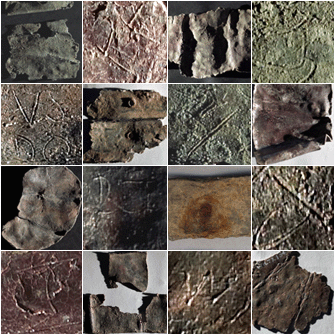
Lead 'curse tablets' comprise thin rectangular sheets which, when complete and unrolled, generally measure 6 - 12cm long and 4 - 8cm wide, although many survive only as fragments. Though often described as 'lead', metallurgical analysis of tablets from Bath, for example, shows that many are better characterised as pewter, given their high tin content. The sheets, having been cast and / or flattened, were generally trimmed to provide a roughly rectangular surface area. The text was inscribed on the tablet with a point, perhaps a stylus like those used to write on wax tablets, and the tablet was then rolled or folded with the written surface innermost, and the ends folded over. This is the state in which they are usually found. The tablets were sometimes pierced by nails, which occasionally survive in situ, although more frequently only the holes indicate their original presence. This nailing provides one explanation of the name of defixio by which these artefacts are often known (the Latin verb from which it is taken, defigere, has the meaning both to fasten and to curse). Some tablets may have been nailed to a wall or post prior to deposition, perhaps to display their message. However nails often seem to have been hammered through the blank side, making the text invisible if the tablet had been on view (Click here for images of curse tablets).

In Britain the majority of lead tablets seem to have been deposited on temple sites, famously at Bath and at Uley in Gloucestershire. At Bath they were deposited in the hot spring. Instances are also recorded from other 'watery' contexts, graves and settlements. On settlements occasional evidence suggests a preference for wet places; for example individual tablets come from the ditch of a fort and the drain of a bathhouse. As tablets are often found outside formal excavation, it can be difficult to identify the type of site on or context in which they were deposited. This is therefore a question for which we need much more reliable information.

In order to read the texts the tablets must be carefully unfolded. Given their usually brittle condition, this process can only be successfully performed in the laboratory. Distortion and cracking from folding and rolling have frequently affected the appearance of the texts. When freshly cut the strokes of the text would have shone against their background, but subsequent oxidisation has made both tablet surface and incisions the same dull grey. Corrosion has sometimes removed or damaged the surface of the tablets. Light must be cast from several different angles on to the tablet in order to render visible all the separate strokes that make up letters. The results of this examination are produced in drawings, on which the readings and subsequent translations of the tablets are based. It is impossible for a single photograph to reproduce adequately all the parts of all letters.

Tuesday, November 28, 2006

Exhibit of North African Mosaics now at the Getty Villa!


I was so excited to see the notice about the "Stories in Stone" exhibit of north African Roman Mosaics that has opened at the Getty Villa! I had hoped to go down there and now I have a particular reason to go before April 30, 2007!

"This exhibition presents a selection of mosaics from the national museums of Tunisia. They are among the finest of the thousands of mosaics produced between the second and the sixth centuries A.D. in the Roman province of Africa Proconsularis, a portion of which is known today as Tunisia.

These works, fashioned as pavements for both public buildings and private homes, represent subjects such as nature, theater and spectacle, and myths, gods, and goddesses. The exhibition also includes material on the conservation of mosaics and on the work of the Getty Conservation Institute's field project on conservation of mosaics in situ.

Mosaic art flourished in North Africa, where the diversity of limestone and marble fostered a tradition of polychromatic (multicolored) work. Beginning in the late second century, mosaics made in Roman Africa became more colorful, featuring geometric designs embellished with floral patterns. During the third century, scenes with figures emerged. In public baths, for example, mosaics often related to the sea and depicted natural elements as well as marine gods. In the fourth century, increasingly original decorative motifs included laurel garlands and crowns as borders. Figural compositions portrayed vignettes of daily life, such as hunting, fishing, athletics, and amphitheater games."


I was afraid I might never get a chance to travel to Tunisia to see their wonderful mosaics because of my husbands fear of me traveling in the region because of all of the anti-American sentiment. Now I have a chance to see at least some of them.

Maybe I can arrange to visit by February 1 and then I can see the special lecture, Puzzling Iconography:

Christine Kondoleon, senior curator of Greek and Roman art at the Museum of Fine Arts, Boston, explores the enigmatic iconography of several mosaics in the exhibition

Thursday, February 1, 2007, 8:00 p.m.

I also noticed that the Getty is selling two very interesting books on mosaics:

Stories in Stone: Conserving Mosaics of Roman Africa
Edited by Aicha Ben Abed and

Tunisian Mosaics: Treasures from Roman Africa
By Aicha Ben Abed

The Getty is charging $75 for the first book (a hardcover) and $29.95 for the second book but I found the first book on Amazon and preordered it for only $29.95 and the second book for only $19.77. Plus I don't have to stuff them in my suitcase!

Thursday, September 28, 2006

Carlisle's Roman History subject of new website

News & Star: "CARLISLE?S Roman history is the subject of an interactive website launched at Tullie House Museum & Art Gallery yesterday.

The website for primary school teachers and pupils, is an informative resource for teachers as well as having child-friendly activities which deliver information on the Romans in the area.

An interactive map details what the Romans were doing and where, in relation to modern Carlisle, and there is a reconstruction of a skull found at an excavation site at the north end of The Lanes.

Julie Wooding, Tullie House Museum & Art Gallery learning and access officer, said it has taken a lot of hard work and creative skills to ensure it is the resource teachers require. "