Tuesday, November 28, 2006

Exhibit of North African Mosaics now at the Getty Villa!


I was so excited to see the notice about the "Stories in Stone" exhibit of north African Roman Mosaics that has opened at the Getty Villa! I had hoped to go down there and now I have a particular reason to go before April 30, 2007!

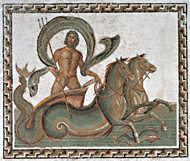
"This exhibition presents a selection of mosaics from the national museums of Tunisia. They are among the finest of the thousands of mosaics produced between the second and the sixth centuries A.D. in the Roman province of Africa Proconsularis, a portion of which is known today as Tunisia.

These works, fashioned as pavements for both public buildings and private homes, represent subjects such as nature, theater and spectacle, and myths, gods, and goddesses. The exhibition also includes material on the conservation of mosaics and on the work of the Getty Conservation Institute's field project on conservation of mosaics in situ.

Mosaic art flourished in North Africa, where the diversity of limestone and marble fostered a tradition of polychromatic (multicolored) work. Beginning in the late second century, mosaics made in Roman Africa became more colorful, featuring geometric designs embellished with floral patterns. During the third century, scenes with figures emerged. In public baths, for example, mosaics often related to the sea and depicted natural elements as well as marine gods. In the fourth century, increasingly original decorative motifs included laurel garlands and crowns as borders. Figural compositions portrayed vignettes of daily life, such as hunting, fishing, athletics, and amphitheater games."


I was afraid I might never get a chance to travel to Tunisia to see their wonderful mosaics because of my husbands fear of me traveling in the region because of all of the anti-American sentiment. Now I have a chance to see at least some of them.

Maybe I can arrange to visit by February 1 and then I can see the special lecture, Puzzling Iconography:

Christine Kondoleon, senior curator of Greek and Roman art at the Museum of Fine Arts, Boston, explores the enigmatic iconography of several mosaics in the exhibition

Thursday, February 1, 2007, 8:00 p.m.

I also noticed that the Getty is selling two very interesting books on mosaics:

Stories in Stone: Conserving Mosaics of Roman Africa
Edited by Aicha Ben Abed and

Tunisian Mosaics: Treasures from Roman Africa
By Aicha Ben Abed

The Getty is charging $75 for the first book (a hardcover) and $29.95 for the second book but I found the first book on Amazon and preordered it for only $29.95 and the second book for only $19.77. Plus I don't have to stuff them in my suitcase!

Thursday, September 28, 2006

Carlisle's Roman History subject of new website

News & Star: "CARLISLE?S Roman history is the subject of an interactive website launched at Tullie House Museum & Art Gallery yesterday.

The website for primary school teachers and pupils, is an informative resource for teachers as well as having child-friendly activities which deliver information on the Romans in the area.

An interactive map details what the Romans were doing and where, in relation to modern Carlisle, and there is a reconstruction of a skull found at an excavation site at the north end of The Lanes.

Julie Wooding, Tullie House Museum & Art Gallery learning and access officer, said it has taken a lot of hard work and creative skills to ensure it is the resource teachers require. "

Friday, September 08, 2006

Teaching Company's new course on Classical Archaeology fascinating


I'm presently listening to the Teaching Company's new course on Classical Greek and Roman archaeology and am enjoying it immensely. I had no idea that Sir William Hamilton, husband of the Emma Hamilton who was the paramour of Admiral Horatio Nelson, was the man that really began the serious study of Greek vases. I also found it interesting that the lecturer, Dr. John Hale of the University of Louisville, observed that the original Bourbon-sponsored excavation at Herculaneum under the supervision of military engineer Rocco Gioacchino Alcubierre was conducted with a high degree of professionalism and was not as amateurish as so-called father of classical archaeology, Johann Winckelmann, would have people believe.

According to Dr. Hale, Winckelmann was outraged that he was not allowed to go down into the tunnels when he first visited Herculaneum and subsequently published unfounded claims that the work there was being shoddily done.

Dr. Hale is also more sympathetic to Heinrich Schleimann than other classicists. He said he feels that Schleimann, although orignally recklessly greedy for fame and unscrupulous in his original methods, eventually attempted to conduct work in his later life with a much more professional approach. He also feels the study of archaeology needed these types of flamboyant individuals from time to time to continue to spark enthusiasm for the field.

In this morning's lecture he also talked about the efforts of German archaeologist Edmund Buchner to find remnants of Augustus' mighty Horologium, a giant sun dial the size of two football fields that used an Egyptian obelisk originally created for Pharaoh Psammetichus as its gnomon, constructed on the Campus Martius. Of course Buchner succeeded in 1979, uncovering part of it in the cellar of a cafeteria in the Via di Campo Marzio. I noticed a website that said permission to see the original marble paving revealed by Buchner is available from the German Archaeological Society.

A good article about it can be read at: http://www.livius.org/a/italy/rome/horologium/horologium_augusti.html

Friday, August 04, 2006

Imperial Rome new exhibit to open September 23 at the Fernbank Museum

The Weekly Online!: "Fernbank Museum of Natural History presents 350 years of illustrious world history with the world-premiere of a special exhibition that explores the legacy of the Roman Empire. Featuring 450 artifacts that range from small coins to larger-than-life statues, Imperial Rome showcases the brilliance of ancient Roman society during its glory days. The exhibition will open on the 2069th birthday of Caesar Augustus, Rome?s first emperor, and will be on view from September 23, 2006-January 3, 2007.

Created through a collaboration between Italy?s Contemporanea Progetti, Florence, and Atlanta?s Fernbank Museum of Natural History, the exhibition examines life during the era of Imperial Rome through a series of galleries showcasing the legendary emperors, gods, households, lifestyles, and peace, or Pax Romana, established by the powerful military. "

Teaching Company offers new course on Roman Archaeology

I see that The Teaching Company is offering a new course on Greek and Roman Archaeology.


" In these 36 half-hour lectures, archaeologist John R. Hale of the University of Louisville guides you through dozens of ancient sites with the skill of a born storyteller. Dr. Hale mixes the exotic adventures, unexpected insights, and abiding mysteries of archaeology's fabled history with anecdotes of his own extensive field experience to create an extremely fast-paced narrative that unfolds like a series of detective stories.

The detective metaphor is particularly apt because archaeologists approach their work like sleuths at a crime scene, using a range of tools, techniques, and technologies to piece together clues that paint a vivid portrait of life during the formative era of Western civilization.

For example, in Lecture 18, Dr. Hale recounts his own search with geologist Jelle de Boer for the secret behind the ecstatic trances of the Oracle of Delphi?a project celebrated in the recent book The Oracle: The Lost Secrets and Hidden Message of Ancient Delphi by Pulitzer Prize?winning reporter William J. Broad of The New York Times. Dr. Hale and Dr. de Boer used traditional archaeological techniques, combined with geological mapping and chemical analysis of rock and water samples, to solve the mystery of the priestess's famous altered states.

Dr. Hale's other research includes a long-running position as field director for the University of Louisville's excavations at Torre de Palma, and he is a participant in the search for sunken ships from the armada that attacked Greece during the Persian Wars, as recounted by the ancient Greek historian Herodotus. The winner of many classroom teaching awards, Dr. Hale has also lectured widely beyond the university, bringing archaeological discoveries to the general public."

It sounds really interesting so I have ordered my copy!

Thursday, August 03, 2006

Early "anti-tank" vehicles used at the battle of Asculum

In Dr. Gerald Fagan's lecture series, "Great Battles of the Ancient World", he mentioned that at the battle of Asculum where the Romans squared off against the Epirotes under King Pyrrhus, the Romans introduced a new weapon to counteract the use of war elephants. Dr. Fagan describes these vehicles as anti-elephant wagons. They apparently were enclosed vehicles bristling with spears that contained javelineers.

Wikipedia describes them as "these were ox-led chariots, equipped with long spikes to wound the elephants, pots of fire to scare them, and screening troops who would hurl javelins at the elephants to drive them back."

Dr. Fagan pointed out that they may have been effective if they had been deployed properly. Apparently the Roman commander deployed them on the Roman left so Pyrrhus simply moved his war elephants to the other end of the line.

Since I had never heard of these early "anti-tank" vehicles, I found it all very interesting.

Wednesday, July 19, 2006

British outbred by Anglo-Saxon 'apartheid'

IOL: "The Anglo-Saxons who conquered England in the fifth century set up a system of apartheid that enabled them to master and outbreed the native British majority, according to gene research published on Wednesday.

In less than 15 generations, more than half of the population in England had the genes of the invaders, investigators say.

'The native Britons were genetically and culturally absorbed by the Anglo-Saxons over a period of as little as a few hundred years,' said Mark Thomas, a University College London biologist.

'They prevented the British genes from getting to the Anglo-Saxon'
'An initially small invading Anglo-Saxon elite could have quickly established themselves by having more children who survived to adulthood, thanks to their military power and economic advantage.

'We believe that they also prevented the native British genes getting into the Anglo-Saxon population by restricting intermarriage in a system of apartheid that left the country culturally and genetically Germanised,' he said.

'This is what we see today - a population of largely Germanic genetic origin, speaking a principally German language.'"

Roman militarism and the definition of warfare

I am listening to a new Teaching Company lecture series entitled "Great Battles of the Ancient World" presented by Professor Garrett G. Fagan
of Pennsylvania State University. His first few lectures explores the various theories about what characteristics define warfare as opposed to other forms of communal violence. One predominate theory is that warfare is distinguished by the use of formations, tactics, and generally uniform weaponry and training. (Sorry, I don't have my course handbook with me so I don't remember the scholar's name putting forth this definition. This made me wonder, though, how proponents of this theory would categorize Roman battles with ethnic groups that did not embrace these hallmark traits, like the Celts or the Germanic tribes. Does warfare exist if only one side employs the distinguishing characteristics of what some scholars define as warfare? I was also surprised that this theory did not take into account communal political goals usually surrounding governance that, to me, would be more of a hallmark of formal warfare than the physical trappings of combat.

Another point Dr. Fagan discussed was that formal warfare appears to become more culturally entrenched in more segmented societies. By segmented, I assume he means hierarchical. This made me wonder about the cultural differences between Rome and Carthage. Both cultures engaged in warfare but Carthage concentrated on commerical development and trade rather than military conquest as its mode of growth. Was Roman culture more segmented than that of Carthage? I know both cultures had slavery and both cultures had an elite aristocracy, but were the social rules governing the "middle class" far more structured in Rome than Carthage? Was this a factor in the emphasis on military achievement in Rome as compared to commercial achievement in Carthage?

Thursday, June 29, 2006

BBC production examines the 'why' of art


BBC production examines the 'why' of art: "'How Art Made the World' may sound like a grandiose title, but the five-part series makes some good arguments in support of that saucy assertion.

Co-producers public television station KCET and the BBC reject the predictable chronological format of 'who did what when' and focus on the question 'Why?' Why are representations of the human body frequently so unrealistic? Why do abstract patterns appear in prehistoric cave paintings? Why do humans create images of death?

The episodes visit sites both remote and spectacular on several continents (Asia is not represented, but that's a longer series) to explore the earliest known examples of artistic expression. They couple those objects -- which range from figurines to temples -- with the latest thinking of not only art historians and archaeologists but of psychologists and neuroscientists.

Highlights of some of the episodes are cave and rock paintings in Europe, Africa and North America, presented with evidence that their abstract patterning derives from trance states, and the filming of such a ritual; works commissioned by the likes of King Darius of Persia, Alexander the Great, and the Roman Augustus for political empowerment and propaganda; a first-century Greek grotto with digitally re-created statues depicting a dramatic scene from Homer's "Odysseus"; an Australian aboriginal storytelling ceremony that amplifies the impact of archetypal painted images; and an Etruscan tomb wherein heavenly and hellish scenes of the afterlife encourage self-sacrifice for the common good over surrender."

Thursday, June 22, 2006

Heroic literature's role in reducing warrior violence

I have now started a new lecture series about the High Middle Ages and find it interesting that with the loss of an emphasis on education and classical literature there seems to have been a precipitous decline in what I would call social conscience during late antiquity up to the High Middle Ages. Dr. Philip Daileader is presenting this lecture series too and he described how severe the problems of noble violence became. Where in the Roman Empire, the wealthy elite were expected to provide civil service and public works, a large number of the warrior elite of the early and high Middle Ages simply used their power to brutalize and extort more wealth from those around them whether another noble, merchant, or peasant.

Dr. Daileader said that clerics tried to stem the tide of violence with the peace and later truce of God movements but the most successful efforts to rein in the aristocracy were achieved with the introduction of chivalric literature modelled somewhat after classical heroic literature.

Dr. Daileader's description of early tournaments was also quite eye-opening. Like war games with fully loaded weapons, these tournaments would be as hazardous to those living near the site where the tournament was to take place as it was to participants. He said that if an opponent hid in a farmhouse, a participant would often burn down the farmhouse to "capture" the opponent, apparently without any concern for the farmer whatsoever. He also described kippers who were peasants with clubs hired by tournament participants to run out on the field and club an unhorsed knight senseless so he could be more easily stripped of his armor. If the person died, I guess that was just considered the breaks! These activities didn't sound any kinder or gentler than gladiator combat!

Monday, June 19, 2006

Depopulation as a primary cause of the fall of the western Roman Empire

In the concluding lecture of "The Early Middle Ages", Dr. Daileader
points out the shortcomings of the "fall" theories of both Edward
Gibbon and Henri Pirenne. Instead, he points to widespread
archaeological evidence of severe depopulation occuring between the
2nd and 7th centuries as the factor underming both the Roman economy
and the Roman military.

He stated that there was evidence of urban decay as early as 200 CE
with successive footprints of towns and cities growing smaller and
smaller. Although some of the urban population may have moved back to
the country, studies of laws dealing with deserted lands also became
increasingly more desperate from the 2nd century onward.

He admits climate change and increased warfare may have played a role,
but there is evidence that new diseases introduced during the second
century, measles and smallpox (probably from China), were devastating
even before the Bubonic plague made its first appearance in the 6th
century. The resulting deurbanization severely impacted such Roman
institutions as its educational systems.

Although he attributed the loss of organized institutions to
depopulation it still leaves the question of why there was a cessation
of tutorage among the elite unless they, too, became so impoverished
they could no longer afford tutors?

As for Pirenne's theory of economic collapse because of disruption of
trade routes by Islamic conquests, Dr. Daileader points out that
current research shows that trade was still quite active through the
Northern Arc via Viking traders. In fact, Daileader points out that
the number of major routes (via Russia) connecting the Mediterranean
with Carolingian Europe actually increased sixfold. He highly
recommended Michael Mccormick's book "Origins of the European Economy:
Communications and Commerce" that was published in 2001 as an
excellent study of this phenomenon.

Church efforts to reshape Roman and Barbarian family structures


I continue to be enthralled by Dr. Daileader's course "The Early Middle Ages" offered through The Teaching Company".

Another fascinating area that Dr. Daileader expounds upon is the
evolution of the family structure during Late Antiquity and the Early
Middle Ages. Dr. Daileader pointed out that Roman and Germanic
families shared several important traits. These include the fact that
a family was based on a concept of household rather than core family
unit. The household would include servants, clients, and property.
Heads of households wielded extensive power over its members including
the acceptance or rejection of newborns. Both Roman and Germanic
peoples practiced marriage but accepted other relational forms such as
concubinage and divorce was an acceptable practice to terminate a
relationship. Both Romans and Barbarians favored indogamy (marriage
within the kin group) to preserve concentrations of wealth within the
extended family. Adoption was also viewed as a totally acceptable way
to augment a family if appropriate heirs had not been produced.

But, significant differences existed as well. Romans practiced
monogamy while polygamy was widely practiced among Germanic tribes.
In a Roman marriage, property was transferred from the bride's family
(dowry) to the groom while in Germanic marriage, the property transfer
went from the groom to the bride in form of bride price and morning
gifts. A Roman marriage required the freely given consent of the two
individuals but a Germanic marriage did not. (He pointed out that
under Roman law a pater familias could involk the death penalty if an
offspring refused to go through with a prearranged marriage but the
marriage itself could not be performed unless both parties agreed to it).

As the two cultures began to fuse and Christianity spread, however,
the church sought to openly reshape family patterns. The church began
to impose sanctions against marriage within the kin group going as far
as the sixth cousin and even forbid marriage to members of godparents
families and even in-laws family members. The church condemmed
infanticide but also opposed adoption. The church opposed divorce but
also opposed remarriage of widows and widowers. Lastly the church
condemned concubinage.

Historian Jack Goody theorized that the church attacked these
practicies because they were strategies of heirship designed to
maximize the possibility of producing an heir so family property could
be transmitted to the next generation. He speculates that this was
done to increase the chances that the church would ultimately receive
bequests of property and increase its concentration of wealth.

Historian David Herlihy argued that the church condemed these
practices for reasons of morality, theology, and social utility. As I
do not see what the moral purpose was for opposing adoption,
remarriage of widows and widowers, and marrying extremely distant
relatives, I find it hard to accept Herlily's argument. It was also at
this time that the Carolingians introduced the 10 percent tithe
extracted with the force of secular law from all practitioners in an
effort to increase church finances so a network of churches could be
built throughout the Carolingian empire. So I personally would be
more receptive to Goody's theory than Herlihy's.

Friday, June 16, 2006

'The Rape of the Sabine Women' Will Preview at the Nasher Museum of Art

'The Rape of the Sabine Women' Will Preview at the Nasher Museum of Art: "The Nasher Museum of Art at Duke University will present the preview exhibition of a new video, ?The Rape of the Sabine Women,? by Eve Sussman and her international company of collaborators, The Rufus Corporation, from July 6 through Sept. 24.

The new work is a video-musical inspired by the French neoclassical painter Jacques-Louis David?s masterpiece, ?The Intervention of the Sabine Women? (1794-1799), documenting the ancient Roman myth of abduction. It features choreography by Claudia de Serpa Soares, costuming by Karen Young and an original score by composer Jonathan Bepler.

The video, about one hour long, will be on a continuous loop on a large screen as the sole exhibition in one of the museum?s main galleries. The NasherMuseum is the first venue to preview the video, a work in progress that Sussman and The Rufus Corporation will continue to edit.

The Nasher Museum of Art is a major new arts center on Duke?s campus that serves the university, Research Triangle area and surrounding region with exhibitions and educational programs.

The Rufus Corporation?s sources for the project include contemporary news photography; paintings by David, Peter Paul Rubens and Nicolas Poussin; early modern architecture in Greece and Berlin; and experimental films of the 1960s. The video was shot on location in Greece and Germany.

?The Rape of the Sabine Women? is a modern process piece that pits the mid-20th-century ideal of ?better living through design? against such eternal themes as power, longing, aggression and desire. Months of improvisation went into creating a work in which the banality of a love triangle grows to epic proportions. Women and children ultimately intervene in a battle that develops from the modernist dream gone awry.

The final fight is staged at Herodion theatre in Athens. Five iconic locations (the PergamonMuseum and the TempelhofAirport in Berlin; the Athens Meat Market; a seaside home built in 1961 by the architect Nikos Valsamakis and the Herodion Theatre at the Acropolis) metaphorically echo classic, fascist and modernist themes behind the power struggles played out by the characters."

Thursday, May 25, 2006

Dr. Philip Daileader Teaching Company course on the Early Middle Ages fascinating!

I began listening to the Teaching Company course ?The Early Middle Ages? presented by Dr. Philip Daileader of the College of William and Mary and became almost immediately intrigued by a discussion of the writings of Belgian historian Henri Pirenne. Unlike Edward Gibbon who attributed the fall of the Roman Empire to a loss of moral fiber and incursion by the Germanic barbarians, Pirenne postulates that the fall didn?t really occur until the 7th and 8th centuries and attributes the eventual decay of European urban centers to the disruption of international trade networks brought about by the Muslim conquest of the Mediterranean region. Pirenne based this thesis, outlined in his book ?Mohammed and Charlemagne? published in 1937, on such observations as the disappearance of gold coin and papyrus north of the Alps that he points to as a clear indication that Europeans no longer had access to the richer areas of the Mediterranean during this time.


Lecture 2 about the Early Middle Ages focused on Diocletian?s reforms to the economic and social structures of the Roman Empire in his attempt to strengthen the empire through authoritarian means. As most of my study of the Roman Empire has been centered on the late Republican period, I know very little about the third century CE except that Diocletian formed a tetrarchy in an attempt to make management of the Roman Empire more efficient and responsive. But, today I learned about Diocletian?s more radical social and economic reforms that essentially lay the foundation for development of the feudal system. Dr. Daileader explained that Roman taxation was based on land production so it was detrimental to have citizens abandoning their farms and migrating to the cities looking for better opportunities. So Diocletian enactied laws that essentially bound people to the land and made them responsible for whatever taxes the land should be capable of producing. He then empowered large landowners to act as judicial officers to not only handle legal problems that might arise on the estate but eventually to collect taxes (ostensibly for Rome although abuse was almost immediate) as well (I couldn?t help but envision the Sheriff of Nottingham!). Diocletian implemented this system by conducting an empire-wide census that required people to register at their place of origin.

Diocletian also analyzed the economy and designated certain occupations as essential to the empire. For people engaged in these occupations, he made it mandatory that their family members would succeed them in the business if the primary provider died. For example, he determined that baking bread was essential to the empire so all sons of bakers had to become bakers to ensure that an adequate amount of the commodity would always be produced.

As for Diocletian himself, I guess he succeeded in requiring petitioners to prostrate themselves in front of his throne (apparently 3rd century CE Romans were more easy to manipulate than the Macedonians of Alexander the Great?s time!), kiss the hem of his gown, and call him ?Lord and God?. No more of this ?princeps? business!

More interesting details today in Dr. Daileader?s lecture about the Emperor Julian?s efforts to reestablish paganism as the religion of choice in the 4th century. He described how Julian issued an edict that restricted the teaching of classical Greek literature to only pagan tutors. Julian thought that the elite considered Greek literature the very foundation of a proper education so would hire pagan tutors for their children if the study of Greek literature was not available from anyone else. These pagan tutors would then influence their charges much in the same way Julian himself was influenced by a pagan tutor.

Dr. Daileader said in response to this edict, Christian tutors took passages of the gospels and transformed them into examples of Greek tragedies, comedies, and Homeric epics so their students would have an understanding of these classical literary forms. I wonder if any of those efforts are extant?

I wish modern educational institutions would place as much importance on the elements of a classical education as the Romans did!

Trajan's Squares exhibit part of Italian June in Bucharest

BUCHAREST DAILY NEWS: "The Italian Embassy will hold a series of cultural events in Bucharest throughout June, in an effort to emphasize the partnership between Romania and Italy.
Italian Ambassador Daniele Mancini suggested that the series of events that encompass cultural happenings in some of the most popular locations in Bucharest are part of a greater strategy of making the Italian culture known to Romanians.

The events will start on May 30, when the National History Museum will inaugurate an exhibition entitled "Traian's Squares," which will depict one of the most flourishing epochs of ancient Rome. The History Museum will also host a show performed by Faber Theatre at 3 p.m. The Italian performing also announced their participation for the Theater Festival in Sibiu. Also on June 1, the Italian Cultural Institute will host a photography exhibition by Italian artist Maurizio Biancarelli under the auspices of Perugia Province. On June 2, on the occasion of the Italian National Day, the ambassador will host a reception that will include a demonstration of flag throwers from Gubbio, in the region of Umbria. The flag throwers will also demonstrate their talent on June 4 with a show beginning at 12 p.m. at Charles de Gaulle Square. On June 8, the Italian Embassy will host the illumination of the Romanian Athenaeum. Green Hours, which is well known for its jazz concerts and experimental theater evenings, will also host the tango concert of the Italian "Nuovo Tango Ensamble" on June 9. The "Summer Celebration" will be opened by I Solisti Veneti, supported by the George Enescu Philarmonic.
Professor Valerio Massimo Manfredi will hold a press conference at the Italian Cultural Institute. According to Ambassador Daniele Mancini, Massimo Manfredi is a well-known historian and archaeologist and is one of the most translated writers in his field. The writer is to present his second most recent novel, "Il Tirano," which is a study of the island of Sicily before the Roman conquest."

Thursday, May 18, 2006

Matthew B. Roller - Horizontal Women: Posture and Sex in the Roman Convivium - American Journal of Philology 124:3


American Journal of Philology 124:3: "Contrary to the view that "respectable" women dined seated until the Augustan era, I argue that a women (of any status) could always dine reclining alongside a man, and that this signifies a licit sexual connection. The sitting posture, seen mostly in sub-elite visual representations, introduces further complexities of practice and ideology. In general, postures attributed to women function more as indicators of sexual mores than as direct representations of social practice?."

"...To begin with the earliest Roman literature, several Plautine dramas (late third to early second century B.C.E.) contain convivial scenes in which high-status males dine and drink while reclining in one another's company and alongside courtesans. The convivium is thus a place where such males enjoy a nexus of pleasures: wine, food, companionship, and the prospect (at least) of sex. 8 These convivial pleasures persist in the late republic as well.

Cicero, early in his treatise on the ideal orator (De Or. 1.27), contrasts such pleasures with more serious activities and concerns (i.e., negotia). He relates that, when he was a young man, the senior senator and orator Cotta regaled him with a story from Cotta's own youth. Cotta said that he himself had participated one day in a gloomy and difficult discussion with certain eminences grises regarding the condition of the state. Following this discussion, however, when the party repaired to the dining couches, the host Crassus dispelled the prevailing gloom with his humanity, urbanity, and pleasantness. Cotta contrasts these moods as follows: "in the company of these men the day seemed to have been spent in the senate-house, while the dinner party seemed to have been spent at [a suburban villa in] Tusculum." 9 That is, the grave affairs of state (negotia), which filled the day's conversation, stereotypically occupied the curia at the political heart of the Roman republican forum, while the pleasurable, cheerful fellowship of the evening convivium (otium) better suited a country villa. Cicero himself, says Plutarch (Cic. 8.4), almost never reclined for dinner before sundown, pleading a bad stomach and also his ascholia (i.e., negotia) as keeping him away. Julius Caesar, a busy man, rather eccentrically combined business with pleasure: Plutarch remarks upon the fact that he regularly dealt with his correspondence while reclining at dinner. 10


Moving onward, Horace contrasts otium and negotium, though not necessarily in these terms, in some of his dinner-invitation poems (e.g., Carm. 2.11, 3.8, 3.29), for he dangles before his addressee?in each case, a magistrate busy with public affairs?the enticements of companionship, sex, and especially wine, requesting that he seize these pleasures and yield for the evening his anxious cares on behalf of the state. 11 Likewise, one declamation in the elder Seneca's collection (Cont. 9.2) posits that a provincial governor executed a criminal in the midst of a convivium at a prostitute's request. Many of the declaimers who handle this theme explore the shocking collapse of the otium/negotium distinction that this situation envisions. For judicial matters, such as punishing criminals, belong in the forum, not the dining room; they should be done by daylight, not at night, and so on. 12 The younger Seneca, in Ep. 71.21, contrasts "lying in a convivium" with "lying on the rack" (i.e., for torture). The former, he acknowledges, is pleasant while the latter is unpleasant, yet the two kinds of reclining are indifferent in regard to Stoic moral value. Finally, Martial (Epig. 14.135) gives voice to an outfit of dining-clothes (cenatoria), which primly defines its proper realm by contrast with "serious" business: "neither the forum nor going to bail are familiar to us: our job is to recline on embroidered couches." 13 These passages are purely illustrative, and by no means exhaustive; they merely show how elite Romans consistently slotted conviviality into the category of otium and regarded it as encompassing a variety of specific pleasures: wine, food, conversation, companionship, sex. They also show how such Romans distinguished conviviality broadly, and the reclining posture that symbolizes it, from activities they perceived as serious or mundane (i.e. negotia), or unpleasant."

"...The next body of evidence dates from the late republic. In this period, too, we find women of diverse social and sexual statuses reclining alongside elite males at convivia. Certainly women of low status figure among these. In his second Catilinarian oration (Cat. 2.10), delivered in 63 B.C.E., Cicero invokes the specter of a debauched convivium in which wine-soaked, gluttonous, perfume-drenched followers of Catiline, exhausted by their illicit sexual exertions, embrace "shameless women" as they recline, plotting murder and fiery destruction for the city. Similarly, in a letter of 46 B.C.E., Cicero describes a convivium at the house of Volumnius Eutrapelus in Rome, attended by a number of male aristocrats, in which the actress and courtesan Cytheris was also present and reclining to dine: infra Eutrapelum Cytheris accubuit. . . non me hercule suspicatus sum illam adfore (Fam. 9.26.2). Bradley (1998, 47) explains that Cytheris reclined because "[s]he was an actress, and for a woman of her profession, or that of a meretrix, the conventions of respectable society did not apply," where by "conventions of respectable society," he presumably means the "strict protocol" (mentioned in the same paragraph), whereby the dutiful, subordinate wife sat while her husband reclined. Cytheris was assuredly not married to Eutrapelus but was his freedwoman and was almost certainly his sexual partner at one time or another. 46<>Att. 5.1), Cicero describes the rudeness of Atticus' sister Pomponia to her husband Quintus Cicero, Marcus' brother, during a day the three spent together while traveling. First, Marcus reports, she harshly rejected Quintus' suggestion that the three collectively host a dinner. Then she refused to join the Cicero brothers and their guests as they reclined for a meal and rejected food that Quintus sent her from the table. Finally, to cap it all, she refused to sleep with Quintus. 47 Marcus makes clear that at every stage Pomponia behaved unreasonably, unsociably, and undutifully. He faults her, then, not merely for refusing to recline with Quintus among the dinner company and then refusing to retire to bed with him. By commenting also on the harshness of her words and on her rejection of food sent her from the table, Marcus seems to invoke a larger social expectation or norm that wives (at least elite ones) were equal partners with their husbands in the pleasure and leisure of the convivium. They should enjoy the same nourishment (hence the gesture of sending food), the same company and conversation, and presumably the same sexual titillation (hence the expectation of retiring to bed together) that normatively characterize the convivial experience for reclining men. These are precisely the expectations that Plautus' Alcmena invoked in conversation with her own spouse. 48 This Plautine and Ciceronian evidence begins to suggest a pattern. Since, in all these passages, the woman who reclines (or is expected to recline) alongside a man on a dining couch is known or likely to be sexually attached to him, it is tempting to propose that the converse is true: namely, a man and woman who recline together on the same couch in a convivial setting thereby signal their sexual connection, regardless of the woman's status. Such a partnership presents itself as "licit"?i.e., involving a man and women who can have sex without stuprum. "Licit" relationships range from marriage proper to quasi-marital relationships (concubinatus or contubernium), to the sexual use of one's own or others' slaves, to prostitution. 49 Conversely, it is a grave transgression if a couple who cannot have licit sex reclines together to dine, for their posture and juxtaposition would be taken to imply that they do, nevertheless, have sex and so are guilty of stuprum. 50< This interpretation is incompatible with the scholarly communis opinio (itself an interpretation of Varro and Valerius) that "respectable" women dined seated in the republican period. I suggest, rather, that any women not precluded under the rubric of stuprum, including both "respectable" ones (i.e., wives) and "non-respectable" ones (e.g., prostitutes), could and did dine reclining alongside their male sexual partners, thereby visibly affirming the existence and social legitimacy of that partnership. Nevertheless, crucial differences remain between women at the high and low ends of this social spectrum. Slave prostitutes, for instance, being inherently instrumental to the pleasure of the privileged, reclining males, can only have reclined on the males' sufferance and only if they thereby made an especially significant contribution to the males' convivial pleasure (e.g., by charging up the erotic atmosphere or providing entertainment). Presumably they could be reduced to standing in service, or be required to do something entirely else, at any time. At the other social extreme, elite wives, in reclining alongside their husbands in convivia, thereby participated substantially or fully in the leisure and various pleasures of the event. They benefited from the slaves' attention no less than their husbands; they shared the same food, drink, entertainment, and erotic subjectivity as their husbands; and?on the evidence of Pomponia?they substantially controlled their own level of engagement, far from being automatically subject to their husbands' commands or wishes. What modes of participation might have been available to a socially intermediate figure like Cytheris?neither a slave nor a wife, but a freedwoman who socialized at the highest levels of elite male society?is less clear, though we catch sight of her reclining alongside her patron and (probable) sexual partner, apparently participating fully.

Representations of women's conviviality become more plentiful in Augustan and imperial texts. These representations confirm that a woman's dining posture?at least in elite male company?expresses her sexuality, but they show considerable ambivalence about the consequences of such expression. Especially striking are several tableaux in Ovid's elegiac poetry where the male lover, reclining in a convivium, observes his beloved reclining on another couch with another man and plots to seduce her. In Amores 1.4, the woman in question is explicitly described as reclining alongside a man, the image of her "warm[ing] the breast of another, placed close below him" (alteriusque sinus apte subiecta fovebis? v. 5), and the other gestures of intimacy that the poet-lover observes or fears that the two may exchange (vv. 4-6, 15-16, 29-30, 33-44) suggest that readers would understand this couple as reclining in close physical contact, with the man at the head of the couch and the woman slightly toward the foot, her back against his chest. That is, he reclines above her (in the high position on the couch) and she below him (in the low position). Clearly, this positioning facilitates physical contact, among other things. 51The lover, for his part, proposes a set of signals that he and his beloved might exchange, across the distance that separates them, to signify their attraction and perhaps set up a tryst. A similar tableau in the Heroides (16.217-58) depicts a banquet in Sparta in which the hosts, Helen and Menelaus, recline together on a couch exchanging various physical intimacies, while Paris, their guest, watches enviously from another couch. Here, too, the sexually charged atmosphere made possible by mixed-sex reclining on a dining couch is vividly portrayed. 52In a third passage, Ars Amatoria 1.565-608, Ovid presents these same convivial practices and social dynamics in a didactic mode: he advises his reader how to proceed if, at a convivium, he should notice an attractive woman reclining on another couch alongside another man."
Friday, May 12, 2006

Lucius Artorius Castus by Linda A. Malcor


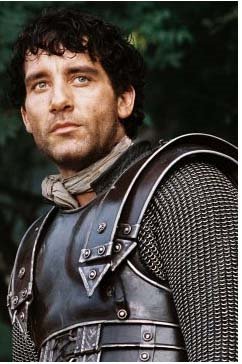
Having just returned from England, I have renewed my interest in the complex history of Roman Britain and find myself resesarching more an more about the various cultures that inhabited that land. I think, despite the criticism levied about the film, the movie "King Arthur" starring Clive Owen is probably closer to the truth surrounding the possible existence of a real King Arthur than any medieval legends.

I know the programs I watched about the foundations of the King Arthur legend did mention the existence of a Roman officer named "Lucius Artorius Castus" who led a documented campaign against the Armoricans in the second century C.E. and some scholars speculate a descendant of his could have been the Arthur of the early Dark Ages.

"Castus has gained in popularity over the years as more has been deduced about him and the period in which he lived. The primary evidence that Castus even existed is slim: one, extremely extensive, autobiographical resume on three fragments from a sarcophagus, which were found in a fence/wall near Epetium (modern Strobrez in Podstrana) and one corroborating memorial plaque found near the chapel of St. Martin (Sveti Martin) of Podstrana on the Adriatic Highway.3 The reconstruction of the main inscription can be translated as:

To the spirits of the departed: Lucius Artorius Castus, centurion of the III legion Gallica, also centurion of the VI legion Ferrata, also centurion of the II legion Adiutrix, also centurion of the V legion Macedonica, also primus pilus of the same [the V legion Macedonica], praepositus of the classis Misenatium (the fleet on the Bay of Naples), praefectus of the VI legion Victrix, dux of the legions of cohorts of cavalry from Britain against the Armoricans, procurator centenarius of the province of Liburnia, with the power to issue death sentences. In his lifetime he himself [possibly: "fecit," "had this made"] for himself and his family . . . ["possibly H. s. est," "lies buried here".4

In addition to the Castus inscriptions, there are what I believe to be other references to him in some of the "nameless" figures that appear in the histories of Cassius Dio and Herodian.

When Malone wrote his article, the stones bearing the Castus inscriptions had not, to his knowledge, been dated. Scholars now believe that the pieces of Castus's sarcophagus date to no later than 200 (Kirigin and Marin 1989:143),5 which means that Lucius Artorius Castus most likely died prior to that date. There is precisely one military action known to have been lead by a dux in the late second century, and that is a military expedition to Armorica in 185, which is documented by Herodian (10.1-7; Whittaker 1969:61-67).6 The dux for this expedition is not named in the text, but, given the inscriptions from Liburnia, the officer had to be Lucius Artorius Castus.7 Given the known date for the Armorica campaign and the fact that the Artorii were of the equestrian class, it becomes possible to reconstruct the life of this obscure individual in rather surprising detail." - Linda A. Malcor, "The Heroic Age: Lucius Artorius Castus, An Officer and An Equestrian

Ms. Malcor goes on to describe the various tours of duty this outstanding cavalry officer had, correlating them to other historical events occurring during his service and reflects her extensive research. If he wasn't the ancestor of "King Arthur" he definitely should have been. His relationships with conquered Sarmatians is paralelled in the Hollywood film. If you saw the film in the theater, try renting or buying the DVD. It contains more background material and is far superior to the theatrical release.

I just finished listening to Valerio Manfredi's "The Last Legion". It is a work of fiction but takes place during the takeover of Italy by Odacer. In it, Manfredi postulates that the last boy emperor Romulus is wrested from confinement on Capri and is spirited away to Britannia where he fulfills an ancient legend of a boy from the east who will lead the Britons in a victorious battle for freedom at a place called Mount Baden under the banner of a dragon. Romulus does so and his followers dub him "Pendragon". He marries the daughter of a local chieftain and they have a son they name "Arthur" - an entertaining piece of alternative history!

Friday, May 05, 2006

Romans in Malta Subject of New Heritage Trail


I see that Heritage Malta is conducting another thematic heritage trail on Sunday 7th May with the focus on the Roman Domus in Rabat and the archaeological site of Tas-Silg. "Tas-Silg has been identified by Ancient Greek and Roman geographers and writers -- most importantly in the works of Cicero -- as having served as an active cultural, political and commercial centre of the ancient world. Excavation works, carried out by the Missione Archeologica Italiana of the University of Rome and the University of Malta in collaboration with Heritage Malta and which are still taking place, uncovered structures and artefacts dating back to the Prehistoric, Phoenician, Punic, Roman, Byzantine and the Middle Age periods."

The Roman Villa and Museum sounds very interesting: "The villa probably belonged to a wealthy Roman merchant or a senior official. The siting has an Italian flair, looking west over the valley towards what is now Mtarfa.

The villa and its grounds were first excavated in 1881. The clean Neo-Classical temple museum building now camouflaged by a forecourt of citrus trees was built in 1921-24 during the second round of excavations.

Not all the museum's exhibits were unearthed within the villa's grounds. Among the artifacts and architectural fragments is an olive-pipper found in Marsaxlokk, parts of flourmills made from Italian lava, and tombstones. The cabinets display terra-cotta ornaments, theatrical masks, glassware, amphorae, lamps from Imperial Rome and a section of fine mosaic from the villa.

The corner stairs lead down to what remains of the villa itself. The main attraction is the now-roofed square mosaic-covered atrium, or central court, enclosed by 16 columns, only one of which is original. The whole of this area would have been roofed except for the impluvium of two birds sitting on a water bowl, from which rainwater would drain to the cistern in the corner. The two rooms off the atrium were, on the left, the triclinium or dining room, which housed the mosaic in the museum, and the reception room. Some heavy-handed restoration has left the remaining mosaics in poor order. In the small annex are relics from later Arabic graves found within the grounds.

Other items in the courtyard include the famous motif of an astonished open-mouthed woman from a mosaic's border, a blurred scene of either a satyr being teased by maenads (orgiastic nymphs) or Delilah and Samson, and marble statues and busts including Octavia, the mother of Emperor Claudius."

The 5th Century Anglo-Saxon Invasion of England


When I was in England recently, I was surprised by a change in thought about the Saxon invasion (or should I now say immigration?) of Britain during the fall of the Roman Empire. A tour guide made it sound as if the Saxons were well settled in Britain by then and indicated they just "rose to prominence" after the Romans left. This is in stark contrast to tales of Saxon "Sea Wolves" fascinatingly rendered by such authors as Rosemary Sutcliff. So I became curious about what the archaeological record had to say about it. I found this interesting article by William Bakken about the subject.


The 5th Century Anglo-Saxon Invasion of England: "An increasing amount of new information about the transition period is being supplied by archaeology. The evidence from first-hand archaeology is free of errors induced by copyists and editor, but is susceptible to improper interpretation and must be used carefully. The chronology of English artifacts requires correlation of evidence in England and on the continent with coins or other materials that can be accurately dated. From this a rough chronological sequence has been developed primarily based on changes in the styles of pottery and jewelry.20 In general, the recovered artifacts are grave goods many of which tend to be durable. It is necessary to look at all of the grave goods for chronological indications as heirlooms and plunder may be included in graves. Sequences of pottery, brooches, buckles and spear heads are now reasonably well established for dating.21 In addition to chronology, pottery and brooches particularly can be used as evidence of continental homelands of immigrant groups.

There was a gradual transition from cremation early in the settlement period to inhumation as the English were influenced by British customs and particularly as they were introduced to Christianity. This happened both in England and on the continent. Therefore, cremation indicates an early grave. Pagan inhumation burials were generally supplied with grave goods which makes them excellent sources of information.

Archaeological artifacts of the sub-Roman Britons are difficult to find. They appear to have continued to use the durable goods produced in the Roman period as long as possible and then replaced them with goods of less durable leather and wood construction. In addition, on sites that were abandoned, the latest levels are the least well preserved. It requires specialized techniques to recover the upper remains of wood construction. However, when allowances are made, the archaeological record still shows a drastic reduction in population and standard of living of the British remaining in southeastern and central England.22

Archaeological evidence indicates there were Germanic troops in what became England well before the fifth century.23 The Romans used auxiliary troops from all over the world to provide garrisons for their military installations. Thus from Roman records, we know that German troops were stationed on Hadrians wall. These troops did not leave identifiable artifacts because they were issued Roman equipment. By the fourth century, the Romans were enlisting Germanic troops under their own leaders with their own equipment. Artifacts show that Germanic troops were guarding towns and roads in England from the fourth century on. Much of the pottery that identifies Germanic people has been found along the Saxon Shore where it appears auxiliary troops were stationed. Cremation cemeteries have been found that date from before the end of Roman rule in Britain. These early cemeteries are generally concentrated near Roman towns, forts or transportation routes. Their location pattern is similar to that of a wheel made pottery decorated in Saxon styles called Romano-Saxon ware. This pottery was apparently made by British potterers for the Germanic trade.24

Brooches, commonly used as clothing fasteners provide a valuable indication of date and origin. The shape and type of decoration varied between tribal groups. Round and equal arm brooches were common among Saxons, while the Angles and Jutes preferred cruciform brooches. In addition, wrist clasps were common among the Angles.25

Pottery fashions have about the same division as brooches. The Angles and Jutes favored rectangular decoration while the Saxons used more curvilinear styles. In addition, stamped decoration was common on Saxon pottery and was not used by the Angles and Jutes.26

Weapon ownership was almost essential in the settlement period and, therefore, weapons were commonly placed in graves. Spears were the most common, typically an iron tip riveted to an ash shaft. Shields of lime wood with a leather cover and an iron boss at the center have also been found. Knives and swords were too valuable to be placed in the graves of ordinary soldiers and farmers and are thus an indication of aristocracy. The swords used by many of the German nobility were heirlooms passed down from generation to generation.27 Helmets and arrows were also rarly found."

Wednesday, April 19, 2006

How Gladiators really lived


How Gladiators really lived: "The fury of gladiatorial combat first came to Ephesus in 69BC, courtesy of Lucullus, the Roman army's commander-in-chief. The city was a vital centre, on a par with Alexandria in Egypt, or Antioch in Syria. Under the Emperor Augustus, it became the first city of the Roman province of Asia, and the residence of the proconsul. A political and commercial centre with a population of an estimated 200,000, it sat astride trade routes that ran from West to East, and from South to North.

To accommodate the contests, the eastern part of the Ephesus stadium built by the Greeks was converted into an elliptical arena. One of the biggest monuments of the city, the stadium was oval-shaped, about 330 yards long and 160 yards wide. Some 25,000 spectators - half the capacity of the Colosseum - could watch the athletic games favoured by the Greeks. Centuries later, people could watch chariot races, and the gladiator combats that began in the afternoon with the participants, right arms raised, hailing high officials, nobles and senators with the ritualistic words: 'Those who are about to die salute you.'

There was no mistaking the purpose of these fights: they were designed to impress people with the might of Rome, and they allowed the cities of the entire empire to show that they belonged to it. Significantly, the Ephesus contests were organised by the high priest who oversaw the worship of the emperor. In the amphitheatre, the audience embodied the Roman nation, the sovereign people of the Earth. It was the people, and not their ruler, who decided whether a vanquished gladiator had demonstrated sufficient fighting spirit and courage to obtain a pardon. The people could also decide to grant a gladiator freedom - most of them were prisoners of war, slaves or condemned offenders - just as they could call for his execution on the spot.

When a gladiator died, his body was carried only a short distance from the scene of his last stand. Some 300 yardsaway, off a covered passage built with huge limestone blocks, lay a cemetery. There, the body was placed in a sarcophagus that rested on the ground. No other objects were buried with the body. But the dead man was often honoured with an inscription that would guarantee him later recognition. Some epitaphs carried the word 'gladiator' in both Latin and Greek, and detailed the cities he had fought in and the victories he had won. One related how Pandos, from Asia Minor, had won 10 contests and that, even though he had had the sun in his eyes, he had managed to kill an opponent 'as if he were a donkey'.

The epitaphs were discovered in 1993, when archeologists stumbled across them as they tried to trace the path taken by holy processions from the centre of Ephesus to the Temple of Artemis - one of the seven wonders of the ancient world - on the city's outskirts. The cemetery, now covered by an orchard and off a street where shepherds walk their sheep, yielded not only the inscriptions but also - much more excitingly - enough material to allow for the first mass autopsy ever performed on the bones of gladiators."