Friday, January 27, 2006

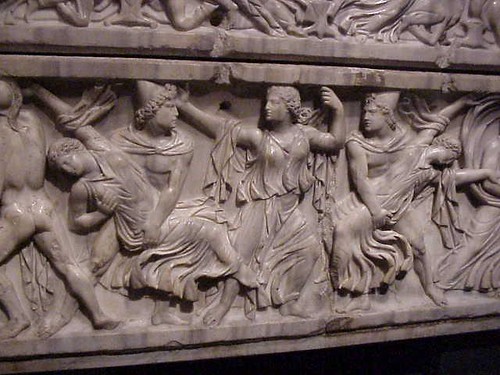
Palmyra


Palmyra: "Little is known of the Palmyrene community before 41 BCE. Its wealth was enough to excite the cupidity of Mark Antony, who ordered a cavalry raid against it. All that the Palmyrenes did was to evacuate their city and flee with their valuables across the Euphrates. This was the first recorded contact between Rome and Palmyra.

When the Emperor Valerian was conquered and captured by the Persians, his unworthy son left him in the hands of the conquerors; but Odeinathus, a citizen of Palmyra, marched against them, defeated them, and took the whole province of Mesopotamia. The services thus rendered to Rome were considered so great that Odeinathus was associated in the empire with Gallienus. This brave man was poisoned at Emesa; but he bequethed his power to a worthy successor - Zenobia, his widow. Unfortunately, ambition prompted her to usurp the high sounding title 'Queen of the East'. But Rome could brook no rival. Her army was defeated, her desert city laid in ashes, and she herself in fetters to grace the victor's triumph.

The expansion of the Parthian empire into the Euphrates region in the mid-second pre-Christian century created a new situation in the Near East. So did the annexation of Syria by Rome about three-quarters of a century later. Between these two world empires stood Palmyra, it's isolated location in the heart of the desert put it outside the reach of the Roman legions as well as the Parthian cavalry. Its merchants benefited by its unique position as the main halting-place on the trans-desert crossing of the north-to-south and east-to-west routes. Its politicians shrewdly exploited its strategic situation between the two great rival powers and, by siding one time with Rome and another with Parthia, kept the balance of power and profited by neutrality. By playing one adversary against the other, they maintained the independence of their city as a bufffer state.

It was not easy for the desert city to preserve full sovereignty in face of the growing ascendancy of the empire on its west. By the start of the Christian era Palmyra must have acknowledged the suzerainty of Rome, judging by imperial decrees of 17-19 CE, under Tiberius, regarding its customs duties, but never surrendered its independence. About the same time the city apparently received a resident representative of Rome and allowed one of her citizens, Alexandros, to undertake a mission on behalf of Rome to Sampsigeramus of Hims. Trajan incorporated it in the province he created in 106 and Hadrian on his visit in 130 granted it the name Hadriana Palmyra as a vassal of Rome. Palmyra's dependent cities also became Roman vassals. At the beginning of the third century Palmyra received colonial rights from Septimius Severus or some other empror of the Syrian dynasty in Rome."

*Thumbnail image "Zenobia Queen of Palmyra" by Howard David Johnson, illustrator.

Friday, January 20, 2006

A STUDY OF SOCIAL STRATIFICATION WITH REFERENCE TO SOCIAL CLASS BARRIERS AND SOCIAL CLASS RIGIDITY

by William Cecil Headrick, 1941

"The legal and political rise of plebeian elements: The extension of political rights to commoners has tended to monopolize the attention of social theorists; they have frequently lost sight of the social classes because of the dramatic aspects of the political struggle.

From the social class point of view the significant fact during this period was the division of the plebs, clearly and markedly, in high class plebs and the masses. The introduction of money, which could be passed from hand to hand without religious ceremony, enabled some plebs to remain or become wealthy. 23 They displayed their riches, arranged themselves into social ranks in true social class fashion. 'Some [plebeian] families were prominent, some names increased in importance. A sort of aristocracy was formed among the people . . . . ' 24 The plebs 'followed the lead of this new aristocracy, which they were proud of possessing.' 25 Not all plebs could aspire to high position; not all did. 'If the plebs were somewhat indifferent, there was a plebeian aristocracy that was ambitious.' 26 There are the upper class commoners who conspired and struggled to abolish political and connubial disabilities, as a matter of pride. Tenney Frank designates those plebeians who gradually won approximate equality with the patricians as 'property-holding plebeians.' 27

Out of these ambitious and prominent groups, in addition to the overwhelming majority of persons related to the ancient nobility, the new nobility of office was formed. Many of the newly ordained official nobility were patricians, many were the younger branches of old patrician gentes, some were descendants of aristocratic plebeians. The artisan class of plebeians and the amorphous mass of Roman proletarians did not present candidates for judgeships or the senate in numbers great enough to arouse comment even in socially class conscious Rome.

Sorokin, although documented history does not corroborate his statement, says:

The period after 449 BC . . . . . to the middle of the fourth century BC . . . . could be regarded as the period of an intensive circulation because during this period the plebeians obtained almost a complete equality with the patricians, and in this way passed from a lower to a higher stratum.

Whatever circulation was approved in that century had already taken place; law ratified a de facto situation. Furthermore, the plebeians, at least the great mass of them, obtained no semblance of equality with the ancient patrician families. The mass of plebs lived very lowly existences indeed. Finally, it is absurd to state that a whole mass, such as the majority of plebs were, could "pass from a lower to a higher stratum." This is somewhat equivalent to saying that the workers in the Soviet Union rose and inherited the places of the ousted nobility, or that the blacks after 1865 took their places as the equals of their former masters. (The situation of the ordinary plebs was less disturbed, changed, or improved than that of these remotely analogous illustrations.) Sorokin's confusion of social equality with limited political rights illustrates the kind of error into which even prominent sociologists can fall.

The Republic reaches middle age. Tenney Frank 29 reports that the Punic wars enhanced the prestige of the senatorial nobility. Furthermore, this "new aristocracy" performed so well that it entrenched itself in power. He also notes the depletion of the ranks of free farmers and the growth of large estates. These data indicate that the middle age of the Republic was not one of social class mobility upward, except, to a limited extent among the equites, that is, the capitalists, merchants, and contractors.


Of upstarts nothing is heard during this era. The new aristocracy, made up almost altogether of two old aristocracies, froze as fast as it formed, entrenched its clique in office, and provided places for its sons. They, with their love of the land, took an active part in grabbing up the land of fallen soldiers and in obtaining parts of the leased ager publicus. 30

Mommsen is quoted as saying that "the overthrow of Junkertum did not take from the common life of Rome its aristocratic character in any way." 31

The significant social class fact concerning the middle period of the Republic is that aristocratic sentiments were exceptionally strong. At the time of the Gracchi, for instance, 32

The aristocracy, drawing its livelihood from slave labor on large estates, not infrequently from a general's share in booty, and occasionally from a shrewd marriage, and basing its claims for social distinction upon ancestry and political office, remained a closed corporation of less than a hundred outstanding families living in one city.

In agriculture, and perhaps in the trades, the introduction of slaves and the conditions of war had begun to depress parts of the lower classes.

The only important movement on the social scale in an upward direction was to be found among the equites. They did not accomplish what bourgeois elements in parts of Western Europe were destined to do centuries later, however; they did not rise to the top.

The rĂ´le of wealth -- the equites. In the third and second centuries BC. wealth per se did not divide man from man, class from class. The older orders of Rome, the aristocrats, did not lose their hold on social prestige. In fact, when the capitalists and other business and governmental elements threatened them, they struck back. On this point the record is clear: 33

Before the Gracchi the knights had not yet formed a separate social caste of peculiar distinction. That some were wealthy and kept elaborate households in imitation of the senators is probable. They provided well-dowered daughters now and then to save noble families from financial ruin, and after a few such connections had been formed with the influential, a member of an equestrian family occasionally succeeded in gaining enough support to dare to be a candidate for aristocratic office. But during the Republic the road to social distinction was always difficult for the financial group. The Gracchi gave them some political recognition and prestige, but also a hostility toward them that cost them dearly whenever -- as under Sulla -- the nobility was secure in the saddle. Rarely has a capitalist class as such suffered the disasters that it did at Rome.

Sulla "organized a terrible butchery among the financiers, from which as a class they never recovered. After Caesar they completely disappeared as a political element." 34

The equites, instead of rising to the highest positions, intrenched themselves in the middle groove. The age of the Republic at its height was not an age of any significant social mobility. This, too, is in the record: 35

For reasons not wholly clear the ranks of the nobility seem not to have been threatened to any extent by parvenus. Between 200 and 146 BC. there were one hundred and eight consuls elected. Only about eight of these belonged to families that had not been represented in consular office before . . . the people were satisfied to continue the old families in positions of dignity.

Cato, one of the commoners to play a stellar role, was not a democrat, certainly. "Though a novus homo himself he seems not to have aided other 'new men' to office." 36

The middle age of the Republic was one of less mobility than the era preceding it; in the earlier period the rich plebeians were able to merge themselves with the older aristocrats. In the middle period the equites were stopped short of that goal; they had to be content with an entrenched middle position. Yet this is the period of "open" classes, as opposed to other eras of "closed" classes, a distinction intimating freedom of movement on the social scale and repeatedly emphasized by Sorokin and Fahlbeck.
"

Race Mixture in Ancient Rome

By Tenney Frank, July 1916:

THERE is one surprise that the historian usually experiences upon his first visit to Rome. It may be at the Galleria Lapidaria of the Vatican or at the Lateran Museum, but, if not elsewhere,
it can hardly escape him upon his first walk up the Appian Way. As he stops to decipher the names upon the old tombs that line the road, hoping to chance upon one familiar to him from his
Cicero or Livy, he finds praenomen and nomen promising enough, but the cognomina all seem awry.

L. Lucretius Pawzphilzts, A. Aemilius Alexa, M. Clodius Philostorgus do not smack of freshman
Latin. Atld he will not readily find in the Roman writers now extant an answer to the questions that these inscriptions invariably raise. Do these names imply that the Roman stock was completely changed after Cicero's day, and was the satirist recording a fact when he wailed that the Tiber had captured the waters of the Syrian Orontes? If so, are these foreigners ordinary immigrants, or did Rome become a nation of ex-slaves and their offspring? Or does the abundance of Greek cognomina mean that, to a certain extent, a foreign nomenclature has gained respect, so that a Roman dignitary might, so to speak, sign a name like C. Julius Abascantus on the hotel register without any misgivings about the accommodations?

Unfortunately, most of the sociological and political data of the empire are provided by satirists. When Tacitus informs us that in Nero's day a great many of Rome's senators and knights were descendants of slaves and that the native stock had dwindled to surprisingly small proportions, we are not sure whether we are not to take it as an exaggerated thrust by an indignant Roman of the old stock. At any rate, this, like similar remarks equally indirect, receives totally different evaluation in the discussion of those who have treated of Rome's society, like Friedlander, Dill, Mommsen, Wallon, and Marquardt. To discover some new light upon these fundamental
questions of Roman history, I have tried to gather such fragmentary data as the corpus of inscriptions might afford. This evidence is never decisive in its purport, and it is always, by the very nature of the material, partial in its scope, but at any rate it may help us to interpret our literary sources to some extent. It has at least convinced me that Juvenal and Tacitus were not exaggerating. It is probable that when these men wrote a very small percentage of the free plebeians on the streets of Rome could prove unmixed Italian descent. By far the larger part-perhaps ninety per cent.- have Oriental blood in their veins.

Wednesday, January 04, 2006

J.J. O'Donnell, "The Career of Virius Nicomachus Flavianus"

J.J. O'Donnell, "The Career of Virius Nicomachus Flavianus":

Was the "last pagan revival" more than late Roman politics?

"First, the only persons recorded to have acted openly on behalf of the 'pagan' cause in 392-394 are Arbogast and Flavianus. No other name occurs anywhere in our sources.

Second, the only support given 'paganism' by Eugenius according to our sources was the money which he tried to 'launder' by channelling through private hands.

Third, the only other 'pagan' behavior reported under Eugenius' reign was connected with Flavianus: his haruspicial activities. Rufinus' text may indicate that sacrifices were offered at Rome, but if so his text still associates those activities closely with haruspicy and with the name of Flavianus. This point will be discussed again in connection with the Carmen below.

Fourth, upon leaving Milan for battle, Argobast and Flavianus were reported to have made an indiscreet remark about what they would do with Ambrose's basilica when they came back victorious.

Fifth, the troops of Eugenius set up objects at the field of battle which hostile eyes read as images of the ancient gods.

Sixth, historians who wrote from a strictly eastern point of view (i. e., Socrates for the Christians, Zosimus -- that is, Eunapius -- for the opposition) said nothing of the religious overtones read into the events by western Christians closer to the scene.

I submit, therefore, that on the basis of this evidence, the 'last pagan revival' is reduced to a half-hearted attempt by Eugenius to buy support in Italy, some indiscreet actions of Flavianus, and an angry, overblown, propagandizing reaction by Christians, taking their lead from the influential patriarch of Milan, Ambrose.[[48]]"

Tuesday, January 03, 2006

The Culinary Reality of Roman Upper-Class Convivia

By JOHN H. D?ARMS
American Council of Learned Societies

"For more than 600 years (from the early second century b.c.e. into the fifth century
c.e.), written texts describing table luxury (luxus mensae) at the banquets
of the rich and powerful corroborate, for the most part, the components of Roman
haute cuisine that were summarily noticed by Goody. Our literary sources
are explicit about the dishes that the Roman elite considered to be special delicacies,
about the ways in which these could be prepared and elaborately combined,
and about their ceremonial?and often spectacular?presentation. In the
last years of the Republic, Cicero, attacking crude Epicurean hedonism, makes
clear that those who regarded themselves as the most discriminating gourmets
looked to fishermen, to fowlers, and to hunters to provide the choicest and most
exotic provender.7 A contemporary member of the senatorial elite, Varro, confirms
this in detail, in a passage on villa husbandry ( pastio villatica) for the purposes
of both pleasure and profit: he observes that fish can and should be raised
in both the villa?s saltwater and freshwater ponds ( piscinae), that the products
of aviaries, too, come in two subdivisions: the peafowl ( pavones), turtle doves
(turtures), and thrushes (turdi) that are land-based; and the geese, teal and ducks
(anseres, querquedulae, anates) that all require water. The products of the hunt, Varro continues, need to be further divided between large game (boar, roe, and
hare), and the bees, snails, and dormice (glires) that are also to be found outside
the villa (De Re Rustica 3.3.1?4).

As I have argued elsewhere, nearly all of these comestibles appear among
the foods on offer at the most elaborate Roman private banquet in the record,
the cena aditialis (inaugural dinner) hosted by the Pontifex Maximus (Chief
Priest) Q. Caecilius Metellus Pius in August of 70 b.c.e., to celebrate the installation
of a new flamen Martialis (Priest of Mars), the young patrician L.
Cornelius Lentulus Niger.8 The menu, which the high priest himself scrupulously
recorded ?in the fourth register of his pontifical records,? and which has
been preserved and transmitted by the late-antique scholar Macrobius (Saturnalia
3.13.12), also featured notable quantities of fresh shellfish, including ?as
many oysters as the guests desired,? haunches of venison and wild boar (lumbos
capruginos aprugnos), and fattened fowls cooked in pastry (altilia ex farina
involuta).

By providing fattened fowls at this inaugural dinner, Metellus was flagrantly
defying a provision that had been repeated in every piece of Roman sumptuary
legislation from the lex Fannia onwards: the stipulation that any dinner
be limited to only a single winged creature ?and that one not fattened? (by cramming:
Pliny Historia Naturalis [HN] 10.139). To be sure, these inaugural dinners
became and remained notorious for the high degree of their culinary experimentation,
for their exotic refinements, and for their astronomically high
costs: it was at one of these, about the same time as Metellus? dinner, that the
orator Hortensius first served a peacock.9 The solitary item on Metellus? entire
menu that derived from a domestically bred mammal were two dishes of sows?
udders (sumina, and a patina suminis): further evidence that at this banquet the
pontifex maximus was parading the culinary privileges restricted to the members
of this highly exclusive feasting group, while flagrantly defying prevailing
social and cultural norms. For sows? udders, too, were among the dishes
proscribed by the sumptuary laws (as must be inferred from Pliny HN 8.209).
Indeed, that they were considered to occupy an exalted place among elite culinary
delicacies is already clear by 191 b.c.e., when Plautus? comedy Pseudolus
was produced. In this play the pimp Ballio, intent on making a good impression
on certain grandees (viros summos) whom he has invited to dinner,
orders a kitchen slave to take special pains with the preparation of the ham (perna),
the pork rind (callum), the sweetbreads (glandium), and the sows? udders (sumen).10 If sumen had not by this time come to count as a delicacy at the tables
of the Roman rich, neither of these passages would have made sense to any
members of Plautus? audience."

Wednesday, December 28, 2005

The Mosaics of Aquincum


Aquincumi Museum: "At the beginning of urbanization, the architectural style of habitations used general Roman forms adopted to local conditions both in the Civil Town and in the area of the canabae. Mosaic floors made from tiny colored pieces of stone were among the most expensive luxury items. Only representative buildings financed from the state budget could muster such artistic features. Aquincum was the administrative center of Pannonia Inferior and the seat of the Legatus Augusti.

The Governor's Palace was built on todays Hajogyar Island. Its location in the northeastern corner of the canabae, across from the Barbaricum on the other site of the Danube, was supposed to demonstrate the monumentality and power of the Roman Empire. Public buildings of the governor's administration and the houses of high-ranking officials occupied the nothern zone of the canabae on the Obuda bank of the Danube branch separated by the island. Floors in the five large reception halls in the eastern, representative wing of the palace ere covered by mosaics as early as the beginning of the AD 2nd century. It is likely that mosaic artists trained in the Italian tradition were commissioned to make these floors characteized by bichromic, geometric patterns. The surface decorated by the contrasting effects of white limestone and black basalt, the rythmic elegance of simple geometric forms certainly showed the cultural superiority of Rome to visiting delegations from the Barbaricum. Meanwhile they were subtle enough not to distract the visitors' attention from the artistic wall-paintings and luxurious furniture. Thus, pompous receptions held in these halls had a full scale visual effect. Local mosaic artists in Aquincum are known only from the beginning of the AD 3rd century, that is the 'Golden Age of Severus'. Following the modification of the frontier by Caracalla in AD 214 the military power as well as political weight of Pannonia Inferior increased. Consesequently, the demand for representative mosaic work increased and such orders could provide a living for artists working in a local mosaic manufacturing workshop. In this new situation, it was again state and central funds that could be mobilized first. During the course of renovation and modernization in the northern bath wing new mosaic floors were laid as well. The central water drainage hole in the most impressive, octogonal exedra hall was surrounded by the figural pictures of a marine scene. In the surviving section of this mosaic picture a swordfish (Xiphias gladius) is chasing a carp-like creature (Cyprinidae) in the seacoast among the reeds. A mallard swims in the direction of a tree trunk covered with water plants such as bulrush, and a mussel is attached to a rock below. A huge dolphin plunges into the waves while a timid goldfish is escaping into the depths of the water. The aforementioned black and white tone dominates in the background of this mosaic that shows elements of incipient polychromism. Yellow highlights also appear in the band that frames the scene as well as in the dolphin's shiny body. The dolphin's eye and that of the goldfish are red. Both the style and execution of the black and white fish-scale patterns monotonously repeated in the frame motifs show harmonic similarity with AD 2nd century geometrical mosaics."

Athanasius and his Influence at the Council of Nicea - by Matt Perry

In the year 313, the Emperor Constantine issued the Edict of Milan which ended the persecution of Christianity. Now, it stood as a protected, even favored religion by the emperor. Once the crises of the persecutions from outside the church ended, crises arose from within the church about, among other issues, the nature and person of Jesus. These discussions had taken place around 150 years before the Edict was enacted with several groups coming to the fore in expressing their views.

Of considerable influence were the Monarchians ? who held to the unity or ?monarchy? (?one source?) of God. Some such as Sabellius, a third-century Roman teacher, who viewed God as one person revealing Himself in different modes throughout history as Father, Son, and Holy Spirit (soon known as modalists). Other Monarchians known as adoptionists believed Jesus was adopted by the Father and endowed with complete divine presence. Neither of these views were embraced widely by the church because, as Mark Noll states, ?they either undercut the conviction that Jesus was a distinct person or shortchanged the fullness of his deity.?[10]

The word ?Trinity? was coined by Tertullian, a distinguished lawyer from Carthage. Origen (c. 185- c. 254) sought to preserve the unity of this concept, while at the same time to preserve the distinction between the Father and Son. Mark Noll states again that, ?some who followed Origen?s train of thought, however, did not share his concern for balance.?[11] This brings us to a presbyter from Alexandria named Arius (c. 250-c.336).

In 318, Arius told Bishop Alexander of his views of the Father and Son. The Father was eternal in character, but the Son was in a lower strata that the Father. Arius began making his teachings about the nature and person of Jesus Christ, the ?logos? of God, known throughout the area. He taught that ?God begat him, and before he was begotten, he did not exist.?[12] The Arians state:

If the Son were, according to your interpretation, eternally existent with God, He would not have been ignorant of the Day [of His return ? see Mark 13:4, 32], but have known it as Word; nor would he have been forsaken if he was co-existent ? nor have prayed at all. . . . [B]eing the Word, he would have needed nothing.[13]

In spite of what the Arians state, Christopher Stead argues that Arius was ?teaching a relatively high view of the Logos.? He continues:

He is determined to safeguard the Father?s preeminence; but ... he has no pressing concern to reduce the honours traditionally accorded to the Logos; he describes him as ?mighty God?, as Monogenes, as God?s first-born Son, as the Wisdom who assisted the Father at creation. Athanasius himself, while criticizing Arius? presentation of this last point, cannot deny that it was made. ... That Arius described the Logos as merely one of the creatures, or alternatively as a mere man, does not rest on good documentary evidence but on polemical sallies which have been wrongly treated as quotations.[14]

Regardless of Dr. Stead?s contentions, Arius? view even on the points of agreement concerning what he did say were still divisive and destructive to the unity of the church and the Gospel.

This teaching, condemned by the bishops of Egypt, forced Arius flee to Nicodemia. He gathered a following and influence and a place where he could state his position. Soon, a Christianity that battled the state in their persecutions now would be infighting concerning who the Son of God truly was and is.[15]

Justo Gonzalez puts it well when he says,

What Arius taught was that the one who had come to us in Jesus Christ was not truly God, but a lesser being, a creature. Such a notion was unacceptable to Athanasius ? as it was also to the monks who had withdrawn to the desert for love of God Incarnate. . . . For Athanasius, for the monks, and for many of the faithful, the Arian controversy was not a matter of theological subtleties with little or no relevance. In it, the very core of the Christian message was at stake.[16]

As mentioned previously, his book On the Incarnation of the Word dealt with this very issue and how it is central to the Scriptures. Athanasius compares it to a king who enters a large city and stays in one of the houses. His staying there guarantees protection not just for that house but for the whole city.

Even so is it with the King of all; He has come into our country and dwelt in one body amidst the many, and inconsequence the designs of the enemy against mankind have been foiled, and the corruption of death, which formerly held them in its power, has simply ceased to be. For the huna race would have perished utterly had not the Lord and Savior of all, the Son of God, come among us to put an end to death.[17]

Athanasius debated that the implications of Arius? views were far-reaching, even to the point of affecting the efficacy of Christ?s ability to save us. If Christ does not share an eternal Godhood with the Father, then our salvation would be impossible for creature cannot redeem creature. Also, as Alistair McGrath points out, ?the Christian church was guilty of idolatry, as Christians regularly worshipped and prayed to Christ. As ?idolatry? can be defined as ?worship of a human construction or creation,? it followed that this worship was idolatrous.?[18] So it is clear that the lines were drawn. The clergy in Alexandria sided with the Godhood of the Logos, while those following Arius in Nicodemia (and soon in all parts of the Empire) believed that the Logos was a created being of God. This issue in particular led to the Council of Nicaea.

Thursday, December 22, 2005

Bioarchaeology in the Roman World

by Kristina Killgrove
submitted as a Masters thesis at the University of North Carolina, Chapel Hill

Until recently, death in the Roman world was only known through literary sources
such as poems and histories. Even Jocelyn Toynbee?s (1971) compendium Death and Burial in the Roman World draws much evidence from funerary art and the epigrams
on funeral markers, two realms beleaguered by the same problems as textual evidence:
the identity of the author and the idealization of the deceased. Although Latin literary
scholars have begun to deal with issues such as authorial intent and intended audience by
appealing to literary theory, for the most part, there has been little in the way of an analogous
movement in Roman archaeology to deconstruct textual truisms using the wealth
of biocultural material from excavated sites. In particular, human skeletal remains, which
can elucidate various past behaviors through careful scientific analysis, have largely been
ignored as a credible source of information about the ancient Roman world of both the
living and the dead.

Osteology, or the study of bones, has been a part of Roman archaeology since at
least the nineteenth century. Cursory analysis of skeletons with the objective of culling
demographic histories, however, was always subsumed by publication of grave goods in
large site reports, sending biological material to languish in appendices. With sex of
a skeleton determined based on associated artifacts as often as estimated by biological
markers, osteological analysis in much of the Old World stagnated, especially when compared
with the advances made in physical anthropology in the United States in the late
19th and 20th centuries thanks in part to the creation of four-field anthropology programs
at universities around the country.

Yet human remains, not prone to the same biases in interpretation as literary evidence,
can help answer questions about diet, disease, war, gender, social status, occupation,
culture contact, and social organization. Through the practice of bioarchaeology, or
the investigation of human skeletal materials from archaeological sites, skilled anthropologists can directly engage with biocultural data to answer pressing questions about past
societies. Roman archaeology in particular can benefit greatly from a bioarchaeological
approach because of the potential to integrate textual, artistic, and other material evidence
with biological remains to create a more holistic picture of all levels of life and
culture in the Roman world.

Wednesday, December 21, 2005

History into fiction: the metamorphoses of the Mithras myths

By ROGER BECK, Toronto

This article is neither about a particular ancient novel nor about the genre of
the ancient novel in general. But it is about story-telling in the ancient world,
and about the metamorphosis which stories undergo when they pass through
the crucible of religious invention. Its subject, then, is narrative fiction ?
narrative fiction as the construction of sacred myth and of myth?s dramatic
counterpart, ritual performance.

The fictions I shall explore are the myths and rituals of the Mithras cult.
Some of these fictions, I shall argue, are elaborations of events and fantasies
of the Neronian age: on the one hand, events in both Italy and the orient centred
on the visit of Tiridates of Armenia to Rome in 66; on the other hand,
the heliomania of the times, a solar enthusiasm focused on, and in some
measure orchestrated by, the emperor himself.

What I am not offering is an explanation of Mithraism and its origins. In
the first place, our subject is story and the metamorphosis of story, not religion.
In the second place, I would not presume to ?explain? Mithraism, or any
other religion for that matter, by Euhemeristic reduction to a set of historical
or pseudo-historical antecedents. In speaking of the ?invention? of Mithraism
and of its ?fictions?, moreover, I intend no disrespect. I would use the same
terms for Christianity (in which I happen to believe). By ?invention? I mean,
in the literal sense, the discovery by its founders of the religion?s fundamental
truths; and by ?fictions? I mean the stories and the ritual performances in
which those truths were expressed. I do not imply that the Mithraists willfully
or naively misconstrued recent history. Stories from the recent past, I shall
suggest, furnished Mithraism not with the substance of its mysteries, but
with some of the themes, incident and coloration of its myths and rites.

Fiction migrates through religion along a two-way road. The flow of
narrative traffic in the other direction, from the fictions of religion to the
fictions of secular literature, has been plotted, most recently and most brilliantly,
by Glen Bowersock. In Fiction as History (1994), Bowersock describes
a burst of inventiveness, starting in Nero?s reign, which engendered
new forms of literature, principally the prose romance. These works are full
of marvels, one of which is the Scheintod, the tale of the ?apparent death? of
one of the characters, usually the heroine. ?The question we must now ask?,
says Bowersock (1994: 119), ?is whether from a historical point of view we
would be justified in explaining the extraordinary growth in fictional writing,
and its characteristic and concomitant fascination with resurrection, as some
kind of reflection of the remarkable stories that were coming out of Palestine
precisely in the middle of the first century A.D.? Another daring suggestion
is that we read not only Achilles Tatius? story of the origin of wine (2,2?3)
but also the last extant episode of Petronius? Satyrica (141), the story of Eumolpus?
cannibalistic will, as plays upon the Christian rite of the eucharist
and the myth of its institution (Bowersock 1994: 125?138). With the Satyrica
we are back in the Neronian age itself.

The Labor Market of the Early Roman Empire

by Peter Temin

Journal of Interdisciplinary History 34:4: "Free urban workers in the early Roman empire were paid for their work and were able to change their economic activities. Hereditary barriers were nonexistent, and Roman guilds do not appear to have been restrictive. Workers in large enterprises, like mines and galleys, were paid wages, as in more modern labor markets. Workers engaged in more skilled and complex tasks received more elaborate compensation, probably for longer units of time than those doing wage labor, again as in more modern labor markets, even though explicit long-term contracts were not yet established. The force of competition under those circumstances probably brought wages and labor productivity into the same ballpark.8

Some of the work in the early Roman empire was done for wages and some under the duress of slavery. The early Roman empire even had salaried long-term free workers in Egypt. Craftsmen sold their wares in cities and also supplied them to rural and urban patrons in return for long-term economic and social support. Similarly, people who worked for, or supplied, senators and equestrians often worked for long-term rewards and advancement. The episodic nature of monumental building in Rome, accomplished largely by free laborers, gives evidence of a mobile labor force that could be diverted from one activity to another. Free workers, freedmen, and slaves worked in all kinds of activities; contemporaries saw the ranges of jobs and of freedom as separate [End Page 518] ?even orthogonal. In particular, rural slaves hardly comprised an undifferentiated gang of laborers; certain lists of rural slave jobs are as varied as the known range of urban or household 'slave' jobs. Some rural laborers received piece rates and others, daily wages. Cicero, anticipating Marx, conflated legal and economic relations by equating wages with servitude.9

A labor market in the early Roman empire would have tended to equalize real wages in different parts of the empire. Suggestively, Cuvigny found equal wages of miners in Egypt and Dacia in Eastern Europe. Nominal wages of unskilled workers were unequal in Rome and Egypt, but the price of wheat and other goods differed as well. Real wages?the buying power of wages in wheat?were close, however; the hypothesis of equality cannot be rejected. These scraps of data provide evidence of a well-functioning labor market. Only the ability and willingness of workers to change jobs in response to wage differentials would produce such uniformity.10

Moreover, in a functioning labor market, wages increase as the number of laborers decreases because of the competition to hire them; workers are more productive when fewer of them are available to work. It is hard to know of small changes in Roman labor supplies, but plagues led to rapid, large falls in the pool of available labor. Egyptian wages doubled after the major Antonine plague of 165-175 C.E. This clearly is the standard labor-market response to a sharp decrease in the supply of labor. It demonstrates that wages in the early Roman empire moved to clear markets, in this case to allocate newly scarce labor.11

Employment contracts also give evidence of labor-market activity in which workers could choose their jobs. The modern division between wages and salaries finds its analog in Roman Egypt: "As a general rule permanent employees of the Appianus and related [End Page 519] estates can be distinguished by their receipt of opsonion (salary), a fixed monthly allowance of cash and wheat and sometimes vegetable oil, whereas occasional employees received misthos, that is 'wages.'" some of these "free" workers were tied to the estate for life, like those subject to the more modern worker contracts studied by Steinfeld, but others were free to leave when their jobs were done.12

Miners and apprentices had employment contracts. One dating from 164 C.E. shows that workers were paid only for work done and that they had more right to quit than the nineteenth-century workers described by Steinfeld:

In the consulship of Macrinus and Celsus, May 20. I, Flavius Secundinus, at the request of Memmius, son of Asceplius, have here recorded the fact that he declared that he had let, and he did in fact let, his labor in the gold mine to Aurelius Adjutor from this day to November 13 next for seventy denarii and board. He shall be entitled to receive his wages in installments. He shall be required to render healthy and vigorous labor to the above-mentioned employer. If he wants to quit or stop working against the employer's wishes, he shall have to pay five sesterces for each day, deducted from his total wages. If a flood hinders operations, he shall be required to prorate accordingly. If the employer delays payment of the wage when the time is up, he shall be subject to the same penalty after three days of grace.13

Most free workers were farmers, many of them tenant farmers, although employment categories in the countryside were fluid. Roman tenancy contracts allocated risks between landowners and tenants in much the same way as analogous contracts did in eighteenth- and nineteenth-century Britain. Major risks were borne by the landowners as events beyond the tenants' control, whereas minor risks were borne by tenants in return for the opportunity to earn more and keep their earnings: "Force majeure ought not cause loss to the tenant, if the crops have been damaged beyond what is sustainable. But the tenant ought to bear loss which is moderate with equanimity, just as he does not have to give up profits which are immoderate. It will be obvious that we [End Page 520] are speaking here of the tenant who pays rent in money; for a share-cropper (partiarus colonus) shares loss and profit with the landlord, as it were by law of partnership."14

We know a lot more about wages in England before industrialization than in the Roman empire. Wages for comparable work were similar throughout England, but they were not uniform. Agriculture was more prosperous in the South than in the North, and wages were higher in the eighteenth century. (This pattern was reversed in the nineteenth century when the North industrialized.) Substantial variation was evident within regions, due to the immobility of the population. A recent summary of the English data shows daily winter wages in the North to be only half of what they were in the South in 1700. They approached each other gradually during the next century and a half.15

England is much smaller than the Roman empire was. If we use Roman data from Egypt and Dacia, a more suitable comparison is pre-industrial Europe. Clearly, labor had even less mobility between countries than within England, and wages varied more, though they did remain at the same general level. Allen demonstrated that wages within Europe began to diverge in the sixteenth and seventeenth centuries. By 1700, the real wages of masons inLondon and Antwerp were more than double those in other European cities.16

Based on this more modern evidence, we do not expect to find wages that are equal in distant places except by coincidence, but we expect wages to be similar. If the early Roman empire had a labor market that functioned about as well as the labor market in pre-industrial Europe, then wages in the early Roman empire would have been approximately equal. Real wages for similar tasks might have varied by a factor of two or three, as real wages did in eighteenth-century Europe, but they were not different orders of [End Page 521] magnitude. As just described, this presumption is consistent with the fragmentary evidence about wages in the Principate.

The army must be distinguished from the private sphere, as in modern economies. Peacetime armies are often voluntary, recruited via the standard organizational lures?favorable wages and working conditions. Wartime armies, by contrast, often rely on conscription, which is a non-market process. Actions within armies are directed by commands, not by market transactions. Armies therefore represent at best a partial approximation to a free labor market and typically an exception to it. Since armies, unhappily, are present in almost all societies, we place this exception to the general rule to one side.

The wages of the Roman army, which was staffed by a mixture of attraction and conscription, stayed constant for many decades at a time. When the army was not fighting, which was most of the time, soldiers had to be set tasks to keep them fit and out of trouble, like building roads and public monuments. This construction work did not interfere with the labor market in Rome or elsewhere in the center of the empire since the army was stationed at the frontiers.17

Slaves appear to be like soldiers in that they are subject tocommand, but such was not necessarily the case in the early Roman empire, especially in cities. Unlike American slaves, Roman slaves were able to participate in the labor market in almost the same way as free laborers. Although they often started at an extremely low point, particularly those who were uneducated, many were able to advance by merit. Freedmen started from a better position, and their ability to progress was almost limitless, despite some prominent restrictions. These conditions created powerful positive work incentives for slaves in the early Roman empire."

Tuesday, December 06, 2005

Asbestos use in the ancient world

Asbestos: "The asbestos industry ushers in thoughts of lung ailments such as asbestosis and incurable mesothelioma cancer. But long before modern medicine showed the dangers of this mineral, ancient people knew of its fire mastering properties and the problems it presented.

Asbestos is a Greek word meaning 'inextinguishable' or 'indestructible'. It is a naturally occurring silicate mineral consisting of magnesium, calcium and iron. It is composed of strong fibres, which are either silky in texture with curly fibres or straight with needle like fibres. When it is processed into manufactured products, very small fibres are created. These invisible fibres are the source of danger when inhaled.

The Romans mined or quarried asbestos from all over Europe and the Mediterranean. It was used in literally hundreds of products because it is strong, insulates well, and resists fire and corrosion. The ancient Greeks used asbestos in their cloth and the Romans used it in their building materials. They wove asbestos fibres into fabrics to make towels, napkins, nets and head coverings for women. It was also used in cremation robes and candlewicks and may have been used in the everlasting flame that was kept alight by the Vestal Virgins."

A Time of Giving: The Three Graces of ancient Greece and Rome


The ancient Greeks and Romans imagined the process of gift exchange in philosophy and art as three women with linked hands known as The Three Graces.

"The Graces were said to be the daughters of Zeus and Eurynome (one of the daughters of Oceanus), although other versions of their parentage mentioned Hera, Eunomia, Lethe and Aphrodite, and Uranus or Dionysus. There was also some ambiguity as to their number and their names, which varied from place to place. In the most distant past, their number was either one or two, and they were known as the wives of major gods or as divinities who rendered services to Aphrodite.

Homer first mentions a Grace who was the wife of Hephaestus. He also tells the story of one of the Graces who was married to Hypnos (=Sleep): Hera had promised her to this god, in exchange for his service in putting Zeus to sleep so that the gods could involve themselves in the Trojan War. At a later period, the Graces were generally considered to be three inseparable sisters, daughters of Zeus and Eurynome, named Aglaia (Brightness), Euphrosyne (Joyfulness) and Thalia (Bloom). They inhabited the summit of Mount Olympus, from where they arranged all things, ceaselessly singing hymns of praise to their father, the king of the gods. They spent much of their life feasting, as their presence was essential at the banquets of the gods: without the Graces, there could be neither pleasure nor dancing. They usually sat next to Apollo, praising Zeus and adorning the assemblies with their presence and their melodious voices."

Friday, November 18, 2005

Tree of Paradise: Jewish Mosaics from the Roman Empire


Brooklyn Museum: "This exhibition will examine the role of twenty-one extraordinary Roman-period mosaics, which were acquired by the Museum in 1905, in the development of synagogue decoration in the late Roman Empire. Approximately thirty-eight related artifacts, such as contemporaneous textiles, marble statues, gold jewelry, and bronze ritual objects, will be included. The presentation will also investigate the origins of synagogues, the development of Jewish art in the Roman period, female patronage in the ancient synagogue, the differences between early Christian and Jewish symbolism in art, and the relationship between ancient and modern synagogues.

Twelve of the mosaic panels that will be on display were part of the sanctuary floor of the synagogue in Hammam Lif, Tunisia (the ancient Punic city of Naro, later the Roman Aquae Persianae), the primary subjects of which are Creation and Paradise. The Latin inscription on the floor panels indicates that Julia of Naro gave the floor to the community. Two menorahs flank the inscription. Included are depictions of a tree in Paradise, sea animals and birds in a scene portraying Creation, and symbolic birds and baskets that relate to the themes of Creation and the coming of the Messiah. Decorative motifs include birds and fruits. The remaining nine panels come from other rooms in the building and other nearby buildings. They depict animals, a male figure, and a female figure."

Friday, November 04, 2005

Genius Cucullatus Exhibition


by Carlie Sigel, curator

"Throughout the past two centuries, excavations in Romano-Celtic settlements on both Britain and the European Continent have turned up a number of representations of a hooded deity interpreted to be cult objects of the genius cucullatus. Providing a case for the origin and identity for the cult has been a challenge for archaeologists because, as with many topics in the study of Celtic culture, the only information available is encoded in the relief carvings and votive objects depicting the deities. Often, these objects have been long disassociated with their original context and have suffered heavy weathering. This essay intends to give an overview of the topics that have concerned scholars of the genius cucullatus including the general attributes of the deity, its origin, the regional variation in the representations, and a list of genii cucullati found thus far.

Hoods, eggs, and parchment scrolls
The genius cucullatus takes on a general form that is modified and embellished according to localized interpretations of the deity's power. To draw up a list of features each figure displays would be short; they wear thick hooded cloaks and are found in pontentially sacred contexts. The cloaks vary in length, number of folds, extent of body coverage, and hood shape. Although no pattern has been determined among the different cloak styles, other differences between the figures are partly linked to the regions in which they were found. Most scholars agree that the genii cucullati of Britain predominantly appear in triads, are small of stature, and often carry eggs, or other fertility attributes (Heichelheim 192-3). In contrast, the cucullati of the European continent appear singularly, as giants and dwarves, and occasionally imply phallus worship(193). In both regions the deities are often found clutching parchments or scrolls, which may signify wisdom (Jenkins 88) or the secrets of healing lore (Toynbee, 1957 158)."

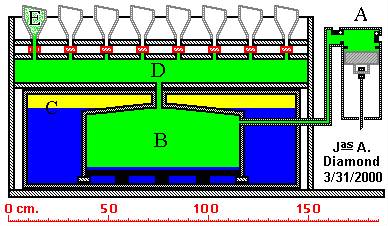
Hungarian museum houses the only surviving Roman water organ in the world


Fire Extinguishing Museum: "

South of the Aquincum Museum In Obuda while the bases of the transformer of the Electric Co. were being dug up the workers found an antique Roman cellar with caved in ceilings. They found broken bronze pipes and the components of an organ under the ruins. They also found bronze tablets which had data saying that the instrument was given as a present to Aquincum's fire-department, which was lead by Gaius Iulius Viatorinus, in 228 AD.

The organ must have fallen into the cellar in 250 AD, when the building, which eventually burned down, was under siege. Since the cellar was not cleaned out after the fire, the pieces of the organ were left there covered with debris."

In 20 AD, Vetruvius described the operation of a Roman water organ:

Compressed air (shown in green) is forced by the pump (A) into the air vessel (B). The piston (grey) is shown at the top of its stroke. The air vessel is nearly empty of water (blue) and the surrounding water chest (C) is nearly full. On the downstroke of the piston, water within the water chest flows into the air vessel from beneath, and continues to maintain air pressure within the vessel.

Water can flow into and out of the air vessel because there are spaces between the blocks upon which it sits. On the upstroke of the piston, water is forced back up into the water chest, compressing the air at the top of the water chest (yellow), as well as in the air vessel. (These reservoirs of compressed air may exist for some little time, subject to leaks and to any key being played.) When the piston reaches the top of the cylinder, the pumping cycle is repeated. Valves on the cylinder prevent the escape of air.

The pressure within the air vessel forces air into the wind chest (D), where other valves (shown in red) may be opened or closed by depressing the organ keys. - The Hydraulicus

Thursday, November 03, 2005

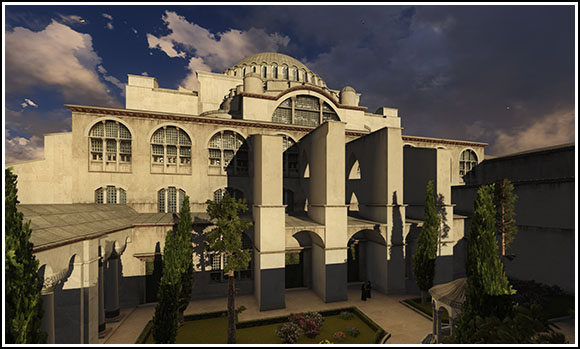
Byzantium 1200 offers new computer reconstructions of Byzantine monuments


"Byzantium 1200 is a non-funded and non-profit project aimed at creating computer reconstructions of the Byzantine Monuments located in Istanbul, TURKEY as of year 1200 AD.

New models added this month include the Hagia Sophia Atrium and an aerial view of Zeuxippos. The Seawalls model has also been updated.

If you have never visited this site before, I urge you to set aside a few hours and indulge yourself!"

Thursday, October 20, 2005

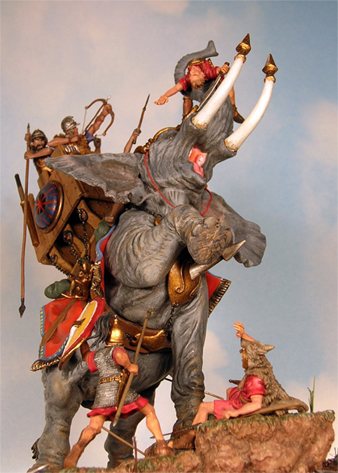
Comparing Strategies of the 2d Punic War: Rome?s Strategic Victory Over the Tactical/Operational Genius, Hannibal Barca


By LTC James Parker, U.S. Army War College

A close examination of the 2d Punic War reveals many lessons at the strategic level of war that endure to this day. Hannibal and Carthage failed when their inherent strategic weakness was confronted by the more robust and resilient Rome. Roman strategy effectively combined all elements of national power into a coherent, war winning strategy. A national strategy should be directed at the enemy?s strategic center of gravity.

In both opponents the strategic center of gravity was the political will of the respective governments, the Roman Senate and the Carthaginian oligarchy. Rome successfully attacked the Carthaginian center of gravity while the Carthaginians pursued a more peripheral strategy aimed at the allies of Rome. Carthaginian strategy focused almost solely on its military strategy, committed to war with Rome by a general unable to muster the strategic resources to win. Carthage never effectively employed its naval forces in concert with its land forces.

Hannibal?s successes point out the importance of training and experience in senior leaders. The strategic assumptions of a campaign plan must be valid for that plan to succeed. Hannibal?s campaign was based on the invalid assumption that Rome?s allies would defect following defeat of Roman armies in the field. Finally successful campaigns consist of operations linked in space and time. Rome succeeded in linking their widely separated operations in Italy, Sicily, Greece, Iberia, and eventually North Africa. This paper looks at the 2d Punic War at the strategic level and attempts to answer question of why one of the ?great captains? of military history failed so completely.

Image Note: Miniature produced by Jim Dero.

Friday, October 14, 2005

The Attack On Vetera

The Attack On Vetera: "The besieged were torn between heroism and degradation by the conflicting claims of loyalty and hunger. While they hesitated, all normal and emergency rations gave out. They had by now consumed the mules, horses and other animals which a desperate plight compels men to use as food, however unclean and revolting. Finally they were reduced to tearing up shrubs, roots and the blades of grass growing between the stones - a striking lesson in the meaning of privation and endurance.
But at long last they spoiled their splendid record by a dishonorable conclusion, sending envoys to Civilis to plead for life - not that the request was entertained until they had taken an oath of allegiance to the Gallic empire. Then Civilis, after stipulating that he should dispose of the camp as plunder, appointed overseers to see that the money, sutlers and baggage were left behind, and to marshal the departing garrison as it marched out, destitute. About 8 kilometers from Vetera, the Germans ambushed the unsuspecting column of men. The toughest fighters fell in their tracks, and many others in scattered flight, while the rest made good their retreat to the camp.
It is true that Civilis protested, and loudly blamed the Germans for what he described as a criminal breach of faith. But our sources do not make it clear whether this was mere hypocrisy or whether Civilis was really incapable of restraining his ferocious allies. After plundering the camp, they tossed firebrands into it, and all those who had survived the battle perished in the flames."

Friday, October 07, 2005

Cypriots in the Roman Army

When Cyprus was incorporated into the Imperium Romanum in 30 BC, the island became a potential recruiting-ground for the Roman army, and military service a potential career for male Cypriots. Two classes of fighting men made up the Roman army. The legions were composed of citizen soldiers and recruited among holders of the Roman franchise, while the auxilia were recruited from non-citizens but received Roman citizenship when they were discharged after twenty-five years' service. To date, no legionaries of Cypriot background have been found in the literary or epigraphical record, but an auxiliary cohort of Cypriots saw service in Romania and the Black Sea region.

After the battle of Actium and the military reforms of Augustus, auxilia came to play a significant role in the Roman army, especially in the north-west border provinces. Previously, auxiliary units had been of varying size; now they were divided into cavalry alae and infantry cohortes of c. 500 men, each cohort subdivided into 6 eighty-man centuriae. Under Augustus, auxiliaries generally served in the area where they had been recruited,[1] often as ethnic units under their own commanders. This policy was gradually abandoned[2] and completely reversed after a series of mutinies and separatist uprisings that shook the Rhine frontier in AD 68-69: cohorts were henceforth stationed outside their area of origin and vacancies filled by local recruitment. By the second century, the auxiliary units had lost much of their ethnic character, but retained their traditional appellations.[3]

Until the mid-first century AD, Roman policy in the Black Sea was based on indirect control of the shores through client-kings. In 61, Scythian forces were besieging Chersonesos (Sevastopol) in the western Crimea, but Kotys, ruler of the Bosporan Kingdom in the eastern Crimea, was unable or unwilling to come to the aid of Chersonesos, and his Roman masters had to intervene directly. An expeditionary force under the command of Ti. Plautius Silvanus, legate of Moesia, forced the Scythians to abandon the siege.[4] Subsequently, Roman control of the Bosporan Kingdom was tightened, and the kingdom of Pontos was made a Roman province. When the expeditionary force returned to its bases in Moesia, a sizeable contingent?according to Josephus, 3,000 men and 40 ships[5]?stayed behind to safeguard Roman interests. Guard duty on the frontier was a typical task for auxiliary units, and it may well be in this context that a unit of Cypriot auxiliaries was raised: Greek-speaking and familiar with the sea, Cypriots were well suited for garrison duty in the northern Black Sea ports.

A generation later, around AD 85, Moesia itself was attacked by Decebalus. Rome was forced to divert forces from the Black Sea coast to the central Balkans.[6] The participation of a Cyprian cohort in the Dacian wars has long been known from a military diploma dated February 110,[7] recording the granting of Roman citizenship and other privileges to veterans of the Dacian wars.[8] A similar diploma, dated to October 109 and found at Ranovac in north-eastern Serbia, was published in 1987.[9] Both diplomas list a number of units, veterans of which benefit from the emperor's decree, and in each list, the cohors IIII Cypria c(ivium) R(omanorum) appears

Wednesday, October 05, 2005

HBO.com to offer indepth information about the production of sets, costumes and props for popular "Rome" miniseries


I'm really enjoying HBO's miniseries "Rome" that portrays inhabitants of a realistically gritty, thriving city of the ancient world. I was excited to see this announcement that an indepth look at the production of costumes, set pieces and props was going to be provided on their accompanying website HBO.com.

"Coming soon to HBO.com, a look at the elaborate costumes, set pieces and props authentically recreated for Rome, including lushly painted murals, sumptuous gowns, beautiful crests and detailed daggers, entire streets of blown glass, even ornately displayed Roman meals of snails and feathered birds. Go behind-the-scenes for a close-up look at the rich tapestry that made up the backdrop of Rome. "