The Music Tiger:
Although Dr. Valerio Manfredi's take on Alexander did not make it in the race to produce an epic film about him, he is apparently busy collaborating with Dino De Laurentis and a couple of other historical projects:
"De Laurentis took an option on The Last Legion, Manfredi's novel which merges the last days of the Roman empire with Arthurian legend. Production should start next year, with Anthony Hopkins being talked of as a likely star. If anything, however, Manfredi is more enthusiastic about his own screenplay of another historical novelist's work, the widely acclaimed Memoirs of Hadrian, by Marguerite Yourcenar. It is going ahead, he explains, with Antonio Banderas as Hadrian and John Boorman directing.
Responding to occasional criticism from peers over his film involvement, Manfredi has observed in the past that 'a minority read books, while millions go to the cinema. You have to simplify, condense.' Mention Ernest Hemingway's famous comment about writing for the studios - 'You throw them your book, they throw you the money. Then you jump into your car and drive like hell back the way you came' - and he laughs. He would certainly have reservations about giving his work to certain directors, he says, although he regards his Memoirs of Hadrian screenplay as (relatively) safe in Boorman's hands - 'unless he has to make cuts ... But we have control of the screenplay.'"
Monday, December 27, 2004


Wednesday, December 15, 2004
Roman influence in Chersonesos
 Chersonesos
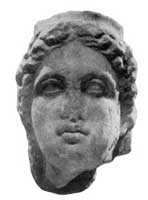
I noticed that this month's History Today featured an article about the ancient city of Chersonesos near Sebastopol in the Ukraine. It was referred to as the Ukrainian Pompeii so I was naturally interested in learning more. I found the official site of the National Preserve of Tauric Chersonesos and it included an extensive history of the city and its interaction with the Roman Empire.
"After Rome subdued the kingdom of Mithradates VI Eupator, Chersonesos found itself subordinate to Bosporos and remained so until Julius Caesar granted the city its eleutheria (freedom). A Chersonesan decree in honor of Gaius Julius Satirus, an ambassador to Julius Caesar, indicates that Chersonesos received its independence in 46-45 BC. After Caesar's death the Bosporan king Asandros attempted to subordinate Chersonesos once again, but the city successfully retained its independence. Around 25-24 BC Augustus normalized relations between the Chersonesan civil community and the Bosporan dynasts. Under the initiative of the Roman administration, Bosporos and Chersonesos created a defensive union which existed until war broke out between Rome and Bosporos. Chersonesos joined the side of Rome during the war, after which Chersonesos was granted certain privileges. The Roman administration became responsible for defending the city from the barbarian tribes. In the mid-60s AD the legate of the Roman province of Moesia, Tiberius Plautius Silvanus, aided Chersonesos in defeating the barbarians who were threatening the city. After these events the Roman authorities started to intervene in the internal politics of Chersonesos more forcefully, a circumstance which was reflected in the issue of coinage. Evidence which attests to the city's growing dependence on Rome during the Flavian dynasty includes the appearance in Chersonesos of statues of the Roman governors of Moesia, and the custom of granting the Chersonesan aristocracy Roman citizenship, a practice reserved for those regions outside the Roman empire which would soon become Roman provinces."
Friday, December 10, 2004
Australian Celtic Festival to Feature Roman War Machine
Gleninnes.yourguide: "Spectacular, colourful, new...that's what sums up the revamped Australian Celtic Festival, according to festival committee chairman Howard Eastwood.
The festival committee has big plans for the April festival, some which include explosive new attractions such as the firing of a replica Roman war machine similar to one used in the long and bloody campaigns during the Roman Empire's reign.
'The festival is now very much a national event and bridging on the international, attracting people from as far as Scotland,' festival committee chairman Howard Eastwood says. 'It's the opportunity for Australians to come together to pay homage to their Celtic heritage or simply to enjoy all things Celtic.'
There are plans to test fire the war machine at sunset on Thursday, April 28, from the Australian Standing Stones. The machine would shoot a spear with a flaming head from the Stones to the safety of open space."
The festival committee has big plans for the April festival, some which include explosive new attractions such as the firing of a replica Roman war machine similar to one used in the long and bloody campaigns during the Roman Empire's reign.
'The festival is now very much a national event and bridging on the international, attracting people from as far as Scotland,' festival committee chairman Howard Eastwood says. 'It's the opportunity for Australians to come together to pay homage to their Celtic heritage or simply to enjoy all things Celtic.'
There are plans to test fire the war machine at sunset on Thursday, April 28, from the Australian Standing Stones. The machine would shoot a spear with a flaming head from the Stones to the safety of open space."
Thursday, December 09, 2004
New BrainPOP Movies Teach Kids About Ancient Rome
'When in Rome...' New BrainPOP Movies Teach Kids About Ancient Rome: "BrainPOP (http://www.BrainPOP.com), the leading destination for educational Math, Science, and English animated content for kids, has added four new movies to its growing Social Studies library. BrainPOP's ROMAN REPUBLIC, RISE OF THE ROMAN EMPIRE, PAX ROMANA, and FALL OF THE ROMAN EMPIRE movies will give students a solid overview of the history of Ancient Rome. With Rome as their backdrop, Tim and his robot pal Moby lead kids through Rome's Republican beginnings, through the rise of Augustus Caesar and the cultural flowering of the Pax Romana, to Rome's destruction by barbarians. From rise to fall, BrainPOP's movies offer a perfect introduction to Rome for use at school or in the home. Each movie is accompanied by a 10-question interactive quiz, crossword puzzle, timeline, comic strip, and its very own fact sheet or experiment. BrainPOP's new ROME movies are part of the company's expansion of its award-winning content library to include topics in ancient and world history. BrainPOP subscribers will be able to access the new ROME movies in the Social Studies section along with recently added topics including titles like SUMERIANS, GREEK GODS, and ATHENS."
Did Roman Baths prompt the development of ancient plastic surgery?
 Ancient Roman Medicine:
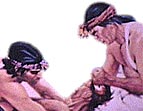
This past week I watched a special on the Discovery Channel about ancient plastic surgery. I had seen a program earlier about how surgeons in ancient India developed nose repair techniques that are still in use today. This information was included in the new program but was augmented by an interesting discussion of Roman plastic surgery. The narrator said that the most important influence on the development of plastic surgery in ancient Rome was the social emphasis on bathing in public baths. To avoid scandalous remarks, many men with battle scars on their backs, or worse, scars from flogging, sought a remedy from Roman surgeons. This was especially true of former slaves who sought to have brands or whip marks removed. I was surprised to learn that one of the most commonly requested procedures was circumcision reversal. Another procedure described was male breast reduction.
Since the Discovery Channel gets a little over zealous in its documentaries at times, I was a little dubious. But, I found this article with references that presented consistent information:
"It was war injuries, of course, that really advanced Roman surgery. If you were lucky, your military unit would have a good medicus/chirurgus who could patch you up before you bled to death, and if you were really lucky he might retire to the same colonia that you were pensioned off to. (Chirurgus was really a corruption of the Greek word for surgeon, which transliterates into English as 'cheirourgos'. The pure Latin phrase for surgeon was actually 'medicus vulnerarius', which means, literally, 'wound doctor'.) Roman military surgeons were, in fact, only rivaled by specialist arena surgeons, who repaired valuable gladiators.
Roman surgeons were also adept at several forms of minor plastic surgery. They did facial and other repairs, removed growths, etc. The most common operation appears to have been male de-circumcision. Reversal of genital mutilation, which might have been the result of religious observance or mischance, was an important procedure which one would seek in order to avoid embarrassment when appearing naked at the baths or in the gymnasia."
The program also mentioned that the Emperor Elagabalus asked a Roman surgeon to perform a sex change operation on him. However, it said there was no further evidence that such a procedure was, in fact, done. The narrator mentioned coyly that when Elagabalus was assassinated, it may have been the first assassination of of a Roman Empress!
Friday, November 19, 2004
New exhibit displays Greek and Roman statues ablaze with color
News: "An exhibition that opened this week at the Vatican Museums shows the fruit of years of research by the Vatican and two other top European museums, proving that the ancient Greeks and Romans lived not in a world of cold white marble gods and goddesses but amid a blazing riot of colours.
The statues as they have been seen for centuries are displayed alongside their replicas painted as the scholars now believe they were originally presented. The famous statue of Emperor Augustus, for example, discovered in Rome's Villa di Livia, now wears a scarlet toga, a variegated red and blue tunic, and armour decorated with multi-coloured images of gods; eyes, hair and lips are also painted.
Paolo Liverani of the Vatican Museums told Il Messaggero newspaper, 'Thanks to the most modern technologies, including ultraviolet photography, microscopic examination and clinical analysis, it has been possible to recover, in the originals of these sculptures, abundant traces of colour.'"
The statues as they have been seen for centuries are displayed alongside their replicas painted as the scholars now believe they were originally presented. The famous statue of Emperor Augustus, for example, discovered in Rome's Villa di Livia, now wears a scarlet toga, a variegated red and blue tunic, and armour decorated with multi-coloured images of gods; eyes, hair and lips are also painted.
Paolo Liverani of the Vatican Museums told Il Messaggero newspaper, 'Thanks to the most modern technologies, including ultraviolet photography, microscopic examination and clinical analysis, it has been possible to recover, in the originals of these sculptures, abundant traces of colour.'"
Thursday, November 18, 2004
PERCEPTIONS OF CLASSICAL ARMENIA: ROMANO-PARTHIAN RELATIONS, 70 BC-220 AD
 Masters Thesis by J Joseph Poirot III, Louisianna State University
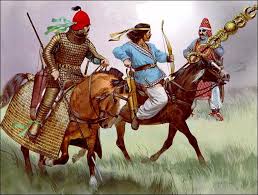
According to many modern scholars and several of the classical authors, Romans feared the looming threat of the Parthian state. Although such panic was unfounded, this fear
supposedly then prompted the Empire?s prolonged obsession with the territory of
Armenia, which both the scholarly and primary sources look upon as a military buffer
state. Yet in reality, Roman action in the East was not the result of a collective decision of all Roman citizens, but rather brought about by the individual wants and desires of Rome?s leaders. These leaders regarded Armenia not as a buffer state, but as a staging ground for their various campaigns against Parthia. It was their personal
ambitions, rather than Rome?s collective fear, that drew Armenia under the veil of
Roman hegemony. This project intends to examine Armenia?s role in the Romano-
Parthian conflict and hopes to prove that Roman imperialism was not defensive, as
some scholars assert, but rather the end product of the ambitions of individual Roman
leaders.
Thursday, November 04, 2004
Rome and the Barbarians
 I am listening to a lecture series on Rome and the Barbarians and Professor Harl has spent three lectures discussing the Roman conquest of Spain. I was not familiar with these activities and found it fascinating. Professor Harl said the Celt-Iberians were skilled warriors that were recruited by both the Romans and Carthaginians to fight in the Punic War. He pointed out, however, that after Carthage was defeated, the Celt-Iberians were not kept in the regular Roman Army for service elsewhere so they continued to raid the former Punic towns as a way of supporting themselves. He mentioned that they also suffered pressure from overpopulation in an area that could not readily support large numbers. The end result was that the Romans had to turn around and fight these former allies to protect the towns that were now under their control.
Professor Harl said these wars in the mid-2nd century B.C.E. were particularly brutal, with casualties in the 40% range, because the Celt-Iberians were not only skilled but had been trained in sophisticated Roman and Carthaginian tactics. He said eventually Rome committed over 100,000 men to the control of Spain, primarily because of its mineral wealth. He also mentioned that Spain became the target of many ambitious Roman commanders for "triumph hunting". He cited cases where subsequent governors would intentionally start wars by breaking existing treaties just to try to wangle a triumph out of the senate.
I also thought it was interesting that during the Republican period, Sertorius used mythology to help control these Spanish peoples by having a pet fawn appear at propitious times engendering the belief that he was favored by the goddess Diana.
Friday, October 08, 2004
Comic book artist recreates ancient Rome
Seattle Post-Intelligencer: "Imagine ancient Rome before its fall: The some 1,350 fountains still trickle with water, the 1,790 palaces haven't fallen to ruins and the 240 public latrines are still in business.
In painstaking detail, French comic book artist Gilles Chaillet has brought the ancient city back to life with an immense map based on a lifetime of research and a touch of artistic license.
Chaillet's immense map is colored in with cheerful greens, russets and pearly tones by his wife, Chantal. Looking at it, you can imagine a day's stroll in Rome circa 314 A.D.: a leisurely morning at the bathhouses, a stop at the market to buy some chickpeas and trip to the Circus Maximus to take in a chariot race.
He set his map in 314 A.D. because the majestic and well-preserved Arch of Constantine wasn't built until around then, and he felt most Rome-lovers couldn't imagine the city without it.
At that time, Rome had about 1 million inhabitants and was ruled by Constantine I, who legalized Christianity.
When Chaillet finally sat down to sketch the 11 foot-by-6.5 foot map, he spent 5,000 hours at the drawing board. His wife spent another 3,000 hours coloring it in.
Chaillet thinks that about 5 percent of the map's 13,000 buildings are completely accurate. About 30 percent are fairly accurate, and the rest is based on educated guesses, he said."
In painstaking detail, French comic book artist Gilles Chaillet has brought the ancient city back to life with an immense map based on a lifetime of research and a touch of artistic license.
Chaillet's immense map is colored in with cheerful greens, russets and pearly tones by his wife, Chantal. Looking at it, you can imagine a day's stroll in Rome circa 314 A.D.: a leisurely morning at the bathhouses, a stop at the market to buy some chickpeas and trip to the Circus Maximus to take in a chariot race.
He set his map in 314 A.D. because the majestic and well-preserved Arch of Constantine wasn't built until around then, and he felt most Rome-lovers couldn't imagine the city without it.
At that time, Rome had about 1 million inhabitants and was ruled by Constantine I, who legalized Christianity.
When Chaillet finally sat down to sketch the 11 foot-by-6.5 foot map, he spent 5,000 hours at the drawing board. His wife spent another 3,000 hours coloring it in.
Chaillet thinks that about 5 percent of the map's 13,000 buildings are completely accurate. About 30 percent are fairly accurate, and the rest is based on educated guesses, he said."
Tuesday, October 05, 2004
Hannibal ad portas - The Power and Wealth of Carthage
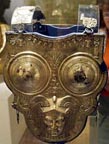 "It was said that Hannibal took an oath from his father when he was 9, that he would hate Rome for life. Also Carthage?s Queen Dido was quoted as saying: "Neither love nor treaty shall there be between the nations... Let your shores oppose their shores, your waves their waves, your arms their arms. This is my prayer let them fight, they and their sons', forever."
Following Hannibal's trail, selected items from a total of 450 exhibits can be touched and explored at a new exhibit running through January 30, 2005 at the state museum in Karlsruhe, Germany.
Tuesday, September 14, 2004
Rome vs. Carthage: The Day the World Trembled
 Rome vs. Carthage: The Day the World Trembled:
I subscribe to Military History Magazine and recommend it heartily. This article appeared in a recent issue and it is a very nice overview of the Punic Wars:
"That the two greatest powers of the Mediterranean should come into mortal conflict was inevitable. Both were vigorous, aggressive, exceptionally organized and well-led. As each expanded its boundaries, ultimately there was no way that a clash of arms could be avoided. The titanic struggle between the two superpowers of the ancient world lasted more than 60 years before one side emerged the indisputable victor.
The showdown came over fair, fertile and rich Sicily, which stood in the path of Rome's expansion toward the south and that of Carthage toward the north. In 264 bc the two mighty empires collided, and for nearly a quarter century, they tore Sicily apart in inconclusive combat. Gradually, Rome gained the upper hand, but several years before the end of the struggle a military genius arose on the Punic side: Hamilcar, surnamed Barca -- "the thunderbolt." His brilliant tactics restored the military balance, and the war slowly ground down to an exhausted stalemate.
In the end, the outcome was decided at sea. The Romans initially had been no match for the Carthaginians in naval warfare, but with typical Roman ingenuity they overcame their deficiency by the invention of the corvu (crow), a long plank with a heavy spike protruding from the end that, when dropped, effectively pinned two warships together. This transformed a sea battle into a land battle, and Roman soldiers -- in essence the world's first marines -- could rush over the plank and fight the enemy hand to hand. The First Punic War came to an end at the naval battle of Aegusa in 241 bc. The Roman navy won a decisive victory over the Carthaginians, and the remaining Punic strongholds on Sicily could now be blockaded."
Performing Cicero
 This is an interesting website where you can view three different reenactments of Cicero's famous defense of Marcus Caelius. I particularly enjoyed version 1 since the New Zealand actor seemed to resemble Cicero more and was more flamboyant. Based on reading the actual speech in the internet archives and remembering its portrayal in one of my favorite books by Steven Saylor, "The Venus Throw", I couldn't help but enjoy the New Zealand version more.
"Impersonation, known by the general terms fictio personae in Latin and prosopopoeia in Greek, was a way to vary and animate a speech by summoning a figure to speak the orator's sentiments in his (or her or its) own voice (cf. Quint. Inst. 9.2.29-35). The device brought the orator's style of performance ever closer to the actor's and encouraged a certain grandeur of manner and style. Among the most famous prosopopoeiae in Roman oratory is a passage from Cicero's speech in defense of Marcus Caelius where the advocate, having already cast Caelius' jilted lover Clodia as the evil genius behind the prosecution, summons her distinguished ancestor Appius Claudius Caecus to shame and scold her for her conduct."
Servius Sulpicius Topic of Roman Law Lecture
 In a recent lecture, Cornell University Professor Okko Behrends "explored Servius Sulpicius's powerful influence on Roman law, and discussed the overshadowing of the great orator by his better-known counterpart Cicero. Behrends outlined the two law schools of their era: the humanistic law of Servius and the pre-classical natural law, illuminating how Servius's ideas represented a major break from the latter's imposing influence on legal thought.
Servius, Behrends said, believed that law was manmade. He understood that 'the rules are laid down by human understanding ... not part of natural reason which only needs detection.' Behrends likened this debate to the phenomenon of language: is language given to mankind, or does man create it himself?
'He no longer accepted floating legal principles; law, Servius believed, should be definite. Law is realized in civil equity or distinct moral qualities inherent in man's consciousness,' Behrends said."
Thursday, August 19, 2004
Ancient India and Rome new exhibition in New Delhi
The Hindu : Treading the old Roman trade route: "The Italian Cultural Centre in New Delhi is celebrating an ancient connection with India by putting together an exhibition with some history behind it.
Bringing to light the intense trade relations between the Roman Empire and India, the exhibition titled 'Ancient India and Rome' hopes to give viewers a chance to catch a glimpse of the past. And for those who could see a `desi' link in the 'Gladiator'', this exhibition provides proof of the Indian connection.
The exhibition aims to throw light on the importance of such exchanges that developed in a particular way during the Roman era when the Pax Augusta enabled the broadening of the markets because of the ever insatiable appetite of the rich Roman middle-classes for spices and luxury products.
The exhibition highlights the "treasures" of the time -- "Amphorae", vases, commonly used bronze objects, Mediterranean terracotta statuettes and Roman coins found in abundance in India.
With their influence extending beyond just commerce, the Romans found a mention in Indian literary texts. While texts speak about the colonies of "Yavanas'' (Westerners) along the coast, archaeological discoveries and literary references substantiate the claims."
Bringing to light the intense trade relations between the Roman Empire and India, the exhibition titled 'Ancient India and Rome' hopes to give viewers a chance to catch a glimpse of the past. And for those who could see a `desi' link in the 'Gladiator'', this exhibition provides proof of the Indian connection.
The exhibition aims to throw light on the importance of such exchanges that developed in a particular way during the Roman era when the Pax Augusta enabled the broadening of the markets because of the ever insatiable appetite of the rich Roman middle-classes for spices and luxury products.
The exhibition highlights the "treasures" of the time -- "Amphorae", vases, commonly used bronze objects, Mediterranean terracotta statuettes and Roman coins found in abundance in India.
With their influence extending beyond just commerce, the Romans found a mention in Indian literary texts. While texts speak about the colonies of "Yavanas'' (Westerners) along the coast, archaeological discoveries and literary references substantiate the claims."
Tuesday, August 17, 2004
Croatian memorial stone source of latest Arthur incarnation
 "CROATIA is a strange place to discover a clue linking King Arthur with Cumbria. But John Matthews, who was a historical advisor on the newly released Hollywood film King Arthur, says the memorial stone of an Anglo-Roman commander found in a Croatian village adds weight to the theory that places the legend against the backdrop of Hadrian's Wall.
Mr Matthews, a leading expert on the legend, from Oxfordshire, says: The historical theory is that a Romano-British leader, Lucius Artorius Castus, was stationed at Hadrian's Wall, probably at Birdoswald.
We know he was the commander of a legion of Sarmatian warriors, who came from between the Black Sea and the Caspian Sea in the second century AD towards the end of Roman rule in Britain. A Roman habit of including a potted biography on a memorial tells historians where Lucius Artorius Castus was stationed and that he was commanding some of the 5,500 Sarmatians, skilled cavalrymen, brought to Britain to fight.
Archeological finds show Sarmatians stayed in Britain long after the Romans left, remaining in a tight knit ethnic group and, like Arthur, their battle insignia was a dragon.
Also, as in the Excalibur myth, they worshipped an image of a sword stuck in the ground as the symbol of their god of war."
Actors take a hike for new play about Hadrian's Wall
: "Actors rehearsing a new play about Hadrian's Wall are learning their lines, blocking their moves, doing route marches and soaking their feet in surgical spirit in preparation for its world premiere in a Cumbrian village hall on Thursday.
The day after each show in communities along the wall, the six actors plus the playwright will don boots and waterproofs and give another kind of blistering performance, striding 10 miles to the next venue.
They will step out along 84 miles of the Hadrian's Wall path, a national trail opened last year."
The day after each show in communities along the wall, the six actors plus the playwright will don boots and waterproofs and give another kind of blistering performance, striding 10 miles to the next venue.
They will step out along 84 miles of the Hadrian's Wall path, a national trail opened last year."
Wednesday, August 11, 2004
Leo III's Ecloga Revises legal penaties in the late Roman Empire
LATER ROMAN EMPIRE: "In a synod held at Constantinople in the reign of Justinian II. numerous rules were enacted, differing from the existing laws and based on ecclesiastical doctrine and Mosaic principles, and these were sanctioned as laws of the realm by the emperor. Thus Church influence and the decline of Roman tradition, in a state which had become predominantly Greek, determined the character of the ensuing legislative epoch under the auspices of Leo III., whose law book (A.D. 740), written in Greek, marks a new era and reflects the changed ideas of the community. Entitled a Brief Selection of Laws and generally known as the Ecloga, it may be described as a Christian law book. In regard to the patria potestas increased facilities are given for emancipation from paternal control when the son comes to years of discretion, and the paternal is to a certain extent replaced by a pareiital control over minors. The, law of guardianship is considerably modified. The laws of marriage are transformed under the influence of the Christian conception of matrimony; the institution of concubinatus is abolished. Impediments to marriage on account of consanguinity and of spiritual relationship are multiplied. While Justinian regarded marriage as a contract, and therefore, like any other contract, dissoluble at the pleasure of the parties, Leo III. accepted the Church view that it was an indissoluble bond. Ecclesiastical influence is written large in the criminal law, of which a prominent feature is the substitution of mutilation of various kinds for the capital penalty. Death is retained for some crimes, such as murder and high treason; other offences were punished by amputation (of hand, nose, &c.). This system (justified by the passage in the New Testament, If thine eye offend thee, &c.), though to modern notions barbaric, seemed a step in the direction of leniency; and it may be observed that the tendency to avoid capital punishment increased, and we are told that in the reign of John Comnenus it was never inflicted. (The same spirit, it may be noted, is apparent in the usual, though by no means invariable, practice of Byzantine emperors to render dethroned rivals or members of a deposed dynasty innocuous by depriving them of eyesight or forcing them to take monastic orders, instead of putting them to death.) The Church, which had its own system of penalties, exercised a great influence on the actual operation of criminal law, especially through the privilege of asylum (recognized by justinian, but with many reserves and restrictions), which was granted to Christian churches and is admitted without exceptions in the Ecloga."
I wonder what reservations and restrictions Justinian had legislated?
I wonder what reservations and restrictions Justinian had legislated?
Romans and Taxes
Warsaw Business Journal Online - business in poland,warsaw,polish companies,companies database: "The first recorded evidence of tax dates back to 2350 B.C. Tomb paintings in Egypt depict relentless tax collectors selling delinquents into slavery for failure to pay tax on fish catches and garden produce. The Greeks fought a bloody war against Persia to resist a tribute tax, but then had to impose one to pay for the war.
Ancient Rome had an elaborate tax system which encompassed sales taxes, inheritance taxes and taxes on imports and exports. In the 4th century BC, the Romans built a tax-free shipping port at Delos, which some refer to as history's first tax haven. It was also the Romans who first invented inheritance tax, imposed upon all citizens at the rate of 10 percent, and who introduced imprisonment for tax evasion. "
The last statement surprised me because I was under the impression the Romans had no prison system, at least not in Rome itself.
Ancient Rome had an elaborate tax system which encompassed sales taxes, inheritance taxes and taxes on imports and exports. In the 4th century BC, the Romans built a tax-free shipping port at Delos, which some refer to as history's first tax haven. It was also the Romans who first invented inheritance tax, imposed upon all citizens at the rate of 10 percent, and who introduced imprisonment for tax evasion. "
The last statement surprised me because I was under the impression the Romans had no prison system, at least not in Rome itself.
Wednesday, July 28, 2004
Healthcare in the Roman Empire
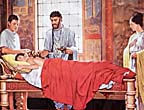 I was rewatching a fascinating program on Galen the other night on the History Channel that included a model of a Roman hospital or Valetudinarium. It used the inner courtyard flooded with sunlight for the operating theater. It had consulting rooms, a kitchen for food preparation, an area where instruments were sterilized in forge-like structures all surprisingly similar to a modern health care facility.
I found a detailed description of the valetudinarium at the archaeological site of Novae.
In addition I found a site about Byzantine medicine.
I also found this interesting quiz about Roman health care:
http://www.educationforum.co.uk/rome.htm
Monday, July 26, 2004
Hellenic Influence On Modern Law Codes
Hellenic Influence On Modern Law Codes"Many contemporary legal scholars claim that the American legal system has its roots in Rome, and more specifically, the legal codes of Gaius and Justinian. Others trumpet the English system of common law, and contend that it is the rightful forefather of our current legal system. These views are not completely merit-less of course. But to the extent that they seek to disclaim the role played by ancient Greece in creating today's modern legal institutions, they do a grave injustice to our collective understanding of law and its origins."
"Our comparison begins with an examination of the overall structure of the two legal systems. Using 4th century BC Athens as a point of reference, one sees that the ancient Greeks devised their court system to handle two basic types of cases: the private case (dike), and the public case (graphe). The dike was used to resolve private, individual disputes between litigants (e.g., failure to pay for goods received), while the graphe was used to resolve disputes that impacted the community as a whole (e.g., treason). Most courts in the United States possess a similar structure: a private citizen claiming some type of personal harm can bring an action as a plaintiff in a "civil suit," while government prosecutors, acting on behalf of the entire community, can bring criminal suits against individuals not for compensation, but to effect community-based penological goals such as retribution and deterrence."
"In ancient Greece, both dikai and graphai were initiated by filing a written complaint and "summoning" the defendant to the magistrate."
"Moreover, both cultures implemented a jury system to make determinations of guilt and innocence...although juries in ancient Greece were generally larger than the ones we empanel today - for instance, a jury in Athens could consist of several hundred, and in certain rare instances, several thousand members - the critical point is that, in both societies, the most consequential decisions were left to a jury of the accused's peers."
"One commonly voiced criticism of the ancient Greek legal system is that, unlike the legal systems of ancient Rome and modern America, it operated without the benefit of lawyers. This criticism is misplaced, however, because ample guidance was available to ancient Greek litigants in the form of the logographos. The logographos was, in essence, a speechwriter who usually had considerable experience either litigating or observing trials. As such, skilled logographoi such as Demosthenes and Isocrates were in high demand, just as skilled American lawyers like Plato Cacheris are here today."
"Other similarities abound between the two legal cultures. For instance, a concern about frivolous lawsuits, and a procedural device to discourage them, is a hallmark of both ancient Greece and modern America. Procedures for alternative dispute resolution" are another characteristic of both legal regimes. Statutes of limitation, which serve to define the time frame within which a claim must be commenced, are an integral part of American legal system, and there is widespread scholarly agreement that these laws find their origins in the real property laws of ancient Greece.
"Our comparison begins with an examination of the overall structure of the two legal systems. Using 4th century BC Athens as a point of reference, one sees that the ancient Greeks devised their court system to handle two basic types of cases: the private case (dike), and the public case (graphe). The dike was used to resolve private, individual disputes between litigants (e.g., failure to pay for goods received), while the graphe was used to resolve disputes that impacted the community as a whole (e.g., treason). Most courts in the United States possess a similar structure: a private citizen claiming some type of personal harm can bring an action as a plaintiff in a "civil suit," while government prosecutors, acting on behalf of the entire community, can bring criminal suits against individuals not for compensation, but to effect community-based penological goals such as retribution and deterrence."
"In ancient Greece, both dikai and graphai were initiated by filing a written complaint and "summoning" the defendant to the magistrate."
"Moreover, both cultures implemented a jury system to make determinations of guilt and innocence...although juries in ancient Greece were generally larger than the ones we empanel today - for instance, a jury in Athens could consist of several hundred, and in certain rare instances, several thousand members - the critical point is that, in both societies, the most consequential decisions were left to a jury of the accused's peers."
"One commonly voiced criticism of the ancient Greek legal system is that, unlike the legal systems of ancient Rome and modern America, it operated without the benefit of lawyers. This criticism is misplaced, however, because ample guidance was available to ancient Greek litigants in the form of the logographos. The logographos was, in essence, a speechwriter who usually had considerable experience either litigating or observing trials. As such, skilled logographoi such as Demosthenes and Isocrates were in high demand, just as skilled American lawyers like Plato Cacheris are here today."
"Other similarities abound between the two legal cultures. For instance, a concern about frivolous lawsuits, and a procedural device to discourage them, is a hallmark of both ancient Greece and modern America. Procedures for alternative dispute resolution" are another characteristic of both legal regimes. Statutes of limitation, which serve to define the time frame within which a claim must be commenced, are an integral part of American legal system, and there is widespread scholarly agreement that these laws find their origins in the real property laws of ancient Greece.
Subscribe to:
Posts (Atom)