Wednesday, July 28, 2004

Healthcare in the Roman Empire

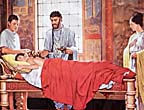
I was rewatching a fascinating program on Galen the other night on the History Channel that included a model of a Roman hospital or Valetudinarium. It used the inner courtyard flooded with sunlight for the operating theater. It had consulting rooms, a kitchen for food preparation, an area where instruments were sterilized in forge-like structures all surprisingly similar to a modern health care facility.

I found a detailed description of the valetudinarium at the archaeological site of Novae.

In addition I found a site about Byzantine medicine.


I also found this interesting quiz about Roman health care:

http://www.educationforum.co.uk/rome.htm

Monday, July 26, 2004

Hellenic Influence On Modern Law Codes

Hellenic Influence On Modern Law Codes"Many contemporary legal scholars claim that the American legal system has its roots in Rome, and more specifically, the legal codes of Gaius and Justinian. Others trumpet the English system of common law, and contend that it is the rightful forefather of our current legal system. These views are not completely merit-less of course. But to the extent that they seek to disclaim the role played by ancient Greece in creating today's modern legal institutions, they do a grave injustice to our collective understanding of law and its origins."

"Our comparison begins with an examination of the overall structure of the two legal systems. Using 4th century BC Athens as a point of reference, one sees that the ancient Greeks devised their court system to handle two basic types of cases: the private case (dike), and the public case (graphe). The dike was used to resolve private, individual disputes between litigants (e.g., failure to pay for goods received), while the graphe was used to resolve disputes that impacted the community as a whole (e.g., treason). Most courts in the United States possess a similar structure: a private citizen claiming some type of personal harm can bring an action as a plaintiff in a "civil suit," while government prosecutors, acting on behalf of the entire community, can bring criminal suits against individuals not for compensation, but to effect community-based penological goals such as retribution and deterrence."

"In ancient Greece, both dikai and graphai were initiated by filing a written complaint and "summoning" the defendant to the magistrate."

"Moreover, both cultures implemented a jury system to make determinations of guilt and innocence...although juries in ancient Greece were generally larger than the ones we empanel today - for instance, a jury in Athens could consist of several hundred, and in certain rare instances, several thousand members - the critical point is that, in both societies, the most consequential decisions were left to a jury of the accused's peers."

"One commonly voiced criticism of the ancient Greek legal system is that, unlike the legal systems of ancient Rome and modern America, it operated without the benefit of lawyers. This criticism is misplaced, however, because ample guidance was available to ancient Greek litigants in the form of the logographos. The logographos was, in essence, a speechwriter who usually had considerable experience either litigating or observing trials. As such, skilled logographoi such as Demosthenes and Isocrates were in high demand, just as skilled American lawyers like Plato Cacheris are here today."

"Other similarities abound between the two legal cultures. For instance, a concern about frivolous lawsuits, and a procedural device to discourage them, is a hallmark of both ancient Greece and modern America. Procedures for alternative dispute resolution" are another characteristic of both legal regimes. Statutes of limitation, which serve to define the time frame within which a claim must be commenced, are an integral part of American legal system, and there is widespread scholarly agreement that these laws find their origins in the real property laws of ancient Greece.

The Iron Lady Returns

The Iron Lady Is ReturningThe Iron Lady Is Returning SUPERWOMAN with a chariot, Essex girl with attitude, Celtic madonna with a spear, Maggie Thatcher with dreads, Braveheart with a bra: these are just some of the images that have been dug up to explain why Hollywood has suddenly gone ape about Boudicca or Boadicea...Add the fact that her rebellion was partly her response to the rape of her daughters by Romans or the theory that she was a "proto-feminist lesbian sexpot" and Boudicca is a writer's dream.

As long ago as 1984, in her book Another Mother Tongue, the poet Judy Grahn made the astounding claim that "bulldyke" is a corruption of the war queen's name and that it would have been "unnatural" if she had not been a lesbian. Theories like that have been given oxygen because so little is known about Boudicca's life and it helps that the facts have been lovingly intertwined with legends."

It always irritates me that strong women with leadership capabilities are frequently portrayed as non-traditional in some way. Why does a society dominated by men feel threatened enough by talented women that they must always be treated as an anomaly?

This article goes on to say:

"Four films are in the offing, one of which is being produced by Mel Gibson, fresh from his bloody recreation of the torment and execution of Jesus Christ.

In addition to Gibson's movie Warrior, Dreamworks is making Queen Fury, Paramount's effort is Warrior Queen, not to be confused with last year's ITV production starring Alex Kingston and another project is called My Country.

Boudicca was a real person who waged a real guerrilla war, but she has also been transformed utterly by the legend of the inspirational warrior queen. The trick will be to portray her as a field commander capable of duffing up the Romans and blessed with enough sex appeal to get the men behind her. Think Nicole Kidman with spears."

Nicole Kidman??? Give me a break. They tried to make her out to be a nuclear scientist in "The Peacemakers" and she couldn't lend enough weight to that role either. Also, despite the studio hype, I simply do not find her to be that talented. Now, take Renee Zellweger and you have a whole new ball game. She could definitely give the role all the punch and emotional tension it would require. Olivia Williams would be another good possibility. Her scenes in "The Postman" where she is shooting at General Bethlehem certainly convinced me she meant business! I also thought Sophie Marceau portrayed a strong female character in "Braveheart" as did Connie Nielsen in "Gladiator". Any of these women would make a far better choice than Kidman.

Thursday, July 22, 2004

Dogs in Ancient Greece and Rome

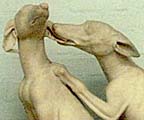
This is a very interesting article about the different types of dogs used in ancient Greece and Rome. It even mentions that hounds were imported from Britain before the conquest: "Hounds from Celtic Britain were famous, as well, and exported to Rome even before the conquest. (Writing at the beginning of the first century BC, the Greek geographer Strabo mentions dogs 'that are by nature suited to the purposes of the chase.') 'It is not only Spartan whelps or only Molossian which you must rear,' says the poet Nemesianus in Cynegetica (c.AD 283), 'sundered Britain sends us a swift sort, adapted to hunting-tasks in our world.' Claudian also speaks of 'slender Spartans, and Britons that can break the backs of mighty bulls.' Such animals, which may have been Irish wolf hounds, can be seen chasing rabbits on the Celtic Castor ware beakers of Britain from the second century AD."

Monday, July 19, 2004

Secrets of Ancient Battle Strategies Come to Life in DECISIVE BATTLES

Secrets of Ancient Battle Strategies Come to Life in DECISIVE BATTLES: "It's hard to imagine that the tranquil fields of present day Italy, Greece and other Mediterranean lands were once the site of some of the most historic battles of ancient times. But now, The History Channel goes on location to the actual battlefields and integrates cutting-edge videogame technology to bring history and imagination together in the new series DECISIVE BATTLES.

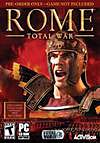
DECISIVE BATTLES is unlike any series The History Channel has ever aired. Employing the same advanced computer gaming technology as in the highly- anticipated new video game Rome: Total War(TM), the series gives viewers an unprecedented perspective of ancient battles by re-creating troops in their vast numbers and landscapes on a scale otherwise impossible."

The series will recreate Cannae, Gaugamela, Thermopylae, Marathon, the Spartacan Revolt, Chalons, Carrhae, Adrianople, Pharsalus, Cynoscephalae, Watling Street (Boudicca), Teutoburg Forest, and Kadesh.

Friday, July 16, 2004

Fossilized plague-ridden Egyptian insects challenge plague origin theories

Fossilized plague in Egypt"In almost all cases, plague epidemics strike areas with poor and cramped living conditions, much like the "Workmen's Village" section of Amarna where Eva Panagiotakopulu, a paleoentomologist at Sheffield University in England, carried out her research on fossilized insect remains. Amarna, the site of excavations by Barry Kemp (a renowned Egyptologist from the University of Cambridge), is a good place to study ancient life in Egypt, Panagiotakopulu says, because the site is well-preserved in the dry desert sands. Archaeologists have flocked to the site for more than 100 years to learn why the city was capital for only 20 years (around 1350 to 1330 B.C.) and then abandoned. However, Panagiotakopulu is the first to look at fossilized insect remains in the ancient city.

The Workmen's Village was the section near the ancient capital reserved for the artisans who toiled on the nearby stone tombs for the pharaohs Akhenaten and Tutankhamun. There, Panagiotakopulu found a very high frequency of fossilized human fleas, bedbugs and other insects and parasites that "present a picture of squalid living conditions" in and around the workers' houses, she says.

Because pandemic plague throughout history often first showed itself by a large number of black rat deaths, scientists have long thought that plague originated in India and Central Asia, where black rats were endemic. They thought the plague then spread throughout the Mediterranean and Europe by fleas on black rats that entered the Mediterranean region via shipboard trading. But the identification of fossilized plague bacteria in the fossilized fleas in Egypt led Panagiotakopulu to hypothesize that plague instead originated in Africa, in fleas that fed on the endemic Nile rat. The plague only grew to epidemic proportions when the Asian black rats - new hosts - were introduced to Egypt, Panagiotakopulu wrote in the February Journal of Biogeography.

Thursday, July 15, 2004

Lays of Ancient Rome

By THOMAS B. MACAULAY

Lays of Ancient Rome: "There can be little doubt that among those parts of early Roman history which had a poetical origin was the legend of Horatius Codes. We have several versions of the story, and these versions differ from each other in points of no small importance. Polybius, there is reason to believe, heard the tale recited over the remains of some consul or praetor descended from the old Horatian patricians; for he introduces it as a specimen of the narratives with which the Romans were in the habit of embellishing their funeral oratory. It is remarkable that, according to him, Horatius defended the bridge alone, and perished in the waters. According to the chronicles which Livy and Dionysus followed, Horatius had two companions, swam safe to shore, and was loaded with honors and rewards.

It is by no means unlikely that there were two old Roman lays about the defense of the bridge; and that, while the story which Livy has transmitted to us was preferred by the multitude, the other, which ascribed the whole glory to Horatius alone, may have been the favorite with the Horatian house."

Tuesday, July 13, 2004

Jerash to Host Roman Army and Chariot Experience

The Roman Army and Chariot Experience"Are you ready for war?" cries a Centurion and Roman legionaries’ roar of "Ready, ready, ready" echoes around the restored hippodrome in Jerash, Jordan.

"Unseen until now, an enemy force appears without warning to your left, on the South Tower. The Romans bring their artillery, renowned for its accuracy and power, into action, delivering missiles at targets at the north end of the hippodrome and then engage the enemy with siege tower and battering ram.

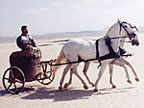
After a vigorous battle the South Tower is captured and the victorious commander rides through the serried ranks of his troops in a triumphal chariot drawn by four horses, accompanied, as was the custom, by a slave who reminds him of his mortality
with the words, "Memento mori."

As the legionaries withdraw, racing chariots appear in a whirl of dust, one for each of the fiercely supported factions, the Reds, Blues, Greens and Whites. Having paraded before you, they take up their position in the carceres. The starter is announced by a fanfare of trumpets and as he drops a white scarf, they burst forward into the first of seven laps, jostling for position at the turn. Choose your favourite colour and give them the most vocal support - you might even be able to hear a faint echo coming down the years!"

This thrilling historical recreation will be presented for visitors to Jordan's ancient city of Jerash beginning in the Spring of 2005.

Friday, July 09, 2004

Ceramics from Roman Africa Exhibited

: "THE KNIGHTS OF COLUMBUS MUSEUM in Thomaston, Connecticut is presenting a new exhibition featuring 105 pieces of African Red Slip Ware ceramics from the Third through the Sixth Centuries. The items are on loan from the Harvard University Art Museums and private collectors. These red clay ceramics--bowls, plates, jugs and lamps--were produced in provinces located in what is now modern Tunisia in North Africa and exported throughout the Roman Empire."

See also: "Light from the Age of Augustine"

Restoration Advances Salvage Marcus Aurelius Statue

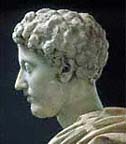
Statue of an Emperor (Getty Exhibitions): "Composed of approximately 40 fragments of four different types of marble, some original, others carved during different restoration campaigns of the 18th and 19th centuries, the statue of Marcus Aurelius belonging to the Pergamon Museum in Berlin was in danger of collapsing because the joints between the fragments had loosened over time. Getty Museum conservators took the statue completely apart and reassembled it.

The work is explored in video segments showing this process as it took place in the conservation laboratories of the Getty Museum. The exhibition, available until September 12, highlights changes in restoration and conservation practices that have occurred between the 18th and 21st centuries."

Getty Museum Examines Byzantine Empire

Art Museum Network News: "The widespread influence of the Byzantine Empire on neighboring countries and the enduring legacy of its art are explored in the new Getty exhibition 'Byzantium and the West,' at the Getty Center, September 14 - December 5, 2004. The exhibition features manuscripts that showcase the distinctive brilliance of Byzantine art and highlight the manner in which different cultures reacted to the artistic heritage of the Empire over time.

Drawn primarily from the Getty's rich collection, the works on view include bound manuscripts, leaves, and a painting, all dating from the 11th through 17th centuries. Among these are several loans from other West Coast collections. The exhibition explores the striking naturalism and courtly splendor that distinguishes Byzantine art, and examines the diverse ways in which the highly admired style was emulated by three of Byzantium's closest neighbors: Germany, Italy, and Armenia. "

Thursday, July 08, 2004

A Gritty Roman Arthur More Realistic

Well, I took off work early yesterday so I could see Bruckheimer's new King Arthur on opening day. I liked this new darker version of Arthur and his knights although I felt the film suffered from some bad film editing trying to fit it into a shorter time slot than it deserved. I think there should have been a more in-depth introduction of characters and examples of experiences that resulted in their bonding as a combat unit and brotherhood that occurred over time as they served together. The film opens with Lancelot being "drafted" and taken from his Sarmatian family as a youth. Then the film jumps ahead 15 years and Arthur and his battle-hardened cavalry are seen riding to the rescue of a bishop traveling to a fort along Hadrian's wall. There is an obvious bond between the men but the viewer is not given any background for this close bond or the legendary exploits that others in the film refer to.

In Gladiator, Ridley Scott illustrates the relationship between Maximus and his men in the opening sequence. You can almost read Maximus' thoughts as he fingers the wheat, smiles at the bird, then his face hardens as he thinks about the battle to come. He passes down the line of his troops, sharing quips, patting armor, obviously respected by his troops as a leader who has shared their lot. He and Quintus discuss the placement of the catapults, clearly establishing Quintus as the second in command and, when Quintus expresses concern about Maximus' safety, demonstrating he is obviously bonded to Maximus as well.

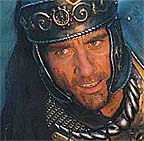
Arthur's director, Antoine Fuqua, leaves the audience guessing about the knights and their relationships to themselves and Arthur. A special relationship between Lancelot and Arthur is slightly inferred but not demonstrated well enough to bring the appropriate level of pathos to the final scenes. Several times throughout the film, Fuqua seems to almost pause the action for a "Kodak" moment. The pauses are so noticeable that I felt they interrupted the flow of the narrative although I must admit I didn't mind at all having a long look at Clive Owen in his Roman attire.

I also thought the sequence where Arthur discovers a Roman noble's bodyguards bricking up a dungeon where Guinevere is being starved to death by monks for her pagan ways while everyone else is fleeing to escape the Saxons (whose drums are heard loudly in the background) a bit contrived. I think it would have been more natural for Arthur and Guinevere to have come into conflict on opposing sides, with Arthur a witness to her warrior skills, then have Arthur get to know her on a personal level when the two sides join to fight the Saxons. As it is, Guinevere is near death when Arthur rescues her. She recovers rather quickly, then is hardly challenged when she announces she is staying with the knights in their delaying action on the frozen lake. Again, I felt there was some insightful film footage that ended up on the cutting room floor. Even so, Guinevere is in a feminine flowing gown during that battle. Later when the Saxons attack the fort, a Guinevere covered with tattoos and sporting a skimpy leather bikini charges into battle and the knights hardly notice the difference.

Of course, I was also a little taken aback that Stellan Skarsgard, my sweet Theseus from the Helen of Troy miniseries, could be such a hardened, merciless warrior.

Overall, however, I liked this version of the Arthur legend better than the fairy tale world of Sir Thomas Mallory. The characters were much more human and believable in their vices and disillusionment that surely were experienced by many Britons during this period of cataclysmic upheaval.

Thursday, July 01, 2004

Boadicea to be featured in four Hollywood Films

Return of the queen: "Hollywood has four films in development about the British warrior queen. One of them, Warrior, is being produced by Mel Gibson, partly with money from the proceeds of his film The Passion of The Christ (a rare example of fundamentalist Christian money backing a project with a pagan heroine). Along with a DreamWorks project called Queen Fury, Paramount's Warrior Queen and another called My Country, the race is on to get what Variety magazine called 'Braveheart with a bra' to the screen first."

This author seems to think Mel Gibson's version will probably be the most lavish. However, I was concerned that his director's understanding of the Iceni's uprising is a bit spotty. This was also noted by the author:

"Gavin O'Connor, the director enlisted by Mel Gibson to make his Boadicea picture, told Variety last month that he expected his film to buck the trend for female-led epics faring badly at the box office. "What drew me," he said, "is that she was driven by personal revenge. Her goals were never political and never went beyond avenging her slain husband and child. She managed to bring together all of these warring tribes to stand against the Roman empire. It is a masculine story with a female point of view."

It is worth pointing out that Boudicca's husband was not slain by the Romans, nor was her "child". "In fact," says Fraser, "her daughters were raped by the Romans and she was flogged."

Maybe, at least, the costuming will be more authentic, not like the cheap Halloween costumes of PBS' Warrior Queen.

A Brief History of Writing Instuments

A Brief History of Writing Instuments - Ink and Letters: "The Romans created a reed-pen perfect for parchment and ink, from the hollow tubular-stems of marsh grasses, especially from the jointed bamboo plant. They converted bamboo stems into a primitive form of fountain pen. They cut one end into the form of a pen nib or point. A writing fluid or ink filled the stem, squeezing the reed forced fluid to the nib.

By 400 A.D. a stable form of ink developed, a composite of iron-salts, nutgalls and gum, the basic formula, which was to remain in use for centuries. Its color when first applied to paper was a bluish-black, rapidly turning into a darker black and then over the years fading to the familiar dull brown color commonly seen in old documents."

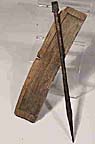
I was also surprised to learn that the iron stylus Romans used with wax tablets was called a graphium.

“The stylus was also termed graphium (Ovid. Amor. i.11.23; Suet. Jul. 82), and the case in which it was kept graphiarium (Martial, xiv.21) or graphiaria theca (Suet. Claud. 35).

http://www.ukans.edu/history/index/europe/ancient_rome/E/Roman/Texts/secondary/SMIGRA*/Stilus.html

I wonder if this influenced our name for pencil lead – graphite?

Thursday, June 24, 2004

King Arthur -- Artorius or Ambrosius

The new “King Arthur” movie coming out on July 7 looks more and more exciting – if somewhat creative with historical accuracy. I watched the History Channel’s presentation “The Quest for King Arthur” last week and it does sort of raise some questions. The movie site refers to Artorius but according to the History Channel presentation, Artorius’ men manned Hadrian’s Wall in the second century C.E. not the fifth century C.E. The program pointed to another “last of the Romans”, Ambrosius Aurelianus consistent with this excellent article by Sheila Brynjulfson on the Vortigen Studies website.

"... civil strife erupted as competition for power among rival warlords began:

Kings were anointed not by God, but who should stand out more cruel than the rest, and after a little were murdered by the anointers . .

One, in later accounts called Vortigern, emerged supreme.

Britain's "old enemies," the Picts and the Scots, who had been checked for a time, suddenly launched another fierce attack. Then came the plague. The manpower shortage which gave priority to fighting the Picts left the dead unburied. The invasion threatened to overwhelm them; Vortigern was forced to hire assistance. Gildas told how "the proud tyrant" enlisted the Saxon mercenary forces of two Saxon brothers against the northern raiders:

A council was convened, to decide upon the best and soundest means of withstanding the frequent brutal invasions and raids of the aforesaid peoples. All the members of the council, and the proud tyrant, were struck blind . . .. To hold back the northern peoples, they introduced into the island the vile unspeakable Saxons, hated of God and man alike.

In return for their services, Vortigern gave the Saxons the island of Thanet and goods to support their settlements. Later, reinforcements were imported. The alliance held until the Saxons increased their demand for supplies. When Vortigern would not pay, the Saxons mutinied. They stormed the island, burning towns and cities. Many Britons died; others fled across the Channel to Brittany or were enslaved. Another group retreated to the mountains and dense forests; among these survivors was Ambrosius Aurelianus.

A descendant of a Roman family, Ambrosius organized a coalition of former supporters of the Empire to resist the Saxons."

Maybe the filmmakers wanted the audience to have a hero with a name more similar to Arthur so they chose to use the name of the earlier commander rather than the later one.

See also: King Arthur the Movie

The Quest for King Arthur

Men and Gods in the Rome of the Caesars

"Glory belongs to Greece, while mightiness belongs to Rome -- the ancient saying reflects the overwhelming position of power that ancient Rome once held in the Western world.

Now, that ancient period comes alive again in Men and Gods in the Rome of the Caesars, an exhibition featuring close to 390 cultural relics, ranging from sculptures, goldware to coins, all on loan from six major museums and archeological institutes in Tuscany, Italy.

"The exhibit is one of the museum's biggest shows this year,'' says museum director Chen Xiejun. "Looking at the masterpieces created by the ancient Romans, you can almost hear the noises from the battlefields, the hurly-burly from the markets, whispers from rural households and ritual music from the royal palace.''

Stepping into the exhibition hall, visitors will immediately be drawn by a series of large marble statues. Young or old, man or woman, citizen or noble, all the statues were carved with an extraordinary expertise, creating vivid representations. Portraits were the most unique feature of Roman fine arts, and were used to celebrate the eminent figures of Roman society or as funerary memorials."

The exhibit will move on to the Seoul Museum of History in September.

See: http://www.korea.net/kwnews/news.asp?Number=20040601030

Friday, June 18, 2004

Transmitting our historical legacy

Shakespeare's play "Julius Caesar" is presently being performed in Kansas City and their theater critic, Robert Trussell, made some interesting observations about the importance of Shakespeare’s play in transmitting knowledge of the Roman Empire to successive generations:

"Funny thing about Americans. We may not know jack about history, but we've all heard of Julius Caesar.

He has impressed himself on us in movies, plays, comic books, children's literature and endless number of biographies. Photographs of his marble bust have been published around the world.

He has been played by famous actors on stage, in movies and on television. The self-mythologizing would-be ruler of Rome is as famous a name as Nero and Caligula, younger relatives who ruled Rome after Julius slept soundly with the fishes.

But this might not have been the case had a handful of ancient writings, particularly Plutarch's parallel lives of the ancient Greeks and Romans, failed to survive. Or if Sir Thomas North had not translated Plutarch into English. Or if somehow Willie Shakespeare had not gotten around to reading North's translation. Because, friends, whether we're talking about big fat movies or long tedious miniseries or scholarly novels or simplified histories or comic strips, most of what we think we know about the Roman Republic comes from Plutarch through Shakespeare."

He also mentions his first exposure to Shakespeare’s play was in the form of a parody by comedian Brother Dave Gardner:

"On his RCA album Rejoice, Dear Hearts, he delivered his own warped impression of Joseph L. Mankiewicz's 1953 film version of Shakespeare's play with John Gielgud, Marlon Brando and James Mason.

"This is the true story of Julius Caesar if it were presented by the Down Home Players," Brother Dave enunciated in his unique Southern patois. "Now the mighty Caesar have returned from a quail-huntin' trip down in South Carolina and on his arm is Mark Antony...and Mark Antony speaks to the might' Caesar in his fluent Roman Italian voice and he say, 'Hey, Julius.' "

In 15 minutes of verbal gags and trippy digressions Brother Dave offered a fairly accurate summary of the first part of the play, paraphrasing Shakespeare at will.

"Let me have me them fat sleek-headed cats that sleeps all the time and eats all the time and don't never think about nothin'," Brother Dave's Caesar tells Antony, later expressing his distrust of Cassius: "He nibbles them No-Doze and drinkin' that Air Wick and sits in that little house away from the house and meditates. Oh, he thinks too much. He 'bout half-smart."

http://www.kansascity.com/mld/kansascity/entertainment/music/8947332.htm

I guess if a work is skewed this much and still instigates an interest in the real history, we shouldn’t be too critical of Hollywood’s recent efforts!

- Libitina
Wealth and the afterlife in the Classical World

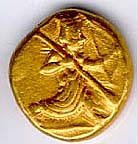
I was reading yet another discussion on the latest Troy film where archaeologists point out that coins were not placed on the eyes of the dead at that time because coins were not invented for another 500 years. I, too, had read that many academicians credit King Ardys of Lydia with minting the first coins in the 7th century B.C.E. and King Croesus with standardizing government-issued coinage However, I found this website about the history of coinage that states the first metallic coins, made of bronze and shaped like cattle, date back to approximately 2000-1800 B.C.E.

"The first metallic money dates back to approximately 2000-1800 BC and was made of bronze. These bronze pieces which traded based on weight, were often formed into the shape of cattle, which again were used prior to the general acceptance of metals as a valuable commodity. The primary reason behind the origins of coinage is a matter open for debate. One school of thought is that the first coins were struck for religious reasons.
Another suggests that they were made solely in order to help facilitate trade. Still another theory promotes the idea that man began making coins strictly for accounting and administrative reasons."

http://www.coin-gallery.com/cgearlycoins.htm

Original criticism also got me to thinking about changes in Greek religion from the time of the Trojan War to the classical period. At what point was the payment of the ferryman across the River Styx introduced? Was this introduction into Greek religion an effort by the wealthy to ensure that they did not have to mingle with the abject poor in the afterlife?

Wednesday, June 16, 2004

Turning Pages and the power of illustration

Turning the Pages: Peter Williams, a fellow blogger who, as a member of the Association of Roman Archaeology, also produces a web log on the topic, recently mentioned a fascinating new project by the British Library called Turning Pages.

"Turning the Pages is the award-winning interactive program that allows museums and libraries to give members of the public access to precious books while keeping the originals safely under glass. Initially developed by and for the British Library, it is now available as a service for institutions and private collectors around the world.

Turning the Pages allows visitors to virtually 'turn' the pages of manuscripts in a realistic way, using touch-screen technology and interactive animation. They can zoom in on the high- quality digitised images and read or listen to notes explaining the beauty and significance of each page. There are other features specific to the individual manuscripts. In a Leonardo da Vinci notebook, for example, a button turns the text round so visitors can read his famous 'mirror' handwriting."

I particularly enjoyed the detailed depictions of medieval life in the LUTTRELL PSALTER and the beautifully illustrated 14th century Hebrew manuscript, GOLDEN HAGGADAH.

The other day a friend and I were discussing the distressing trend of sparse illustration, especially in academic texts, and pondered whether this a result of simple economics or a growing cultural concern with "appropriate" images and various censorship movements.

Tuesday, June 15, 2004

Waters of the City of Rome

Waters of the City of Rome: "During the Age of the Kings (ca. 625 - 509BC), the landscape was dramatically transformed by the construction of a large drain called the Cloaca Maxima. This drain collected the waters from the living stream, refered to as the Forum Brook, which flowed into the valley between the Palatine, Quirinal, and Capitoline Hills, thus drying out the seasonally marshy area that was later occupied by the Forum Romanum. 'Living water', that is the water flowing from a natural spring, was considered sacred and was not included within the newly constructed protective walls that surrounded the plateau of the Palatine hill. Another drain, the Cloaca Circus Maximus, was constructed during the 'Age of the Kings' in order to drain the area to the south of the Palatine where games were held. The first bridge across the Tiber River, the Pons Sublicius, was constructed during this period."