Menander the Orator (c. ad 300), who is very sound on how to eulogise a harbour, suggests the following for a great man’s funeral. It all sounds quite ghastly. Encomia of the dead person, he tell us, should be based on the following topics: family, birth, nature, nurture, education, accomplishments, actions, Fortune, ending with consolation. Under ‘family’, the eulogist must stress that there is none more brilliant in the city. ‘Birth’ is an important topic if a child has died: mention the rejoicing of the whole family, the splendid hopes, the prospect of a great destiny, all dashed by fate. ‘Nature’ should cover physical beauty and mental endowment; ‘nurture’ should touch on the speed with which the person developed; ‘education’ should stress that he was far ahead of his contemporaries; ‘accomplishments’ should deal with his fairness, humanity, approachability and gentleness. ‘Actions’, what the person achieved in life, is the topic that Menander suggests the eulogist should concentrate on, and he should point out that Fortune followed him all his life so that he was wealthy, loved by his friends, honoured by the great and good, and so on. Throughout, Menander goes on, the dead person must be shown to have been fit to rival any man in distinction.
Friday, May 28, 2004


Thursday, May 20, 2004
When in Rome
With all the current interest in the ancient world stirred up by such movies as "Gladiator" and "Troy", the regional government along with two historical societies is offering free Latin classes to tourists in a bid to lure even more of the sword-and-sandals loving crowd to Rome.
'Given all the excitement over the Roman Empire lately, we thought it was crazy not to do something here in the heart of it all,' said Alessandro Pediconi, one of the organisers.
The first courses are being offered for English and French speaking tourists using a comic book starring 'Caesar' and featuring cursory history and language lessons.
For those itching to really live the Roman experience, organisers plan to team up this summer with the Scuola Gladiatori Roma, or gladiator school, to offer a package with Latin classes and a crash course in gladiator fighting.
After donning tunics and helmets, tourists would also be treated to a typical Roman feast."
'Given all the excitement over the Roman Empire lately, we thought it was crazy not to do something here in the heart of it all,' said Alessandro Pediconi, one of the organisers.
The first courses are being offered for English and French speaking tourists using a comic book starring 'Caesar' and featuring cursory history and language lessons.
For those itching to really live the Roman experience, organisers plan to team up this summer with the Scuola Gladiatori Roma, or gladiator school, to offer a package with Latin classes and a crash course in gladiator fighting.
After donning tunics and helmets, tourists would also be treated to a typical Roman feast."
Tuesday, May 18, 2004
Roman Marching Camps Used by Offensively and Defensively
There is an interesting article on Roman fortifications in this month’s issue of Military Heritage magazine. The author, Arnold Blumberg, takes issue with the conclusions of J.F.C. Fuller and Liddell Hart that the practice of entrenching each day slowed the Romans down to the point that they seldom had a chance to select advantageous positions for pending battles. Blumberg said that as far as Fuller was concerned, Roman warfare was little more than “mobile trench warfare” requiring them to always assume “the strategic and operational defensive”.
Blumberg says strategically, marching-camps proved to be an aggressive military instrument. He observed that not only were these displays of “massive military power” demoralizing to the enemy but that fortifications left in the wake of an advancing army served as stepping stones to sustain the army’s movements. Many were transformed into permanent fortified positions that became centers of territorial administration and troop staging areas protecting communication lines.
He says there are a number of examples of marching camps employed both offensively and defensively. He cites the battle of the Sambre River in 57 B.C.E. between Julius Caesar’s troops and the Belgae. The Gauls launched a surprise attack on the Roman camp but the legionaries used the camp as a protective screen for their flank and rear, pivoted, and routed the enemy.
Labienus reversed the strategy in Trier, Germany in 54 B.C.E.. “He unleashed a double flanking attack against the army of the Treveri. He sent his cavalry storming out of the front and rear gates of the compound on a devastating charge that killed the rebel leader and caused the collapse of the Gallic uprising,” Blumberg says.
He also pointed out that contrary to claims that building a camp slowed the Roman armies down, the Romans averaged 20 miles per day. On the other hand, Gallic and Germanic war bands usually included many more women, children and livestock herds, averaging only three to nine miles per day.
See also: Roman Camps
Blumberg says strategically, marching-camps proved to be an aggressive military instrument. He observed that not only were these displays of “massive military power” demoralizing to the enemy but that fortifications left in the wake of an advancing army served as stepping stones to sustain the army’s movements. Many were transformed into permanent fortified positions that became centers of territorial administration and troop staging areas protecting communication lines.
He says there are a number of examples of marching camps employed both offensively and defensively. He cites the battle of the Sambre River in 57 B.C.E. between Julius Caesar’s troops and the Belgae. The Gauls launched a surprise attack on the Roman camp but the legionaries used the camp as a protective screen for their flank and rear, pivoted, and routed the enemy.
Labienus reversed the strategy in Trier, Germany in 54 B.C.E.. “He unleashed a double flanking attack against the army of the Treveri. He sent his cavalry storming out of the front and rear gates of the compound on a devastating charge that killed the rebel leader and caused the collapse of the Gallic uprising,” Blumberg says.
He also pointed out that contrary to claims that building a camp slowed the Roman armies down, the Romans averaged 20 miles per day. On the other hand, Gallic and Germanic war bands usually included many more women, children and livestock herds, averaging only three to nine miles per day.
See also: Roman Camps
Monday, May 10, 2004
Acting Troupe Dedicated To Making History Interesting
"Stewart Hulme's mobile Bluesilver Theatre company is now bringing history alive to schools across the North and Midlands with his plays about key phases in time accompanied by just three other actors, a minimum of props and an extremely tightly-packed Vauxhall Vectra estate.
After participating in No Pasaran (They Shall Not Pass), a play about the persecution of Jews in Nazi Germany, Hulme designed his first play for schools, Moved East, about the rise of Facism in Germany in the 1930s and its effect upon three young people living there. He began studying the national curriculum, carrying out self-styled market research among teachers about what were the favoured topics.
This spawned three other plays: The Great Dying about the Black Death epidemic in medieval Europe, A Spin o' The Wheel which deals with the Industrial Revolution and Speakeasy, focusing on the prohibition years and the Great Depression in 1930s America.
These 90-minute creations are all primarily designed for secondary schools and are proving to be extremely popular with both the teachers - and more importantly the pupils.
Another actress, Helena Jacks, from Woolton, joins Stewart for the Living Theatre performances, a series of plays written for primary schools by Jean and Peter Davies, from Great Budworth in Cheshire, from whom Bluesilver acquired the rights to perform.
These are far more interactive allowing the children to supplement the acting roles not covered by either Stewart or Helena.
For instance in Tudor Times, Stewart plays Henry VIII and a selection of pupils represent his Six Wives.
In another, The Ancient Greeks, pupils play the soldiers erupting from the Trojan Horse to rescue Helen (Helena).
"The kids really enjoy it," says Stewart. "And we do get through a lot of plastic axes and swords!"
Like Mr. Hulme, I've always been disappointed in history classes that seem to dehumanize a fascinating subject by emphasizing the memorization of names and dates. I think his creative solution to the problem a commendable one.
After participating in No Pasaran (They Shall Not Pass), a play about the persecution of Jews in Nazi Germany, Hulme designed his first play for schools, Moved East, about the rise of Facism in Germany in the 1930s and its effect upon three young people living there. He began studying the national curriculum, carrying out self-styled market research among teachers about what were the favoured topics.
This spawned three other plays: The Great Dying about the Black Death epidemic in medieval Europe, A Spin o' The Wheel which deals with the Industrial Revolution and Speakeasy, focusing on the prohibition years and the Great Depression in 1930s America.
These 90-minute creations are all primarily designed for secondary schools and are proving to be extremely popular with both the teachers - and more importantly the pupils.
Another actress, Helena Jacks, from Woolton, joins Stewart for the Living Theatre performances, a series of plays written for primary schools by Jean and Peter Davies, from Great Budworth in Cheshire, from whom Bluesilver acquired the rights to perform.
These are far more interactive allowing the children to supplement the acting roles not covered by either Stewart or Helena.
For instance in Tudor Times, Stewart plays Henry VIII and a selection of pupils represent his Six Wives.
In another, The Ancient Greeks, pupils play the soldiers erupting from the Trojan Horse to rescue Helen (Helena).
"The kids really enjoy it," says Stewart. "And we do get through a lot of plastic axes and swords!"
Like Mr. Hulme, I've always been disappointed in history classes that seem to dehumanize a fascinating subject by emphasizing the memorization of names and dates. I think his creative solution to the problem a commendable one.
Monday, May 03, 2004
Authenticating ancient 7-inch barbarian proves to be an epic quest
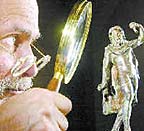 "Nineteen years ago, Robert Cohon strode through the classical galleries of the Nelson-Atkins Museum of Art in Kansas City, Mo. The light was low. The room was quiet. A spotlighted statue in a display case stopped Cohon in his tracks.
The barbarian was only 7 inches tall, but, Cohon says, 'it was spectacular.'
The nude figure had muscular legs and a cape. It held the right hand high, the other low, as if carrying a shield and a weapon. The dark bronze surface was mottled with tiny patches of red and green patinas. With its twisted posture, the look on its face and a bandaged leg, the barbarian appeared wounded and in pain.
To someone steeped in the art of ancient cultures, this small bronze statue of a warrior was quite a prize. Its presence at the museum helped Cohon decide to take a job as the Nelson's curator of antiquities.
Yet, within a couple of years, his elation turned to doubt amid questions about the figure's authenticity.
Could it really be 2,000 years old? Or was it of more recent vintage - from the Renaissance, say, or even a forgery?
The barbarian appeared to be left handed and the barbarian's face was Christlike, with flowing locks and a goatee. His thigh was bandaged, also an unusual detail for 2nd century Roman depictions of conquered barbarians.
Now, 17 years later, Cohon has pieced together the truth, and in April, for an audience in a Nelson-Atkins auditorium, he revealed what he learned about the little bronze warrior and the thrills of archaeology."
New Interpretation Panels Installed at Roman Fort of Cramond
 "Between 208 and 212AD, the African-born Roman Emperor Septimus Severus chose Cramond as a key base to lead the last major campaign of Roman conquest in Scotland.
In the last years of his reign, Severus travelled to Scotland where there were uprisings against the Roman Empire. He restored Hadrian's Wall and helped to strengthen the Romans' power in Britain again.
Severus built his fort on an existing Roman military settlement which was established around 140AD during earlier campaigns. He died in 212AD in York.
Now, new interpretation panels provide visitors with a fascinating insight into life at the 1800-year-old fort near Cramond Kirk, which was designed to help protect the empire's western flank, and at the nearby bathhouse, described as one of the best surviving Roman buildings north of the Border. The remains of the Roman fort are explored in detail on three of the information panels, which focus on the occupation of the fort during the third century AD.
The panels depict the fort within the landscape of the time, showing the harbour and also the large defended settlement attached to the fort’s eastern side.
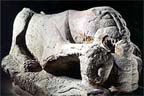
The Roman remains are described by archeologists as of 'huge historical importance', and sit close to the River Almond site where a ferryman discovered the celebrated Cramond Lioness."
Wednesday, April 21, 2004
Spartacus remake follows history more closely than original
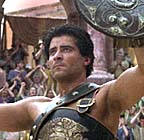 Sunday and Monday, USA Networks broadcast their remake of "Spartacus". I must admit that the remake was much more true to history in many respects than the Kirk Douglas version. I wondered if they would include the incident where Spartacus crucified a Roman soldier in view of the Romans to display his own ruthlessness and determination and by golly, they did! They also showed Spartacus as a somewhat hesitant leader and correctly portrayed the conflict between him and Crixus. Crixus also broke away with his Gauls and was slaughtered by the Romans as really occurred in history. I'm afraid the actor playing Spartacus just didn't have the intensity of Kirk Douglas though.
There was no hint of homosexuality in Crassus (although I questioned the proliferation of beards - including Crassus). The Romans did not use stirrups (you see Crassus jumping down from his mount without their aid). I did wonder about the Roman uniforms, though, as the legionaries wore leggings which I thought was not adopted until after Caesar invaded Gaul. They also included the conflict between Crassus and Pompey and how Pompey tried to claim the victory over Spartacus for himself. In a brief scene in front of the senate, we also see Julius Caesar acting as the "mediator" to reconcile Crassus and Pompey with a joint consulship and the "pregnant" looks between a smug Caesar and the old senator attempting to manipulate events to his own advantage.
Thursday, April 01, 2004
Killer Queens New Series on The History Channel
 In the first of this new six part series about famous women rulers, presenter Rory McGrath takes us on an entertaining and bloody romp through the Boudiccan revolt against the Romans. We learn how the defiant Iceni Queen was flogged by the Romans and her daughters raped and how in turn this led to her vengeful massacre of the entire Roman population of Colchester. Continues next week as Boudicca takes on the whole Roman Army.
Wednesday, March 31, 2004
Roman Funerary Sculpture Featured in New Exhibit
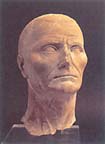 "A new exhibit at the National Museum of Western Art in Tokyo features Roman funerary sculpture gleaned from the collection of the Vatican Museum. The tradition of funerary portraiture grew out of elite practices during the years predating Augustus' epochal Pax Romana, the era of (relative) peace brought about by Roman domination of the Mediterranean region. In those early years -- the literary heyday of Rome (the first century B.C. produced Virgil, Horace, Ovid and Livy) -- wax portraits known as imagines would be paraded in the funeral processions of the upper classes. These would then be displayed, perhaps alongside portraits or busts in bronze, marble or terracotta, in the lararium (household shrine), not unlike the way photographs of ancestors are displayed to this day on the butsudan (family altar) in many Japanese homes.
Roman funerary monuments from the third century and fourth century A.D. show declining levels of artistic skill.
One of the most powerful pieces here is the head of a terracotta votive statue dating from the first quarter of the first century A.D.; the face is aquiline and patrician, seeming to anticipate the so-called hieratic style of later centuries. Or, rather, hieratic representation, which evolved in the third century, was a conscious effort to recapture the stylistic purity of such early Roman sculpture, after two centuries of cheerfully expressive but unrefined representation -- as exemplified by those tradesmen's funerary friezes. "
Tuesday, March 30, 2004
The Mithraic Mysteries
 "Closed for six years, the planetarium at the Rosicrucian Egyptian Museum has reopened with a show on the skies of 2020 B.C., the cusp of a celestial shift that spawned one of the major competitors of early Christianity.
The star show "The Mithraic Mysteries'' explores a secretive ancient religion that has been a particular enigma for archaeologists and historians. It takes viewers through the steps that led a San Francisco scholar of ancient religions to theorize that changes in the night sky formed the basis for Mithraism, practiced throughout the Roman Empire in the first centuries A.D.
The reinauguration of the planetarium at the popular San Jose tourist attraction -- with its Egyptian revival buildings and gardens and mummy- and artifact-filled museum -- is the first of many renovations this year at the 77-year-old Rosicrucian Park complex. Planned renovations include an authentic 18th-dynasty Egyptian Peace Park that will have a small temple, viewing dais, sycamore fig, grape arbor and dhoum palms surrounding a reflecting pond."
Monday, March 22, 2004
Byzantium: Faith and Power Exhibit Opens at the Met
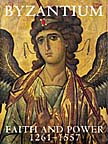 "A landmark exhibition featuring three centuries of Byzantine culture opens tomorrow at the Metropolitan Museum of Art in New York. Seven years of research, negotiations, and collaboration have brought together 377 artifacts from 27 countries -- among them Russia, Bulgaria, Serbia and Montenegro, Romania, Macedonia, Egypt, Greece, and Turkey. Many of the masterpieces are borrowed from churches and monasteries, and have never been exhibited before.
'Byzantium: Faith and Power' exhibit covers the period when Constantinople resumed its role as a cultural and political center of the Eastern Roman Empire until 1557. "
Wednesday, March 17, 2004
Winged sandals
 "If multi-media mythology sounds appealing, simply strap on a pair of Winged Sandals. As those who still remember their Greek mythology will know, the site's title refers to the unique footwear of Hermes, messenger of the gods (and more recently, upscale clothing and accessories retailer). The artist's interpretation of the immortal emissary, and the messenger's 'Alvin and the Chipmunks' voice make it clear at the outset that this is a site primarily designed to introduce children to its subject matter. (The target age is 6-12 years old.) But while the information is appropriately rudimentary, interested adults can still get a quick refresher course, and won't be bored while supervising their children's visits. (The Australian Broadcasting Corporation production won best e-learning site and best in show at the annual Australian Interactive Media Association awards in February.)
Of the site's various sections, Storytime is the most engaging, as it recounts legends that include Perseus' battle with the Medusa, and Orpheus' journey into the underworld to rescue his beloved Eurydice. Each story includes a 'cast list,' which links to specific biographies on each character, including a few lines of text, keyword list (mortal/immortal, female/male, etc.), a family tree, and -perhaps one of the most useful features at the site- the ability to hear the proper pronunciation of each character's name. (Someone who has never been properly introduced to Eurydice or Antigone might make reasonable but wildly incorrect assumptions about inflections -yuri-dice? anti gone?- and find themselves banned from Mount Olympus' better parties.)"
Winged Sandals can be found at http://www.wingedsandals.com/
Thursday, March 11, 2004
Appius Claudius Caecus and the letter Z
 "The Latin alphabet derived from the Etruscan, which was adopted from the Greek of colonists who had settled at Cumae in Campania. An indication of this borrowing is that the sound of k was conveyed by three different letters: gamma (G) before e and i, kappa (K) before a, and koppa (Q) before u. (Indeed, that is their names: ce, ka, qu). In Latin, kappa soon became redundant, except in the archaic spelling of such words as Kalendae (the first day of the Roman month), and was dropped from the alphabet. And Q was restricted to cases in which it preceded u. Principally, it was gamma, the third letter in the Greek alphabet and represented by the letter C in Latin, that conveyed the sound of k.
But C also had the sound of g and, since gamma already represented k, a new letter was added to distinguish between these two values. Plutarch (Quaestiones Romanae, 54, 59) attributes its introduction (in the third century BC) to Spurius Carvilius Ruga, a freedman whose grammar school was the first to charge a fee (he also was the first Roman to divorce his wife). The letter continued to represent the sound of k but, by adding a stroke to C, Carvilius created the letter G to denote that sound. Its older value survived, however, in the abbreviations for Gaius (C.) and Gnaeus (Cn.). The seventh letter in the Latin alphabet, G took the position originally held by Z (zeta), which had no equivalent value in Latin and was discarded.
The introduction of the new letter also has been attributed to Appius Claudius Caecus, Roman censor in 312 BC. According to Martianus Capella (De Nuptiis Philologiae et Mercurii, III.261), 'Z was abhorrent to Appius Claudius, because it resembles in its expression the teeth of a corpse,' that is, in sounding the letter the lips pulled over the teeth looked much as they would in the rigor of death. More prosaically, the loss of Z may have been due to rhotacism, in which the s sound it represented was transferred to r (for example, Fusius becoming Furius), a replacement that consequently made the letter unnecessary."
Augustus' Program of Cultural Renewal
 By Paul Zanker
"At the same time as his 'restoration of the Republic' and the creation of his new political style, Augustus also set in motion a program to 'heal' Roman society. The principal themes were renewal of religion and custom, virtus, and the honor of the Roman people. Never before had a new ruler implemented such a far-reaching cultural program, so effectively embodied in visual imagery; and it has seldom happened since. A completely new pictorial vocabulary was created in the course of the next twenty years. This meant a change not only in political imagery in the narrow sense, but in the whole outward appearance of the city of Rome, in interior decoration and furniture, even in clothing. It is astonishing how every kind of visual communication came to reflect the new order, how every theme and slogan became interwoven. Again, however, there was no master plan outlining some sort of a propaganda campaign for the revival of Rome. As in the development of imagery after Actium, much happened as if of its own accord, once the princeps had shown the way and taken the first steps.
Augustus did not need to formulate a new program himself; it had already been done for him. For generations the ills of state and society had been proclaimed, described, and lamented as incurable evils. The surprising thing, for many people virtually a miracle, was that the new ruler actually took the lament seriously and decided to do something about it. He was utterly irrepressible as he set about addressing, in terms of concrete policies, all the problems that he had himself decried back in the 30s B.C., immediately creating the foundation on which he would build his programs. In the next sections we shall observe the remarkable confidence--one might almost say naivete--with which he went about building on that framework, step by step, going through the whole catalog of ills left over from the Late Republic, until in 17 B.C. he could sail the rebuilt ship of state into a safe harbor called the Golden Age.
It started with the program of religious revival in 29 B.C. There followed efforts toward publica magnificentia and the restoration of Roman virtus in the Parthian campaign of 20 B.C. Two years later, in 18, with the Romans’ confidence in their ability to rule an empire now bolstered, a legally imposed moral renewal was required. This completed the internal overhaul of Rome, and nothing now stood in the way of the new Golden Age. Nothing could be simpler!
At first, of course, each of these points in the Augustan program amounted to little more than one of the old slogans. They were statements of intention, which then had to be realized in action and in architecture and the visual arts. The princeps would need the help and cooperation of many. Since no written source gives us a picture of how the complex machinery of this cultural program actually worked, we must try to infer from the results themselves an idea of the collaboration and the mutual influence on one another of princeps, political cronies, creative poets, architects, and artistic ateliers."
The McMasters Trajan Project
 "From the earliest days of the city, the hub of Roman business, politics, and ceremony had been the Forum Romanum. Located at the base of the Palatine hill just south of the capital, the Forum Romanum was embellished over the years with temples, places of meeting and business, and various honours to famous citizens. Here, politicians debated, citizens met, talked, and voted, priests made sacrifices, and triumphant generals rode through on their way to the Capitol. On special occasions, gladiators even fought to the death while spectators looked on from temporary wooden stands. By the time of Caesar, however, the old forum was no longer large enough to handle all the business which needed to be transacted. Some of these activities were moved elsewhere: for example, new facilities for voting were constructed on the Campus Martius, removing a major political function of the old Forum. The other approach to this problem of space was to construct supplementary venues nearby. Caesar, Augustus, and Nerva each built new fora to the north east of the old Forum, but still linked to it and to each other by doors and passageways. Domitian is said to have started construction on a fourth imperial forum, but work on this ceased at his death. Thus, it was left to Trajan to fill the need for yet more forum space. Trajan did more, however, than simply provide more space for the public business of Rome; he constructed at the same time a monument to himself and to the glory of the Empire.
The two main elements of the new Forum of Trajan were an open piazza and a basilica, and both were astonishingly large. The entire Forum of Nerva would have fit within the basilica, and the piazza, its open area alone measuring more than 80m in width and 120m in length, was large enough to hold almost the entire Forum of Augustus. This piazza, the heart of the Forum, was paved with imported marbles and surrounded by a colonnade. Atop this colonnade were inscriptions stating that the whole complex had been built using the spoils of war taken by the emperor. One of the functions of this massive open space was to provide a setting for public business and ceremony. For example, the successor of Trajan, Hadrian, performed in it a great ceremony of burning debt records. Later, during a time of dire military need, the emperor Marcus Aurelius used it as a venue for a great auction of the imperial possessions. Another function was to provide a display area in which to exhibit honours to great Romans. Naturally, the greatest honour went to Trajan himself, who was immortalised by a great equestrian statue, cast in bronze, gilded, and placed atop a pedestal in the centre of the piazza. The size of this statue was so great that it defied replication by any later rulers. When the emperor Constantius visited the Forum of Trajan in the 4th century, he declared somewhat rashly that he would order a copy of this horse to be made. One of his companions, a Persian prince named Ormisda, replied wittily that first the emperor should build a new stable, if he could, so that the proposed new steed might roam as freely as the one they saw before them. The base of this statue has recently been discovered in the centre of the Forum piazza, and its measurements give us an idea of the size of the horse which Constantius desired to copy: the horse and rider together (not including the base) may have been as much as 12 metres tall. By comparison, the famous equestrian statue of Marcus Aurelius, which now stands on the Capitol, is only about one third as large.
Beyond the eastern end of the piazza was a multi-level market, in which spices and other luxuries were sold. The solid brickwork of this structure has proven so enduring that, except for the column, it is today the best preserved element of the forum complex. The north end of the piazza was dominated by the basilica. Its huge interior space (120m by 55m) was covered by a timber and tile roof supported on a forest of massive columns, and was enlarged by the provision of apses at each end. Its decoration was sumptuous. The walls and floor were clad in marble, and the roof was covered with bronze tiles thickly gilded. This sheltered yet extremely imposing space would have provided a suitable setting for public business, especially important trials. The dual apses, unusual for a Roman basilica, may have been added to double the space available for such affairs.
When finally sated with the sights of the grand piazza, exhausted by the bustle of the market, and overwhelmed by the fervent pleading of the advocates in the basilica, a visitor could exit the north side of the basilica and enter a much different environment. Walking out through the last row of imposing columns, our visitor would emerge into a small courtyard on the other side of the basilica. This courtyard was flanked to the west and east by two libraries, one for Latin and one for Greek texts. It is not certain what lay to the north. A temple to the divine Trajan has been suggested, but no remains of such a building have been found in this area. However, a visitora's attention would be immediately drawn to the imposing monument which stood in the centre of the court: the column of Trajan."
Thursday, February 26, 2004
Scipio Africanus: The Man and the Model
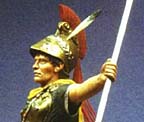 by Greg DiFranco
It was 211 BC and the two most powerful city-states of their time were locked in the mortal combat of the Second Punic War. It was the wealthy maritime power of Carthage pitted against Republican Rome. By now Carthage had brought Rome to the brink of total destruction, and arguably to the lowest point in its history. Hannibal and his fellow commanders had successfully defeated many Roman armies, and had completely annihilated a number of them in the process. Most notable was Hannibal’s annihilation of one of the largest armies Rome had ever assembled (70,000 troops) at the battle of Canne. Many of Rome’s most prominent citizens were lost in this battle, as in keeping with Republican Roman tradition, the most important citizens fought in the front ranks. The city of Rome itself was left almost helplessly exposed and was in chaos with the expectation of a siege. And if things weren’t desperate enough for the Romans, the Carthaginians now took complete control of Iberia (Spain), one of the most important economic areas of the region. In the process two of the most highly respected and admired Roman commanders were killed on the same day, they were the Scipio brothers. Although Rome fielded formidable armies, armies that in fact had beaten Carthage in the first Punic wars, they were proving no match for Hannibal’s troops and tactics. Rome fielded a non-professional citizen army with rather static legionary tactics based on breaking the enemy’s center, and without a strong cavalry contingent. On the other hand, Hannibal had successfully trained and honed an array of professional foot and mounted troops from African, Iberian (Spain) and Celtic stock, into a superior fighting force capable of flexible tactical maneuvers. To this he applied brilliant tactics, including classic flanking maneuvers the Roman legions were unable to counter.
Somehow, in the middle of the carnage that was Rome’s defeat at Canne, the young son of Scipio the Elder managed to survive. In an unprecedented move, the desperate Romans elected this young patrician to lead the remnants of the Roman army in Spain, he was just in his early twenties. Young Scipio immediately exhibited an uncanny ability for leadership and quickly set about retraining and improving the moral of the defeated Roman army of Spain. With the winter season as his respite, Scipio began laying plans for correcting the Roman legions weaknesses, and laying the groundwork for an army that could match Hannibal’s. No detail was left unattended, from the complex work of adding flexibility to legionary level tactics, to strengthening man to man fighting techniques, to details such as which sword would be most effective in close quarter combat.
Attila and the legacy of the Huns
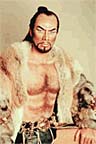 "Perhaps no other people have struck greater fear in the west than the Huns. In the end of the fourth century the Huns seemed to have materialized out of nowhere and crushed they way into the Hungarian plains. From there they extended their domains south of the Danube River, into Gaul and then northern Italy, leaving a trail of destruction and terror wherever they went.
However, in Western Europe, the Huns failed to achieve any long-term effect other than a rearrangement of barbarian power, the relocation of the Goths westward, and the founding of Venice by those who fled the Huns in Northern Italy. Thus, in western history the Huns are best remembered as one of the barbarian groups that contributed to the collapse of Rome. Because of this, they are generally seen as being cruel and barbaric.
In Eastern Europe, however, the Huns had a different effect. In countries such as Hungary, Attila is regarded as a hero and a symbol of power, bravery and courage. The Hungarian dynasty of Arpad even claimed direct descent from Attila and the procession of Attila’s sword. Whether Attila was a ruthless barbarian or a man of bravery and courage, the Huns will always be remembered for the fierocity of their warriors. "
Wednesday, February 25, 2004
Roman Mosaics added to Yale University Art Gallery
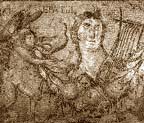 "The Yale University Art Gallery has acquired and will display five fragments of a Roman floor mosaic from Gerasa (now Jerash), a site in present-day Jordan that Yale excavated in association with the British in the 1920s and '30s. A fat garlanded boy sitting astride a panther, a partially nude maenad and two conversing satyrs are all part of the tableau of one of the five pieces of Roman mosaic recently acquired by the University art gallery."
Penal Tattooing in Late Antiquity
 By Mark Gustafson
Calvin College
"The origins of tattooing are very ancient, and the modern fascination with the practice serves to remind us that it has been an enduring fixture in human history. Its functions are many and often overlap, but the particular focus here is on the tattoo as an aspect of punishment. Comparative evidence, however, is welcomed whenever it proves useful. This article first marshals and examines the late antique literary evidence (which is predominantly Christian) extending from North Africa in the third century to Constantinople in the ninth. Then that evidence is put in its legal context.
From at least the time of Augustus, the penal tattoo, which was generally placed on the face or forehead, had been associated with degradation. Such remained the case in late antiquity, and it also becomes clear that the tattoo accompanied a sentence of exile and hard labor, usually in mines or quarries. The deeper meaning of the tattoo and its placement on the forehead is considered in the light of modern understandings. There follows a discussion of the actual form taken by the tattoo, which normally displayed the name of the crime, the name of the emperor, or the name of the punishment. Based on the available data, the last option appears to have been the most common penal tattoo in this period.
Finally, the article hypothesizes that the Christians effected a transformation of the tattoo and subverted its original intent, so that, rather than being a sign of punishment, it became a sign of glory in which one could take pride. Thus the penal function, in some settings at least, was overtaken by a primarily religious one. "
Roman Wall Painting
 By M. Hoover, San Antonio College
"Roman wall painting is described as having four distinct styles, identified from the wall paintings found at Pompeii, Herculaneum, Boscoreal and other cities buried under the volcanic ash of Mt. Vesuvius. Roman mosaics either imitated the painting styles or became very abstract.
The First Style Roman wall painting, called 'Incrustation style' is thought to imitate Greek painting that created flat areas of color and 'faux' finishes (like a fake marble or oak finish). In the second style Roman wall painting, called the "architectural style," space extends beyond the room with various perspective ("illusion of three-dimensional space on a flat two-dimensional surface) devices. Roman artists came close to developing a true linear perspective.
In the Third Style Roman Wall Painting, called the "Ornate Style," pictorial illusion is confined to "framed" images, where even the "framing" is painted on. The overall appearance is flat rather than a 3-d illusion of space. The Fourth Style Roman Wall Painting, called the "Intricate Style," confines full three-dimensional illusion to the "framed images," which are placed like pictures in an exhibition. The images themselves do not relate to one another nor do they present a narrative, as in the Second Style. The Fourth Style is also characterized by the open vistas and the use of aerial perspective, as well as the elaborate architectural framing.
Subscribe to:
Posts (Atom)