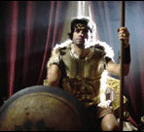
 We have been having a lively discussion about historic truth on our Imperial Rome discussion group. I noticed that the program "The Real Jason and the Argonauts" was going to air again this weekend and found this article about the project interesting - especially the director's philosophical sensitivity about historical truth.
"'You have to be careful dealing with myths because they have a lot to do often with people's sense of self and national identities, and there's no need to shatter things like that.
'What I'm looking at complements rather than undermines. It's just a different way of understanding these stories in different ages, I think.
'These days, the modern inquiring mind requires that we find out who the real people are, but it doesn't mean those myths are any less true for the people of other ages.
'There's a fine balance between literal truth and artistic truth, and often we learn more about ourselves from artistic truth than literal truth."
I was also interested to note that the article pointed out that even the Romans were convinced of the historical nature of the story and attempted to find evidence of the real Jason in ancient Georgia.


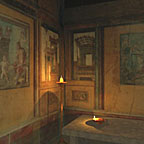 Kate Devlin, a researcher specializing in the computer reconstruction of archaeological sites explains her unique approach that incorporates realistic ancient lighting with archaeological perspective, "The ways in which we view, perceive and understand objects is governed by our current lighting methods of steady, bright electric light or large windows, but in order to understand how an environment and its contents were viewed in the past we must consider how they were illuminated. Light cannot be captured in the archaeological record and consequently its importance is rarely considered in interpretations of past environments. Experimental archaeology and realistic lighting simulation allow us to recreate the original lighting of an archaeological site or artefact and show it how it might have looked to those who built and used it. "
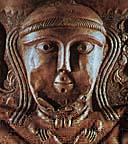 "Many of the ancient peoples of Europe marked the end of the harvest season and the beginning of winter by celebrating a holiday in late autumn. The most important of these holidays to influence later Halloween customs was
 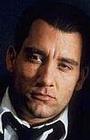 Clive Owen will be seen as King Arthur in Disney's big-budget adaptation from director Antoine Fuqua and producer Jerry Bruckheimer.
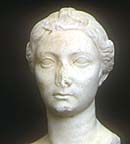 by Mary McHUGH
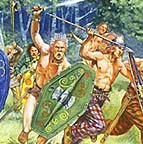 By Alexa Jervis
 by Emily Albu
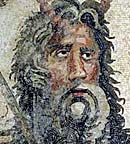 Last night I watched another program on the last-minute excavations at Zeugma. I had seen one earlier but I think this one was different. Of course, I love beautiful mosaics and the mosaics uncovered at Zeugma were some of the most beautiful I have ever seen. In fact, when it showed a computer recreation of the triclinium, I wondered how anyone could concentrate on their meal with such a breathtaking colorful mosaic on the floor.
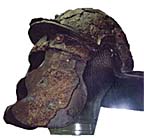 "Suetonius chose a position in a defile, with a wood behind him," explains military historian Martin Marix Evans. "There could be no enemy, he knew, except at his front, where there was open country without cover for ambushes."
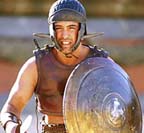 "The really sexy new history shows have been entrusted to the BBC’s Special Projects, and the BBC’s two most prestigious productions for the autumn are not drama series, nor comedies, but proud examples of their new toy: 'drama reconstruction'. It’s a genre they pioneered last year with a somewhat enervating portrayal of the construction of the Great Pyramid. If the computer graphics, sets and location filming were all groundbreaking, Pyramid was let down by concerning itself with, well, groundbreaking. Try as you might, it is difficult to make a building site exciting, even if these were the foundations for one of the wonders of the ancient world. The stilted and witless 'dramatisation' also stopped well short of arresting the attention. "
 I, too, finally got a look at Warrior Queen last night. I see what everyone was talking about in the costuming. The Roman’s armor looked like it came from a store specializing in cheap Halloween costumes and it seems like every time the Romans were the primary scene, the cinematographer turned the color setting so low they almost appeared in black and white with ghoulish white faces. Camulodunum looked like the backlot of a B-rated movie studio with cheap props scattered around a vacant lot. The attack scene made no effort to portray the ferocity of that battle.
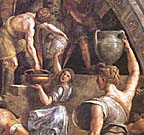 Last night I watched a "Secrets of the Dead" presentation on PBS about the great fire of Rome. I think I've seen it before but I couldn't remember. Anyway, it sounds as if Art historian Eric Varner seem to think that Nero really didn't have anything to do with it. It was just an unfortunate event that he eventually was blamed for. The narrator said that one of the reasons that archaeologists think it was not set by Nero was that it began in the poor district over by the Circus Maximus. Nero's primary support base was the poor. It was the senators that didn't support him. The program also mentioned that Nero rushed back to Rome and provided food and shelter for the thousands that were left homeless following the disaster. This does not sound like someone who would have intentionally set the fire. The program also demonstrated how the contents of the rich marble and stone villas would have provided ample fuel for the spread of the fire in the wealthier districts, especially after the fire had reached the level of a firestorm in the highly inflammable tenements of the suburra.
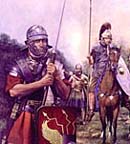 "In the late fourth century A.D., a citizen of the Roman Empire wrote a treatise known to history as De Rebus Bellicis (On Matters of Warfare). The author, whose name is unknown, offered dramatic proposals for inventions and reforms to shore up the Empire's defense. The manuscript was addressed to the highest level: the Emperor himself.
 C.J. Silverio, a software engineer in Menlo Park says author Richard Condon plagiarized "I, Claudius" in his famous novel "The Manchurian Candidate.
 "EVE ADLER, a classicist at Middlebury College in Vermont, may have just changed all Virgil's post-Renaissance diminished position in literature with her new book, 'Vergil's Empire: Political Thought in the Aeneid.' After this analysis, it will be difficult to think of Virgil merely as a gifted imitator of Homer. If Adler is right, Virgil had ambitions at least as grand as his Greek predecessor--and with good reason."
 I noticed that in honor of the 100th anniversary of Soviet composer Aram Khachaturian’s birth, the Pasadena Civic Auditorium presented his ballet “Spartacus” this week.
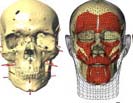 "Software that reconstructs faces from skulls has been developed by researchers from the Max Planck Institute for Computer Science in Germany. The software starts with a 3D laser scan of a skull, adds markers to indicate tissue depth, then builds layers of muscles and skin.