Monday, June 23, 2003

The Use of the Tribunate for Reforms

By Ling Ouyang

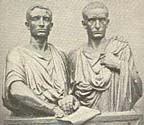
Between the years 133 and 70 B.C., the tribunate was used by a number of men for reforms. The men who used the tribunate as the platform for reforms included the Gracchi brothers, Fulvius Flaccus, the younger Livius Drusus, Saturninus and Sulpicius Rufus. While the problems each addressed varied, they were invariably threats to the future and welfare of Rome, be it the poverty in the city, the abuse of senatorial power or the Italian problem. The solutions, though often enacted with infringements of senatorial authority or deviation from traditions, would have ameliorated the problems Rome faced, if embraced.

Friday, June 20, 2003

Famous Men of the Middle Ages: Clovis

By By John H. Haaren, LL.D. and A. B. Poland, Ph.D.

I have been listening to John Gormans "The King of the Romans" and was quite intrigued with one of the last of the true Roman generals, Syagrius who was eventually defeated by Clovis I. Gormans Syagrius is quite noble and courageous but I could not find out much about him in my research. His enemy, Clovis I, however, pops up all over the net. (They always say history favors the victors). I found this particular article about Clovis interesting, primarily because there appears to be distinct differences with information presented in Gormans text. In "The King of the Romans", Clovis is supported by Christian bishops who want to topple Syagris and his Romans because they are Arrian heretics. This article, in contrast, claims Clovis was an outright pagan and did not convert to Christianity until after calling upon his wifes Christian god during a battle with the Alemani tribe and delivered from defeat. (This sounds suspiciously like the Constantine tale).

"Soon after his marriage Clovis had a war with a tribe called the Alemanni. This tribe had crossed the Rhine from Germany and taken possession of some of the eastern provinces of Gaul. Clovis speedily got his warriors together and marched against them. A battle was fought at a place called Tolbiac, not far from the present city of Cologne. In this battle the Franks were nearly beaten, for the Alemanni were fierce and brave men and skillful fighters. When Clovis saw his soldiers driven back several times he began to lose hope, but at that moment he thought of his pious wife and of the powerful God of whom she had so often spoken. Then he raised his hands to heaven and earnestly prayed to that God.

"O God of Clotilde," he cried, "help me in this my hour of need. If thou wilt give me victory now I will believe in thee."

Almost immediately the course of the battle began to change in favor of the Franks. Clovis led his warriors forward once more, and this time the Alemanni fled before them in terror. The Franks gained a great victory, and they believed it was in answer to the prayer of their king.

When Clovis returned home he did not forget his promise. He told Clotilde how he had prayed to her God for help and how his prayer had been heard, and he said he was now ready to become a Christian. Clotilde was very happy on hearing this, and she arranged that her husband should be baptized in the church of Rheims on the following Christmas day.

Meanwhile Clovis issued a proclamation to his people declaring that he was a believer in Christ, and giving orders that all the images and temples of the heathen gods should be destroyed. This was immediately done, and many of the people followed his example and became Christians.

Sunday, June 08, 2003

Book by Victorian antiquarian explores classical sexuality

"The ancient Roman and Greek cultures had a very different attitude about sexuality than successive European cultures, more akin to that of the Kama Sutra. This, of course, was unimaginable to latter day Europeans, who rigidly compartmentalized body, mind and spirit, and to whom any sexuality was sinful and morbid," explains J.B. Hare in his introduction to the online presentation of Musee royal de Naples; peintures, bronzes et statues erotiques du cabinet secret, avec leur explication by Cesar Famin. "Excavators (at Pompeii) were horrified to discover erotic frescos, mosaics, statuary and phallic votive objects. The moveable erotic artifacts were taken to Naples and kept in seclusion in the Royal Museum."

But in 1836, Cesar Famin published a book containing 60 lithographs of this "forbidden" material.

"Famins text to accompany the images is deeply conflicted," Hare observes. "He is obviously drawn to the subject matter and has a deep understanding of the significance of the artifacts. He also takes every opportunity to condemn Classical sexual practices and cultural values. Whether this is a figleaf or a sincere reaction is impossible to determine. However, in spite of the shocked, shocked attitude in Famins text, it contains quite a bit of valid and well-researched information, including quotes from classical authors and details of mythology, artistic methods, spiritual practices, architecture, and literature."

This online text is accompanied by drawings of the subject images. Parental discretion is advised.


Sunday, June 01, 2003

The Campaign of Cestius Gallus and the Defeat of the Twelfth Legion

By G. J. Goldberg

In July of 66 CE, after violent clashes between the Judean people and the troops of Judean procurator Florus, Roman governor of Syria Cestius Gallus received a complaint from the leaders of Jerusalem and a simultaneous counter-complaint by Florus against the Judaeans. Although Cestius advisers recommended he lead an army to Jerusalem to settle the dispute one way or the other, Cestius himself decided to gather more information by sending an emissary--thus showing the personality traits of reasonableness and slowness to take action that would prove disastrous in his subsequent campaign.

Cestius emissary, Neapolitanus, was treated with great respect by the Jerusalem leaders and given a full account of the recent actions, including a tour of the significant sites. While waiting for Neapolitanus to make his report to Cestius and for the Governor to respond, however, King Agrippa made a disastrous attempt to persuade the people to abstain from complaining to the Emperor and to continue to submit to Florus, which resulted in the outbreak of open revolt.

The Murder of Appuleius Saturninus

By M. Horatius Piscinus

"This essay-cycle concerns the murder of Appuleius Saturninus, and the trial of Rabirius for the crime some 47 years later. It is an interesting tale, its characters well known. Marius, the prosecuting tribune Titus Labienus, the praetor Julius Caesar sitting as judge, Consul Cicero speaking for the defense, Q. Caelius Metellus Celer as the opposing praetor, his wife Clodia, her lover Catullus, her brother P. Clodius Pulcher, all in the few short months leading up to the Catalina episode."

"Every tale should have a clear beginning and a definite end. But this is a tale of a feud. A feud not between two rival political factions, as it is often portrayed, but a family feud lasting over generations."

In 103 BCE the tribunus plebis Appuleius Saturninus passed a series of measures: drastically reducing the price of the monthly corn ration, establishment of new permanent courts to hear cases of maiestas which broadened the definition of what constituted treason (the Lex Appulia will come into play later), and the distribution of land in North Africa to the veterans of Marius Numidia campaign. His colleague, tribunus plebis G. Servilius Glaucia introduced a separate law restoring the Equites to a position where they constituted the permanent tribunals.

In 102 Numidius was censor and tried to have both Saturninus and Glaucia removed from the Senate. The Senatorial Party was opposed to Saturninus' agrarian law that gave land to Marius veterans. Marius had of course first upset them by recruiting the urban poor into his army. The fact that Marius had won the war with this rabble of sewer scum, where Numidius had failed with an army of Roman gentry, was just too much of an insult to Numidius dignity.

In 100 BCE Saturninus was again elected as Tribunus Plebis, with Glaucia now as Praetor, and Marius was in his sixth consulship. Saturninus proposed a new agrarian bill, giving land to Marius veterans of the Cimbri campaign in Cisalpine Gaul, establishing Latin colonies in Sicily, Macedonia and Achaea, and granting citizenship to those Italians who had sent troops to fight in the German campaigns. By this time the majority of troops in Roman legions were Italians, but not citizens, and Saturninus proposed to correct that.

Saturninus won reelection as tribunus plebis for 99. Glaucia had attempted to run as consul, but the Senate disallowed his candidacy. Disorder broke out. Saturninus arranged for the assassination of G. Memmius who was the Senates candidate for consul. So no elections were being held for the consulship. The Senate made some moves against Saturninus, and Saturninus and Glaucia seized the Capitoline.

The senate passed a senatusconsultum ultima calling on the consuls to restore order. One of the consuls, however, was Gaius Marius. Marius brought his troops into Rome. Ostensibly they were there to quell the riots and seize Saturninus, but also as a reminder to the Senate that it was his veterans who had been promised land, and that his present legionaries expected no less. There is some conflicting reports about Marius role in this affair. The general interpretation is that after being allied with Saturninus so long, Marius withdrew his support because of what appeared to be the excesses of Saturninus that were leading to what Cicero would later call rule by the tribunes. Assured of Marius protection, Saturninus and Glaucia entered the Senate to negotiate a resolution of the situation that would allow an election of the consuls to take place. The Senate locked its doors behind them, and then murdered Saturninus and Glaucia.

Sunday, May 25, 2003

Roman politicians and the Alexander Legend

Alexander the Great has been both glorified and villified by Roman politicians and philosophers seeking to effect a particular public personae. I found this interesting paper on the topic by Diana Spencer, St. Johns College, Cambridge:


She points out the dilemma of using this "legend" to interpret and formulate governmental structure "during periods of political flux":

"Alexander can never be as effective as a consul because he is a king, and kings have no checks placed upon their whims; paradoxically, this detrimental lack of struggle is also represented as an advantage: the monarch does not follow in the train of circumstance, he controls the destiny of his state." (referring to Livy IX.18.13-16).

During the civil war between Octavian and Antony, Octavian actively sought to portray himself as an Alexandrian image-conscious ruler:

"The need to create a political and visual vocabulary for the emerging post-Caesarian power structure was initially defined as much by emphasis on what Antony was not, as by what Octavian sought to introduce. Alexanders control of his own image--or at least, his reputation as an image-conscious ruler--serves as a boundary to acceptable Roman-ness in terms of Antony versus Octavian, but also as a potential intellectual model for how an emperor might want to be portrayed, and how to comment on this scenario."

Senecas view of Alexander was more villainous but this became a problem using Alexander as the example when evaluating the behavior of Nero in comparison.

"Senecas involved voice is characterised by this question: what man would destroy the source of his own education?; the overt subject is Alexanders treatment of Greece, but beneath the surface simmers a sub-text, dealing with the madness of a pupil who robs his tutor of the voice and attributes with which he was taught [Ep. ad Luc. 94.62-63]. Because the Roman image of Alexander shows him as excessive (and unsuccessful) in his eastward campaign, there are inherent difficulties for Seneca in his use; Romans also seek eastern dominion, and Nero had Alexandrian hankerings; this parallel could also be read as a comment on the prince who exceeds the teachings of his mentor and ends by ascribing to contradictory views. How suitable a model is this Alexander for a Roman emperor when (even though his youth is seen in terms of pupillage and education) potential madness and self-destruction haunt visions of his later career? "

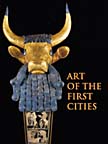
"Art of the First Cities: The Third Millennium B.C. from the Mediterranean to the Indus" at NY Met

"Art of the First Cities: The Third Millennium B.C. from the Mediterranean to the Indus" explores the emergence of the worlds first city-states and empires in Syria and Mesopotamia during the third millennium B.C. and relates these developments to artistic and cultural connections stretching from the eastern Aegean to the Indus valley and Central Asia. Over 400 works of art illustrate the splendor of the most famous sites of the ancient world including the Royal Graves of Ur, the palace and temples of Mari, the citadel of Troy, and the great cities of the Indus Valley civilization.

Monday, May 12, 2003

"Stories of An Eruption: Pompeii, Herculaneum, & Oplontis" Exhibit In Naples Until August 31, 2003

Body casts and artifacts from the sites of Pompeii, Herculaneum and Oplontis, devastated by the eruption of Mt. Vesuvius in 79 A.D., are now on exhibit at the National Archaeological Museum in Naples until August 31. The exhibit then moves to Musees Royaux dArt et dHistoire in Brussels from Oct. 9 to Feb. 8, 2004.

Comparatively few inhabitants of Herculaneum remained to be caught by this blast, since most had had the opportunity to flee. During the 1980s, however, a new excavation of the towns harbor area uncovered a series of barrel-vaulted sheds along a beach, seemingly used to keep boats and fishing tackle. About 300 people had sought refuge in these shelters, and although they were protected from the full force of the volcano's first surge, they died soon after from the intense heat and toxic gases. The exceptionally detailed cast (thanks to modern techniques) of a group preserved in the agonized throes of death, is the exhibition's most nightmarish display. Among the individuals in the boathouses were a doctor or surgeon, who was carrying a set of instruments strikingly similar to their present-day equivalents, and a soldier, who had with him his weapons and a knapsack containing tools.

Many ancient frescoes are exhibited for the first time. Three complete dining rooms have been reconstructed with nine walls of frescoes from a villa in Moregine, a suburb of Pompeii, where the Emperor Nero visited. Another reconstructed dining room from a villa in nearby Terzigno--its entire length opening onto a portico--features extraordinarily fine frescoes of mythological scenes in Pompeiis architectural style. The owners sold their estate to a wine and olive-oil producer after the earthquake of A.D. 62, an omen of the eruption to come.

The show also includes an incredibly detailed scale model from 1879 of the excavations with a retrospective of paintings, literature and film clips--even a psychoanalytical study by Sigmund Freud--inspired by the eruption since Pompeiis rediscovery in the 18th century.

See also: http://www.time.com/time/europe/magazine/article/0,13005,901030519-450959,00.html

Roman battlefied medicine not surpassed until the 20th century

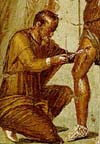
I watched an interesting program on The History Channel about combat medicine through the centuries and it was very favorable towards Roman battlefield medicine. The Roman used silver wound staples because they are hypoallergenic and their surgical clamps were almost identical to clamp design in modern 21st century hospitals.

An excellent site by a physicians daughter,Tanya Marton, pointed out that Augustus founded the first professional army medical corps.

"Augustus, realizing that they were key in an empire and especially an army, gave all physicians that joined his new army medical corps dignified titles, land grants, and special retirement benefits!. . . At the beginning of the first century, all army doctors were required to attend the new army medical school, and by the third century, all doctors, both civilian and army, were required to pass medical school."

"Interestingly, the Romans did not yet really understand how germs related to disease, but they did use many of the techniques that killed germs, techniques that were not reinvented until much later. For example, they boiled their tools before use and would not reuse the same tool on a patient before reboiling. Wounds were washed with "acetum," which is actually a better antiseptic than Joseph Listers carbolic acid (Joseph Lister rediscovered antiseptics in the 1860s, based on Louis Pasteurs brand-new germ theory of disease). "

"Over the years, Roman war doctors also learned how to prevent many battlefield epidemics. They accomplished this by placing forts AWAY from insect infested swamps. They also installed drains and sewers to transport sewage away from the men. Similarly, they invented sophisticated permanent hospitals, with specialized rooms for different tasks, and with isolation of some patients from others to reduce the spread of disease. Central heating and good ventilation also helped patients."

The Roman also introduced the battlefield "medic": "One Roman innovation was providing limited medical training to certain soldiers who remained with the troops. These soldiers functioned as combat medics who provided far-forward care to injured soldiers, such as using bandages to control bleeding. The army also had special units which evacuated soldiers from the battlefield to the field hospitals where they were treated by medical personnel."

Jenny Booth of the London Telegraph reported the discovery of a Roman-amputated thigh bone in October, 2000. The femur was found in a tomb near the city of Portus in Italy. (http://omega.cohums.ohio-state.edu/hyper-lists/classics-l/00-11-01/0301.html)

"THE first evidence that doctors in ancient Rome were able to carry out successful amputations has been uncovered by anthropologists. A 2nd
Century thigh bone found in a cemetery near Rome clearly shows the serrated marks of a surgeons saw. The amputee was a tall man who must
have survived for months or even years after his operation, because the bone had started to heal. This suggests that the surgeons were skilled
enough to fashion a flap of tissue to sew over the amputated end, protecting it from the air. "

Thursday, May 08, 2003

Purple Dye and Its Importance In The Ancient World

I have been listening to lectures on the history of ancient Egypt, a Teaching Company course presented by Professor Bob Brier. In the last of my 48 lectures on ancient Egypt, Dr. Brier mentioned an interesting detail about Cleopatras daughter by Marc Antony, Cleopatra Selene. Apparently, Cleopatra Selene married King Juba of Mauretania and had two children, a son and a daughter. Cleopatra and Juba had developed a thriving export business due to the high concentration of murex snails in the waters off the coast of Mauretania. Murex snails are the source of one of the best dyes in the ancient world. Anyway, Cleopatras son, Ptolemy, decided to travel to Rome to visit his cousin Caligula. Ptolemy wore a rich purple cloak dyed with his familys trademark product. When he got to Rome, Caligula was so upset that Ptolemys cloak was such a richer purple than his own that he had Ptolemy killed.

Murex was a highly valued source of dye in the ancient world. I found this excellent collection of papers about it.

"Although Pliny describes many varieties of purple, there were just two main categories, Hyacinth Purple and Tyrian Purple, that were produced from different species of shellfish: the former from banded dye-murex (Ph. trunculus) and the latter mainly from spiny dye-murex (B. brandaris)," writes Irving Zidernman. "The controversy as to whether banded dye-murex produces a unique violet (hyacinth) colour or the same purple hue as Tyrian purple has raged since the dye source was rediscovered in the 1830s."

Brendan Burke writes, "According to Julius Pollux (Onomasticon I, 45-49), writing in the second century AD, purple dye was first discovered by Herakles, or rather, by his dog, whose mouth was stained purple from chewing on snails along the Levantine coast, the area most famous in antiquity for its purple dye. Palaephatus (De Incred 62) also attributes the discovery of purple dye to Herakles and locates it at Tyre in the mid-second millennium B.C. King Phoenix received a purple-dyed robe from Herakles and decreed that the rulers of Phoenicia should wear this colour as a royal symbol.

Although the Levantine coast and the people of Tyre were renowned for their purple in antiquity, the earliest archaeological evidence for purple-dying from sea-snails in the Mediterranean is found on Crete. The earliest known deposits of murex shells on Crete, in quantities substantial enough and worn in such a way as to suggest dye-extraction, occur on the small island of Kouphonisi, at Palaikastro, and at Kommos. Pottery found at these sites suggests a date within the early Middle Minoan period, ca. 20th-18th c. B.C. Slightly later finds of murex shells occur elsewhere in the Aegean, at Troy, and in the Levant.

See also: http://www.convertingloop.com/cgi-bin/cl.pl/db_area/converting/paper_film_foil/2002/pffc20020701.1.shtml

Tuesday, May 06, 2003

New Language Study Sparks Debate Between Linguists and Archaeologists

The invention of agriculture has long been invoked to explain the spread of the Indo-European languages. Now, Dr. Jared Diamond of the University of California at Los Angeles and Dr. Peter Bellwood of the Australian National University in Canberra have applied the concept to 15 major language families. Their article appeared in the April 25 issue of Science.

The premise is that when humans lived as hunters and gatherers, their populations were small, because wild game and berries can support only so many people. But after an agriculture system was devised, populations expanded, displacing the hunter-gatherers around them and taking their language with them.

On this theory, whatever language happened to be spoken in a region where a crop plant was domesticated expanded along with the farmers who spoke it.

Even if the farmers interbred with the hunter-gatherers whose land they took over, genes can mix, but languages cannot. So the hunter-gatherers would in many cases have adopted the farmers language. That is why languages "record these processes of demographic expansion more clearly than the genes," Dr. Bellwood said.

Dr. Diamond said the new theory also predicted that expansions would occur more easily on an east-west axis than a north-south axis because the crop plants on which an agriculture depends tend to be able to grow only at particular latitudes.

Monday, May 05, 2003

Teutoburg Battle Subject of New Exhibition

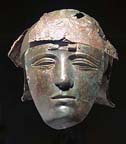
The worst defeat to strike the Roman empire is subject of new exhibition at Archeological Museum Frankfurt. Artifacts found the ravines, thick forests, marshlands and bogs at the foot of the Kalkriese hillwhere the Teutons trapped the armies of the Roman governor Varus north of the present-day Lower Saxony city of Osnabruck will be displayed. Some 6,000 relics have been excavated since a British amateur archeologist unearthed a couple of Roman catapult projectiles and coins in 1997. These artifacts include bones, weapons, everyday utensils, jewelry and coins. Some of the coins bear the mark VAR, for Varus, and historians have confirmed with certainty that they were minted between AD 6 and AD 9.

The exhibition runs at the Archeological Museum Frankfurt until Sept. 14.

Tuesday, April 29, 2003

"Goddess" exhibit reflects classical influence on modern fashion

"Goddess," the new exhibit at the Costume Institute of the Metropolitan Museum of Art in New York, aims to convince museumgoers that fashion, no matter how ephemeral, has remained consistently under the spell of Greco-Roman imagery from the French Revolution right through to the spring 2003 runway collections. The impact of classical dress on modern fashion is translated in the popular imagination to mean long fluted gowns, off-the-shoulder silhouettes and endless yards of draped chiffon.

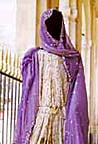
The peplos gown, a common garment in ancient Greece, was worn folded over at the top for a blouson effect that covered the waist. It was made out of one large rectangular piece of cloth, folded in half to form a cylinder. The exhibit includes a 20th century example, a 1922 Poiret dinner dress made of two panels of fabric, but the abbreviated bell-sleeved top and full-length skirt are, all impressions to the contrary, actually the exact same size. Another example is A purple Halston, donated by Rosina Rucci, whose brother is the designer Ralph Rucci, was made from one continuous loop of fabric and spirals around the body from the neck, giving the impression that a mere tug would unravel it, instantly undressing the woman wearing it.

"Goddess" would have benefited most had it offered a sense of metaphorical unraveling--had it veered away from a portrayal of women as made of marble. The goddesses and female figures of Greek mythology were steeped in a world of lust, blood, envy, transgenderism, betrayal and constant motion. In "The Odyssey," as Camille Paglia pointed out in her book, "Sexual Personae," Athena appeared eight times as a male, twice as a human girl and once as herself.

The dresses in the show that prove most memorable are two that convey the sense of sexual devastation that animated so much of Greek literature. One is an Alexander McQueen from the spring 2003 collection, nicknamed the "Shipwreck Dress," which is cut in dark nude silk crepe, crisscrosses the breasts in messy folds and falls to a pierced, shredded, asymmetrical hemline.

It is here that you get an idea of a woman embattled in something psychologically terrifying and life-altering. The second piece is a brown chiffon evening gown by Tom Ford from his summer 2002 Yves Saint Laurent collection. It falls to the knees in front, drapes to the floor in back and contains the breasts with what is meant to look like a primitive harness.


Monday, April 28, 2003

Who Killed Julius Caesar?

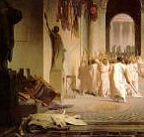
Well, I got back from Portland (OR) in time to watch the "Who Killed Julius Caesar?" program on the Discovery Channel last night. I found it interesting that the investigator used reenactments to determine how many actual conspirators stabbed Caesar. From the reenactments he determined that no more than 5 to 10 people could have had close enough access to Caesar during the killing frenzy. In fact he estimates the number closer to 5 since 10 people stabbing wildly with daggers would have probably inflicted more wounds. He expressed his opinion that the rest of the conspirators were probably engaged in keeping the other senators back--in other words, crowd control.

Although Cassius motives were clearly explained, the investigator went on to study Caesars own behavior and eventually concluded that the conspirators simply played into Caesars own hands as his instruments to end his life in such a way as to ensure his designated successor and "immortalize" Caesar for all posterity. His "contrived suicide" theory was based on several incidents and observations. The most convincing evidence, from his perspective, was a public indescretion in which Caesar refused to rise for a group of senators that approached him with a proclamation deifying him. He referred to a passage by Suetonius but also mentioned a passage in Plutarch in which Caesar was described as having a "fit" then, tearing his toga open, demanding that the Senators kill him now and that he would not resist. He also pointed out that Dio said Caesars supporters had claimed he had loose bowels and was afraid of disgracing himself if he tried to stand. He said this indicated how ill Caesar really was.

This all appears to be a little convoluted. I found the passage in Suetonius about the refusal to rise for an honor (not described as deification): "But it was the following action in particular that roused deadly hatred against him. When the Senate approached him in a body with many highly honorary decrees, he received them before the temple of Venus Genetrix without rising. Some think that when he attempted to get up, he was held back by Cornelius Balbus; others, that he made no such move at all, but on the contrary frowned angrily on Gaius Trebatius when he suggested that he should rise." - Suetonius, De Vita Caesarum, Divus Iulius, Book LXXVII

I also found a passage in Plutarch about Caesar telling a group of Senators to go ahead and kill him but it was following the Lupercalia incident with Antony and the diadem: "...twining a garland of bay round a diadem, he ran up to the Rostra, and, being lifted up by his companions, would have put it upon the head of Caesar, as if by that ceremony he were declared king. Caesar seemingly refused, and drew aside to avoid it, and was applauded by the people with great shouts. Again Antony pressed it, and again he declined its acceptance. And so the dispute between them went on for some time, Antony`s solicitations receiving but little encouragement from the shouts of a few friends, and Caesar`s refusal being accompanied with the general applause of the people; a curious thing enough, that they should submit with patience to the fact, and yet at the same time dread the name as the destruction of their liberty. Caesar, very much discomposed at what had past, got up from his seat, and, laying bare his neck, said, he was ready to receive the stroke, if any one of them desired to give it."

The I found the diarrhea passage in Dio: "when once they had voted to him on a single day an unusually large number of these honours of especial importance--which had been granted unanimously by all except Cassius and a few others, who became famous for this action, yet suffered no harm, whereby Caesar's clemency was conspicuously revealed--they then approached him as he was sitting in the vestibule of the temple of Venus in order to announce to him in a body their decisions; for they transacted such business in his absence, in order to have the appearance of doing it, not under compulsion, but voluntarily. And either by some heaven-sent fatuity or even through excess of joy he received them sitting, which aroused so great indignation among them all, not only the senators but all the rest, that it afforded his slayers one of their chief excuses for their plot against him. Some who subsequently tried to defend him claimed, it is true, that owing to an attack of diarrhoea he could not control the movement of his bowels and so had remained where he was in order to avoid a flux. They were not able, however, to convince the majority, since not long afterwards he rose up and went home on foot; hence most men suspected him of being inflated with pride and hated him for his haughtiness, when it was they themselves who had made him disdainful by the exaggerated character of their honours."

The investigator also said Caesar appeared to provoke the conspirators by other actions such as wearing purple--the historical dress of kings.

However, Cassius Dio says: "First, then, they voted that he should always ride, even in the city itself, wearing the triumphal dress, and should sit in his chair of state everywhere except at the games;" Dio goes on, "As he seemed to like all this, a gilded chair was granted him, and a garb that the kings had once used." Dio continues, "When he showed himself pleased with these honours also, they accordingly voted that his golden chair and his crown set with precious gems and overlaid with gold should be carried into the theatres in the same manner as those of the gods, and that on the occasion of the games in the Circus his chariot should be brought in. And finally they addressed him outright as Jupiter Julius and ordered a temple to be consecrated to him and to his Clemency, electing Antony as their priest like some flamen Dialis."

So, Caesar's wearing apparel seemed to be dictated by the Senate, not necessarily by Caesars own whim.

The investigator also consulted a forensic psychologist who suggested that Caesars behavior indicated he may have suffered from temporal epilepsy. He said Caesars voracious sexual appetite, voluminous writings, and increasing airs of superiority would be consistent with a person suffering from this condition. He explained that temporal epilepsy only grows worse over time and Caesar may have feared he would eventually lose physical control and his precious dignitas if his condition continued to worsen.

The investigator also pointed out that Caesars autopsy revealed that he clutched the very note warning him of the assassination. The investigator could not believe that he did not read it despite what the ancient sources said.

The thing that confuses me, though, is if Caesar intended to be killed, why did he hesitate after learning of all the bad omens and thinking about his and Calpurnias warning dreams? Even Dio says he had to be persuaded to go to the senate house by Decimus Brutus:

"He was warned of the plot in advance by soothsayers, and was warned also by dreams. For the night before he was slain his wife dreamed that their house had fallen in ruins and that her husband had been wounded by some men and had taken refuge in her bosom; and Caesar dreamed he was raised aloft upon the clouds and grasped the hand of Jupiter. Moreover, omens not a few and not without significance came to him: the arms of Mars, at that time deposited in his house, according to ancient custom, by virtue of his position as high priest, made a great noise at night, and the doors of the chamber where he slept opened of their own accord. Moreover, the sacrifices which he offered because of these occurrences were not at all favourable, and the birds he used in divination forbade him to leave the house. Indeed, to some the incident of his golden chair seemed ominous, at least after his murder; for the attendant, when Caesar delayed his coming, had carried it out of the senate, thinking that there now would be no need of it. "
"Caesar, accordingly, was so long in coming that the conspirators feared there might be a postponement--indeed, a rumour got abroad that he would remain at home that day--and that their plot would thus fall through and they themselves would be detected. Therefore they sent Decimus Brutus, as one supposed to be his devoted friend, to secure his attendance."

Maybe embracing this relatively modern suicide theory made the program more sensational to increase the viewership.
Friday, April 18, 2003

The Etruscans Revealed: New Perspectives on Pre-Roman Italy

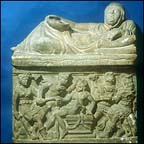
The symposium, "The Etruscans Revealed: New Perspectives on Pre-Roman Italy," was held in conjunction with the opening of a new gallery of Etruscan antiquities at the universitys Museum of Archaeology and Anthropology.

Dr. P. Gregory Warden, an Etruscan archaeologist at Southern Methodist University, said the significant change was a movement away from almost total reliance on evidence from tombs, splendid as some are, to systematic excavations of where the people lived.

The ruins of settlements and cities, Dr. Warden said, are revealing the "social landscape" from huts to houses to palaces. At places in and around Florence, Bologna, Perugia and Pisa, excavators are uncovering remains of fortification walls, artisans' workshops and kilns, temples and grids of streets.

Friday, March 28, 2003

Historical Causation in Herodotus

By Carol Abernathy, Tulane University

The ancients themselves criticized Herodotus methods. Thucydides snidely dismissed his predecessor by refusing to include to mythodes, "mythical lore," in his history of the Peloponnesian War. Aristotle is well known for giving Herodotus the title "father of history," but in his Poetics it is clear Aristotle meant this honor as a dubious one. Aristotle relegates Herodotus to the company not of historians in the modern sense but rather of mere chroniclers. He intimates that the creative process, poiesis, is lacking in Herodotus and in history in general so that "poetry is something more philosophic and of graver import than history, since its statements are of the nature rather of universals, whereas those of history are singulars" (Poetics 51a36). Aristotle set the academic approach to Herodotus for centuries. Scholars, even though fascinated by the wealth of information in the Histories, largely agreed with the assessment of Herodotus as expressed by Thucydides and Aristotle.

Thursday, March 27, 2003

Cleopatra: from history to myth

By Mary Beard, Newnham College

I was reading Mary Beards essay about Cleopatra and found descriptions of several Roman triumphs particuarly illluminating.

"Julius Caesar, in his triumph of 46BC, had treated the gawping crowds to a series of pictures of the last moments of his rivals in civil war: Cato disembowelling himself "like a wild beast", Scipio throwing himself into the sea, Petreius stabbing himself at dinner. (It is a striking insight into Roman notions of good taste that one ancient commentator should note that Caesar refrained from displaying the names of these casualties - apparently that would have been too much for the sensibilities of the audience.) "

"In AD118, the Emperor Trajan enjoyed a posthumous triumph for his victories over the Parthians. In its bizarre procession, the part of the triumphant Emperor in his chariot was played by a dummy."

"In 61BC, for example, in the triumph of Pompey the Great - then victorious over King Mithridates, though later defeated by his arch-rival Julius Caesar in the civil wars of the early 40sBC - the extravagance of the artwork proved counterproductive in the eyes of some. In his encyclopedic Natural History, Pliny the Elder gleefully bemoaned the effeminate luxury of one particular portrait of Pompey that was carried in the procession: it was a head made entirely of pearls and was, Pliny crowed, an uncomfortable omen of Pompey's ultimate, undignified fate - to be beheaded by a eunuch on the shores of Egypt.

"In a famous procession in the 2nd century BC, the eyes of the crowd all fell, not on the Roman victor, but on the pathetic infant sons of the defeated Eastern king, who were walking with the captives."

The article goes on to speculate about the problems a triumph including Cleopatra would pose for Octavian:

"Octavian must have known of the impact that Cleopatra's sister, Arsinoe had made when she was displayed in Julius Caesars procession in 46BC: no rejoicing at her well-deserved fate, but pity and sympathy at the sight of an exotic princess in chains, and tears shed by the onlookers as her misfortune reminded them of what they themselves had suffered in the wars."

So, the article points out, Cleopatras last public appearance in the city of Rome was in the form of a wax model, complete with model asp, carried in the victory parade of Octavian in 29BC.


Monday, March 24, 2003

Oracula Sibyllina: Aspects of Their History and Political Exploitation

By Brian Muraresku, Brown University

"In their present form, the Sibylline Oracles represent a vast accumulation of prophecies dating from both their archaic origins during Romes formative years and later in the first centuries A.D. when Jewish and Christian interpolations were made. Since the books themselves are directly quoted only once by our extant ancient sources, it is difficult to discern the exact form and content of the ancient Roman version and, moreover, the level of divergence from our existing collection. After a fire in the temple Jupiter Optimus Maximus consumed the Libri Sibyllini in 83 B.C., an interesting series of events transpired that elucidates the true Roman conception of the books author(s) and format, as opposed to the more mythical accounts that are rendered in Virgils Aeneid VI. The treatment of the oracles after 76 B.C. (when they were replaced) down through the principate of Augustus also demonstrates their susceptibility to political exploitation at the hands of a patrician senate, in an attempt to assert its waning authority amidst civil wars.

Perception and Persecution in the Roman Empire: The Edict of Decius

By Joshua Burns, New York University

"The earliest sources on the Decian persecution fall strictly into the category of Christian literature, a fact that naturally complicates any attempt to assume an objective point of view. Contemporary pagan-authored works are nearly void of any discussion of Decius reign, although it is quite plausible that the words of Ammianus Marcellinus and the Historia Augusta were in later generations subjected to revisions with intent to purge all memory of the accursed emperor and his activities."

Thursday, March 20, 2003

"Antiqua Medicina: Aspects in Ancient Medicine"

As a profession, medicine was more highly regarded in Greece than in Rome, however physicians were basically craftsmen, probably enjoying some esteem among their customers, but not being part of the socio-political elite. Roman doctors did not fare so well. Many doctors were freed Greek slaves, hence the social standing of doctors was quite low. Because cure rates were so low, many people were skeptical or even scornful of doctors. Their skepticism is easily understood. Roman literature contains much which tells us about the reactions of individuals to medicine and doctors. To listen to the Roman authors is to hear tales of quackery at all levels of society.